Canadian Astronaut Chris Hadfield cover of David Bowies Space Oddity click and see!


Canadian Astronaut Chris Hadfield cover of David Bowies Space Oddity click and see!
phys.org : Reports from “Humans 2 Mars Summit” suggest dust may prevent human settlement of Mars by Bob Yirka
…. perchlorates appear to be widespread on the planet’s surface. The fine dust material produced by perchloric acid has been known to cause thyroid problems in people here on Earth.
Just as problematic, … is gypsum…. been known to cause a condition similar to black lung in coal miners in people exposed to it for long periods of time.
… known presence of silicates on the Martian surface—if breathed-in they can cause reactions with water in the lungs and result in the creation of harmful chemicals.
Martian dust could pose health hazards because of the difficulty of removing it from space suits and boots. … fear the dust would build up in air filters and living quarters, adding yet another life threatening element to the list of other known hazards (traveling and landing safely, exposure to radiation and cosmic rays, etc.) for the people who seek to colonize the planet.
You can always find some pretext for why not to do something.
This sort of narrow thinking is why it the Mars colonization effort by somewhat older unworried warriors is a great idea, they will lead the way, they may die earlier…will almost certainly die earlier than they would on Earth but in the big picture they will be immortal.
I think that a commercial fly by of Mars possibly convoying with early colony equipment makes a lot of sense. Drop off a 3D printer to start fabbing buildings or building parts. The fly by would work on the tech of getting there and of living in space for long periods. Multiple (4 in a Bigelow Cross?) inflatable Bigelow modules would make a light weight but spacious habitat that one or two couples could live in for the time needed. I would boost and decelerate the complex with an earth orbital tug and have minimal onboard propulsion since its pointless mass to take with you. With the right kit of science and DIY they would keep busy doing various types of investigation the whole time.
Big picture:
All possible in the next twenty years, tenish if we really pushed, and I think we could commercial/ kick start/survivor fund the whole bloody thing…
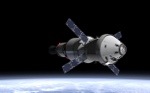




State of solar system missions as of October 2012 (Credits: Olaf Frohn).
FromSpace Safety Magazine, who knew there was such a periodical?
 Modeling of various atmospheric pressures shows that Exo earths could have life friendly atmospheres across a broader range of orbital distances than our thin aired original. Since we are ‘seeing’ a lot of big worlds out there this is promising, though of course too much of a good thing is bad, as our sister world Venus shows.
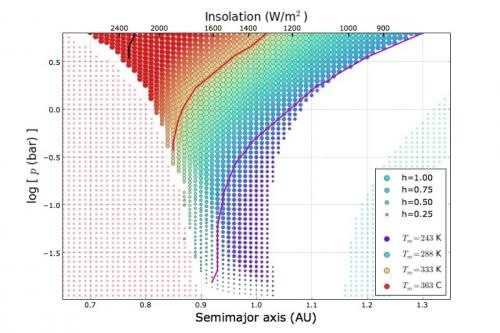
A figure from Vladilo’s paper summarizing the general findings. The area of the circles is proportional to their habitability. The bottom axis shows the virtual worlds’ distance from their Sun-like star, with 1 AU (astronomical unit) representing the average Sun-Earth distance of approximately 150 million kilometers (93 million miles). The top axis (insolation) shows solar radiation (in watts) received on a unit area (a square meter). Surface pressure is on the y axis to the left. Credit: Vladilo et al. 2013, ApJ, 767, 65; http://wwwuser.oats.inaf.it/astrobiology/planhab/
Read more at: http://phys.org/news/2013-05-pressure-density-exoplanets-atmospheres-odds.html#jCp
Eyeball Earths…Red or Brown Dwarf Life Worlds?

Artist’s concept of a planet where one side always faces its star, with the dark side covered in ice. Credit: Beau.TheConsortium
Red dwarfs are small, faint stars about one-fifth as massive as the Sun and up to 50 times dimmer. They are the most common stars in the galaxy and make up to 70 percent of the stars in the universe, vast numbers that potentially make them valuable places to look for extraterrestrial life. Indeed, the latest results from NASA’s Kepler space observatory reveal that at least half of these stars host rocky planets that are half to four times the mass of Earth.
Read more at: http://phys.org/news/2013-05-eyeball-earths.html#jCp

Tucked under the B-52H’s port wing, the X-51A is pictured prior to launch on May 1
The U.S. Air Force has released new details of the record-breaking hypersonic test flight conducted by the Boeing-built X-51A Waverider demonstrator on May 1. The diminutive scramjet-powered vehicle achieved a blistering Mach 5.1, covering 230 naut. miles in just over six minutes (240 seconds!) over the Point Mugu Naval Air Warfare Center Sea Range in the Pacific.
This technology could be the next breakthrough for space booster technology…next as in ten to twenty years. In the meantime it could fuel a new arms race in rapid strike weapons. This is not a US first move, the Russians, Australians, the Europeans, maybe even the Chinese have been leading in this speed regime up to this point.

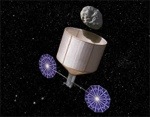
This plan is getting pushback because its not a return to the moon or a Mars landing plan. But the reality is that this idea is all NASA can afford given the cost involved with the Senatorial ( or Space, take your pick) Launch System A Saturn V + class heavy lift direct ascent launch system
The lack of resistance is tied to Senate support of the Space Launch System. Senators from key NASA states – Florida, Texas and Alabama – pushed President Barack Obama to build it, and the asteroid mission is seen as a way to give purpose to the rocket, once criticized as a “rocket to nowhere.”
Illustrative of that point was the initial reaction of Sen. Richard Shelby, R-Ala.
“NASA should continue to explore the universe and challenge scientific and technical boundaries,” he said in a statement. “However, NASA should maintain focus on its core mission and continue development of the Space Launch System so that it will be ready for any future NASA mission.”
So my question is, why the SLS, don’t get me wrong some of the SLS related work like resurrecting the Saturn V F1 engine (as I pointed to a few days ago) is a good thing, but reality is it should be part of getting a commercial venture to back development. NASA shoulddevelop Orion and its support module, but the booster should be gov’t sponsored / stimulated effort as part of a get to the moon, Mars, big asteroids plan, in support of the commercial civilian space efforts.
If you look at all the recently proposed and ongoing civilian efforts and roll in appropriate gov’mnt support you can see a very robust human and robotic space development plan emerge.
Read more at: http://phys.org/news/2013-04-nasa-chief-asteroid-agency.html/

New phase of water could dominate the interiors of Uranus and Neptune : phys.org: by Lisa Zyga
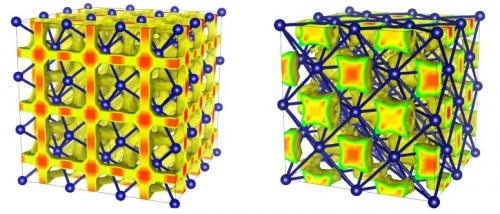
Structure of superionic ice in (left) the bcc phase and (right) the newly discovered and more stable fcc phase. Credit: Hugh F. Wilson, et al. ©2013 American Physical Society
Read more at: http://phys.org/news/2013-04-phase-dominate-interiors-uranus-neptune.html/
Mysterious planets
Although superionic ice doesn’t exist under normal conditions on Earth, the high pressures and temperatures where it is thought to exist are very similar to the predicted conditions in the interiors of Uranus and Neptune.
“Uranus and Neptune are called ice giants because their interiors consist primarily of water, along with ammonia and methane,” Wilson said. “Since the pressure and temperature conditions of the predicted new phase just happen to line up with the pressure and temperature conditions of the interiors of these planets, our new fcc superionic phase may very well be the single most prevalent component of these planets.”
The researchers predict that understanding superionic ice—particularly the stable fcc phase—will offer insight into these ice giants.
“Uranus and Neptune remain very poorly understood at this stage, and their interiors are deeply mysterious,” Wilson said. “The observations we have are very limited—every other planet in the solar system we’ve visited multiple times, but Uranus and Neptune we’ve just done brief flybys with Voyager 2. What we do know is that they have bizarre non-axisymmetric non-dipolar magnetic fields, totally unlike any other planet in our solar system. We also know that they’re extremely similar in mass, density and composition, yet somehow fundamentally different, because Neptune has a significant internal heat source and Uranus hardly emits any heat at all.”
It’s possible that the predicted bcc-to-fcc phase transition may explain the planets’ unusual magnetic fields, although more research is needed in this area.
“Our results imply that Uranus’s and Neptune’s interiors are a bit denser and have an electrical conductivity that is slightly reduced compared to previous models,” Militzer added.
Understanding Uranus and Neptune’s interiors could have implications far beyond our solar system, as well.
“One thing we’re learning from the Kepler mission is that Uranus-like or Neptune-like exoplanets are extremely common,” Wilson said. “They appear to be more common than Jupiter-like gas giants. So understanding our local ice giants is important, because they’re an archetypal example for a huge class of planets out there in the universe.”


This is the family, an interesting thing about the Heavy is the plan to have the strap-ons share fuel with the core, consequently when they separate the core is still fully fueled, a big performance increase.
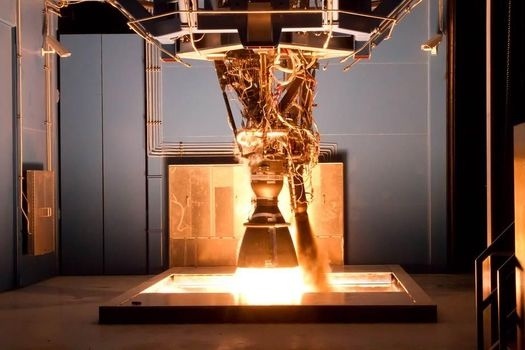
The engines have been run far harder than standard rating regimes require, 1) to solidify their ‘man rating’ for future crew lofting flights, 2) because SpaceX wants to reuse them, 3) because SpaceX wants top line insurance rates for their customers even while brining new approaches to the party.

Rocket engines, so ugly you just know they’re powerful!
Cool videos at the Verge article.

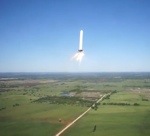
Held at height and then landed straight down unaffected by what looks like a reasonable breeze.
Second gen Falcon this year, possibly Falcon Heavy first flight, soft water return for a booster this year and ground return next year! Each demonstrates fundamental capabilities and the power of a committed commercial / civilian play with tech and team unfettered by bull crap FARS oversight dead weight. But each is advancing tech at a rate that seems more reminiscent of the sixties NASA and aviation tech| 2nd gen Falcon: new improved engines, Heavy: buddy tank w/ common boosters engines, any of the above: fly back boosters w/ powered soft landing first at sea then on land. Each step something daring and commercially valuable. I’m not sure how some of the competitors keep from going into terminal depression, if Musk’s SpaceX team nails the string the old guard are toast.
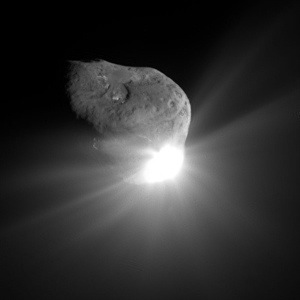
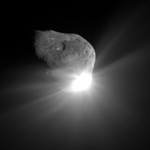
This spectacular image of comet Tempel 1 was taken 67 seconds after it obliterated Deep Impact’s impactor spacecraft. Credit: NASA/JPL-Caltech/UMD
Currently, Bhaskaran is running simulations that make his virtual impactor go splat against the furrowed, organic-rich regolith of asteroid 1999 RQ36. The 1,600-foot-wide (500-meter-wide) space rock is the target of a proposed JPL mission called the Impactor for Surface and Interior Science (ISIS). The impactor spacecraft, which looks a little like a rocket-powered wedding ring, would hitch a free ride into space aboard the rocket carrying NASA’s InSight mission to Mars. The impactor’s trajectory would then loop around Mars and bear down on RQ36.
“One of the things that helps me sleep at night is that we know a lot about RQ36 because it is the target of another NASA mission called OSIRIS-REx,” said Bhaskaran. “But it also provides some challenges because the scientists want us to hit the asteroid at a certain moment in time and at a certain location, so that the OSIRIS-REx spacecraft can be sure to monitor the results from a safe vantage point. It is a challenge but it’s also really exciting.”
Read more at: http://phys.org/news/2013-04-asteroid.html#jCp
 This World and Others