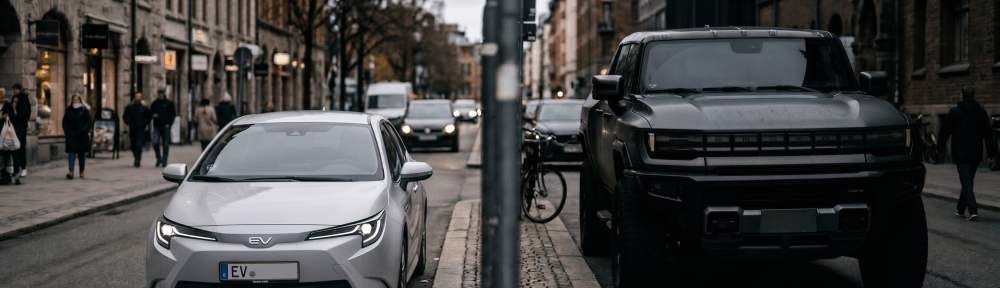

Related video: Range Anxiety — The Unreal Reality
I’ve been involved with EV power and propulsion for much of the last 30 years. My latest stint was at Wolfspeed, developing SiC power modules for EVs and fast chargers. When the EV market stalled and the company went into Chapter 11, I was among the people who lost their jobs.
I still think EVs are the right direction. I don’t own one. That’s not a contradiction, it’s the actual story, and the video above is where I work through it.
The short version: range anxiety was always overblown for most drivers, and the auto makers never built the product mix that met the needs of the broad market. Now the industry is driving hard away from EVs, especially in the US, and that’s just wrong-headed. The video closes on that but doesn’t dig into why. This post does.
The Part That Stings
While the US was arguing about mandates and turning the issue into clickbait, China was engineering.
BYD is selling comfortable, adequate-range EVs in the $15–20K range. That’s the vehicle that moves the majority of buyers. Not the Cybertruck, not the F-150 Lightning, not the Rivian. A practical car at a price most people can actually consider.
We handed them that market. Not through malice or conspiracy, but through a combination of policy that optimized for the wrong things and an industry that focused on protecting its margins.
The policy pushed hard for EV adoption with mandates, subsidies, timelines. Some of that pressure was probably warranted. The market would have gotten there on its own, but the question of when and at whose expense was real. The intervention accelerated some things. What it didn’t do was direct the industry toward the product that would actually move the needle for most buyers.
The industry copied Tesla’s playbook; premium vehicles, long range, performance, high price points. That was the wrong lesson. Tesla used that model to fund the manufacturing and infrastructure investment that actually mattered. Everyone else just took the margin and stopped there.
The charger network made the same error I described in a previous video: build for the metric that looks good in the grant report, not the outcome that matters to the driver. 97% uptime. 71% charging success rate. Two different measurements, only one of which tells you whether the thing worked.
Why Big Auto Isn’t Saving Itself
I always loathed the heavy-handed government push on EVs and what I read as gaslighting on the rationale. Mandates handed down by people who had never looked at a cost model. Timelines written by committees that had no idea what it actually takes to retool a supply chain or build an infrastructure.
At the same time, I think some intervention was warranted. Not because the market was wrong about EVs, but because the market was optimizing for the next quarter. And the externalities of the status quo were landing on people who weren’t in the pricing model.
Intervention at scale creates dependencies. The industry made bets premised on the government backstop continuing. When the political environment shifted, those bets didn’t just look bad, they collapsed. And the response has been to drive hard back toward gasoline, as if that solves anything.
US old-line auto companies have been struggling for decades, and the reasons are structural. They’re trapped by regulatory capture and built-in costs that make adaptation nearly impossible.
Start at the sales end. Their dealer networks are regulated state by state, which makes wholesale change all but impossible. Safety regulations run through a system where insurers push regulators to require improvements that the industry develops partly because those improvements push up vehicle margins. Manufacturing plants are at their core decades old, and the capital they represent sits on the books, write it down and you impair the balance sheet. Design is path dependent by habit and incentive: most changes are incremental tweaks to last year’s platform because that’s easy, cheap, and legible to accounting.
And the margin structure makes it worse. Bill-of-material cost for a vehicle increases slowly with size and content. Market value is largely bling-dependent. So the incentive always points toward large, well-fitted vehicles where the spread is widest, and away from the small practical vehicle where there’s almost none.
Meanwhile, the manufacturing model has already been cracked. A new generation of EV makers proved you can build at scale in the US, turn a profit, and drive down the cost curve without the legacy overhead strangling the old players. Big Auto is watching that happen and still can’t follow, because the legacy network isn’t just a cost problem, it’s a constraint on every decision they make.
Moving back to gasoline doesn’t fix any of this. It may help sales volume near-term, but fewer and fewer buyers are willing to pay up for big iron, and as the recent spike in gas prices reminded everyone, the cost of operating a gas vehicle is not as predictable as it felt a few years ago.
The wholesale abandonment of EVs is as wrong-headed as the mandates-first push that preceded it. You’re walking away from the future as it’s getting its feet under it, and you’re not fixing your actual problems in the process.
Different direction, same failure mode: optimizing for the political moment rather than the real problem.
What I Expect to Happen
The market will keep sorting this out despite the policy environment, not because of it.
Amazon is sponsoring the Slate, a small electric truck aimed squarely at the price point where the volume is. Ford is talking about smaller, value-forward platforms. The product mix gaps are starting to fill in, and the players doing it understand they have to meet buyers where they are, which is around $20K for a vehicle that’s good enough and built around what EVs actually do well.
BYD is a harder question. It was built on the back of Chinese state support and practices that wouldn’t survive scrutiny elsewhere, but that doesn’t change what it demonstrates: a level of technical maturity across product fit, design, and manufacturing that very few other automakers can match. Tariffs and regulatory barriers will slow it down. They won’t hold permanently. Some form of that capability will find its way into the US market, and when it does it will accelerate the shakeout that’s already coming for Big Auto.
Charging infrastructure will improve in the corridors where the economics support it and stay thin everywhere else, and that’s how it should work. Where it’s thin, the economics will eventually pull in local investors, the same way any other service infrastructure fills in. It won’t be fast, but it will happen.
The transition will come, just slower and more expensively than it had to be. The destination is probably the same. The cost of getting there is substantially higher, and much of the value being created will go to manufacturers who aren’t American. That’s the envelope effect of all the intervention and counter-intervention stacked on top of each other.
The engineers mostly knew it was going to be complicated. Technical change at a social scale always is. The complicated part is rarely the technology.
Mark Harris is a systems and mechanical engineer, recovering from a career in EV power electronics, and the author of Stranded in the Stars (Book One, The Sea of Suns Trilogy). He writes about engineering, technology, and the creative life at This World and Others. The Unretired Engineer is on YouTube at https://www.youtube.com/@Scifiengineer-09

