
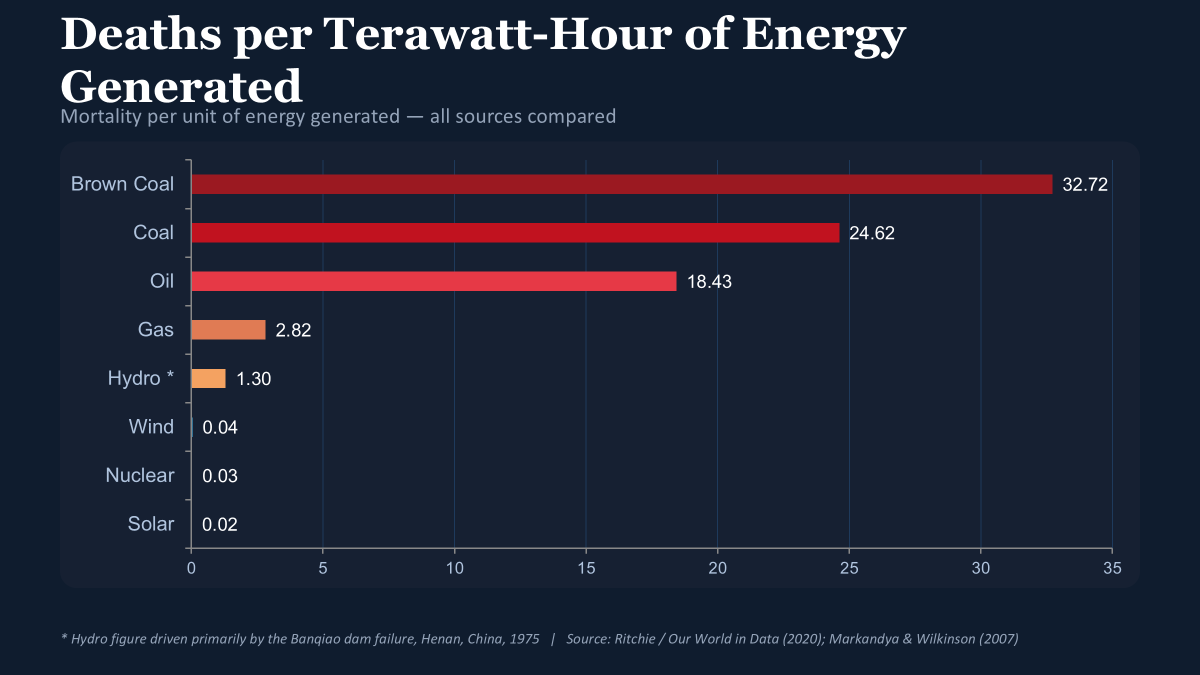
Two numbers.
Hydro: 1.30 deaths per terawatt-hour of energy generated.
Nuclear: 0.03.
I spent thirty years in power electronics and systems engineering. I’m used to evaluating risk from data. When I first looked at those two numbers sitting side by side in the same table, I had to read them twice. Then I went looking for where the data came from, who had reviewed it, and whether anyone had poked holes in it. Nobody had. The methodology is consistent across multiple independent sources, and the numbers have held for years.
The question that’s stuck with me since is a simple one: why does one of those numbers drive policy, and the other one barely gets mentioned?
That’s not a rhetorical question. It has an answer. And the answer is worth understanding, because the same mechanism is almost certainly operating right now on something else entirely.
August 1975
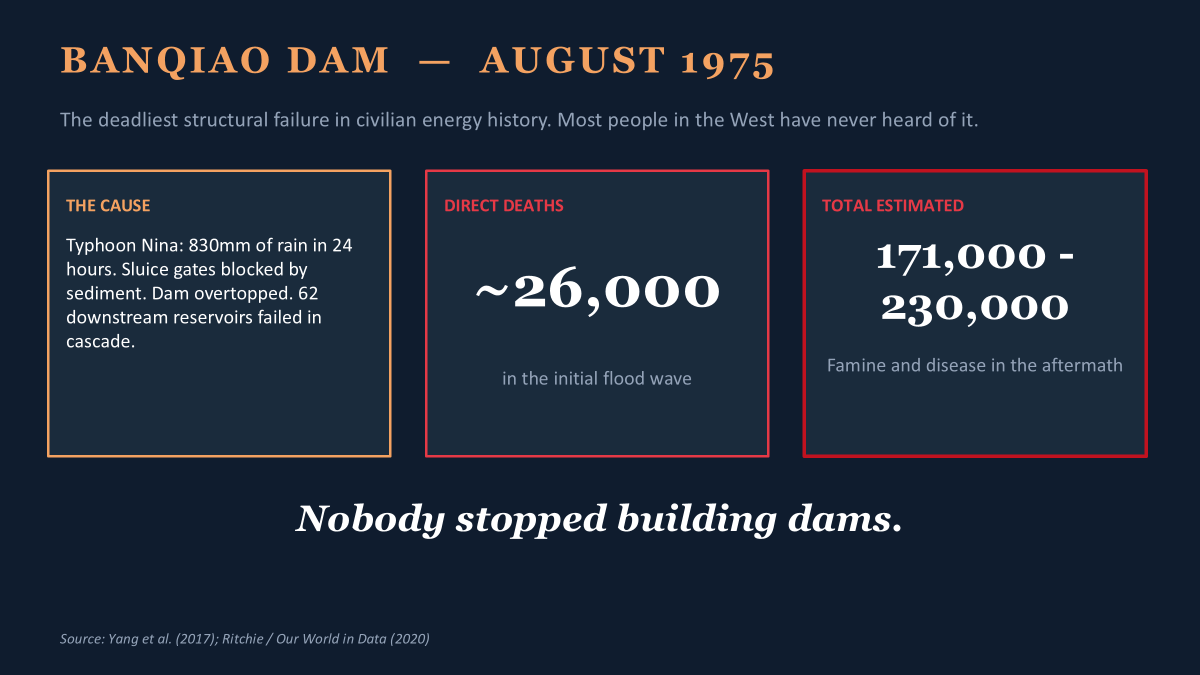
Henan Province, China. Typhoon Nina hits a cold front and drops roughly a year’s worth of rain in 24 hours. The Banqiao dam, built to handle a so-called thousand-year flood, gets overtopped. Sluice gates are partially blocked by sediment. The dam fails. Then 62 downstream reservoirs fail in sequence.
A wall of water six meters high and ten kilometers wide moves down that valley at close to 50 kilometers an hour.
Direct deaths: approximately 26,000. Total deaths, once you account for the famine and disease that followed the destruction of the regional water supply and agricultural system: somewhere between 171,000 and 230,000 people. The Chinese government suppressed the numbers for decades. Most people in the West have never heard of Banqiao.
Nobody stopped building dams.
No global regulatory freeze. No decades-long moratorium on new hydroelectric construction. Banqiao killed more people than every nuclear incident in history combined, and the policy response was essentially nothing.
Hold that thought.
Nuclear’s Actual Record
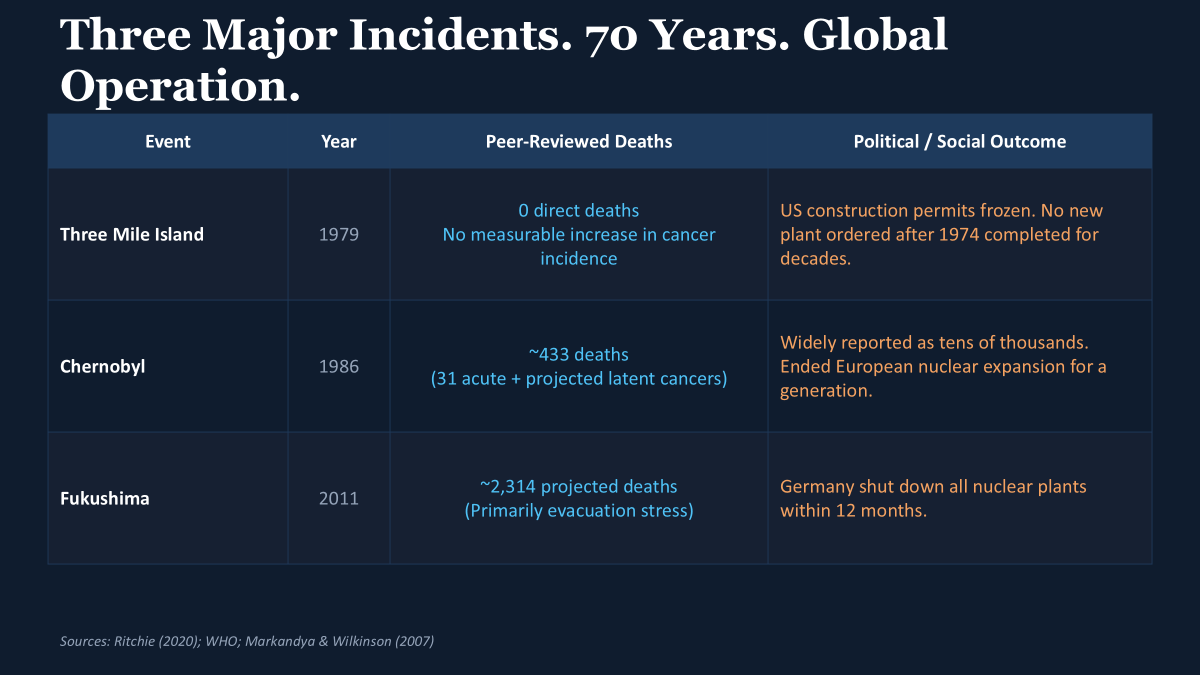
Three events define public perception of nuclear power.
Three Mile Island, 1979. Partial meltdown. Serious incident. Zero direct deaths. Peer-reviewed studies found no measurable increase in cancer incidence in the surrounding population. The containment system worked.
The public response: mass panic. The regulatory response: construction permits frozen across the United States. No new nuclear plant ordered after 1974 was completed for decades.
Chernobyl, 1986. A genuinely catastrophic failure of a reactor design with known safety flaws, operated outside its safety envelope during a test. Peer-reviewed death toll: approximately 433. That number gets reported in popular media as tens of thousands, sometimes hundreds of thousands. The peer-reviewed literature does not support those figures.
Fukushima, 2011. This one needs context. A magnitude 9 earthquake and a 15-meter tsunami killed approximately 20,000 people directly and destroyed the regional infrastructure. The nuclear plant failure was a knock-on of that disaster, not a standalone event. Hospitals were already overwhelmed, supply chains already broken, shelters already strained.
That context matters, and it makes what follows more striking, not less.
Deaths from radiation: zero. UNSCEAR and the WHO both confirm no member of the public or plant worker died from acute radiation exposure.
Deaths from the evacuation: 2,313. Officially certified by the Japanese Reconstruction Agency. Cohort studies compared evacuated groups against matched groups in the same disaster zone who were not subject to the nuclear evacuation order. The excess mortality still tracks to the evacuation specifically, not the general disaster. Patients pulled off ventilators and loaded onto buses. Elderly evacuees in unheated gymnasiums in March without their cardiac medications. Long-term displacement that drove a documented spike in strokes, heart attacks, and suicides.
The evacuation killed 2,313 people. The radiation killed none.
Germany’s response: shut down all nuclear plants within twelve months.
The Thing Nobody Talks About
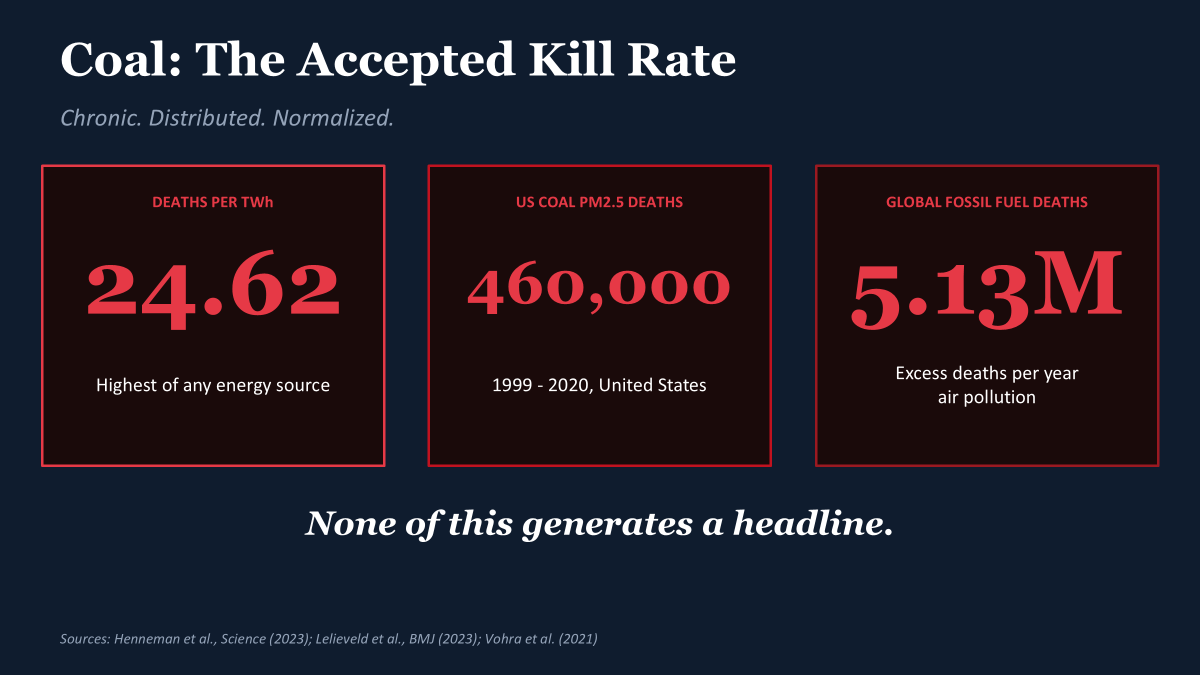
If nuclear is the thing people are afraid of, coal is the thing nobody discusses.
Coal sits at 24.62 deaths per terawatt-hour. That’s not an accident rate. That’s a baseline. It runs every hour the plant is operating, in every community downwind, invisibly.
The mechanism is particulate matter, specifically PM2.5. Fine particles that bypass your lung filtration and enter the bloodstream. They drive ischemic heart disease, stroke, and chronic obstructive pulmonary disease. The people dying from this don’t die in a dramatic event. They die over years, and the death certificate says heart disease, not power plant.
In the United States alone, between 1999 and 2020, 460,000 deaths were directly attributed to coal particulate emissions. That’s a peer-reviewed figure from a study published in Science in 2023, based on Medicare records.
Globally, fossil fuel air pollution causes an estimated 5.13 million excess deaths per year.
No headlines. No evacuation zone. No footage. No panel of experts. It just happens, continuously, and we have decided as a society that this is acceptable.
Why the Data Didn’t Matter
This is the part worth sitting with.
The deaths-per-TWh data has been available and consistent for a long time. The numbers aren’t new. So why did the policy response to nuclear go one way and the response to everything else go another?
The answer isn’t scientific illiteracy, though that plays a part. The answer is how human risk perception actually works, and specifically a category psychologists call dread risk.
Before applying it to nuclear, try it somewhere closer to home.
Roughly 40,000 people die in car accidents in the United States every year. Commercial aviation kills, in a typical year, somewhere between zero and a few dozen. Per mile traveled, you are orders of magnitude more likely to die in a car than on a plane. Most people know this, at least abstractly. And yet a significant portion of the population is afraid to fly and gets in the car without a second thought.
That’s not stupidity. That’s a predictable failure mode of the human nervous system. Dying in a plane crash feels uncontrollable, invisible in its causes, and catastrophic in its image. Dying in a car feels like something that happens to other people who weren’t paying attention. The statistics are not what’s driving the fear response. The characteristics of the event are.
Psychologists have a precise vocabulary for this. The factors that amplify perceived risk include: whether exposure is voluntary or involuntary, whether the mechanism is visible or invisible, whether effects are immediate or delayed, and whether the hazard carries prior cultural associations with catastrophe. Score high on those dimensions and people will treat a low-probability event as an existential threat. Score low, and they’ll accept a high-probability harm without complaint.
Nuclear hits every trigger. Radiation is invisible. Exposure is involuntary. The effects are delayed. And the word “nuclear” has carried the weight of Hiroshima and Nagasaki since 1945. Thirty years of Cold War civil defense films, fallout shelter drills, and duck-and-cover exercises had done their work long before Three Mile Island. The public was primed.
Coal has none of that. It kills more people per unit of energy than any other source in widespread use. It kills them slowly, distributed across populations, through mechanisms that show up on death certificates as heart disease and stroke. There is no “coal incident” that preempts the evening news. So coal never triggered the dread response. It just kept running.
Here’s where it gets interesting from a broader perspective. Once you understand that nuclear had a unique set of psychological vulnerabilities, you also understand that those vulnerabilities were predictable. And predictable vulnerabilities are usable ones.
You didn’t need to fabricate data to keep nuclear from expanding. You didn’t need to lie about the death toll or invent risks that didn’t exist. You just needed to keep the fear operational. Any outcome you wanted from that situation, whether it was energy policy, geopolitical competition, protection of existing energy assets, or genuine environmental concern, ran through the same lever. The mechanism did the work regardless of the motive behind it.
That’s how you get a policy response that froze an industry after an incident with zero deaths, while an energy source that kills hundreds of thousands of people a year kept operating without comment.
The data didn’t change the policy because the data was never the driver of the policy. The fear was the driver, weaponized by a lot of different actors. And fear, once well-established in a culture, doesn’t need new information to sustain itself.
What It Cost
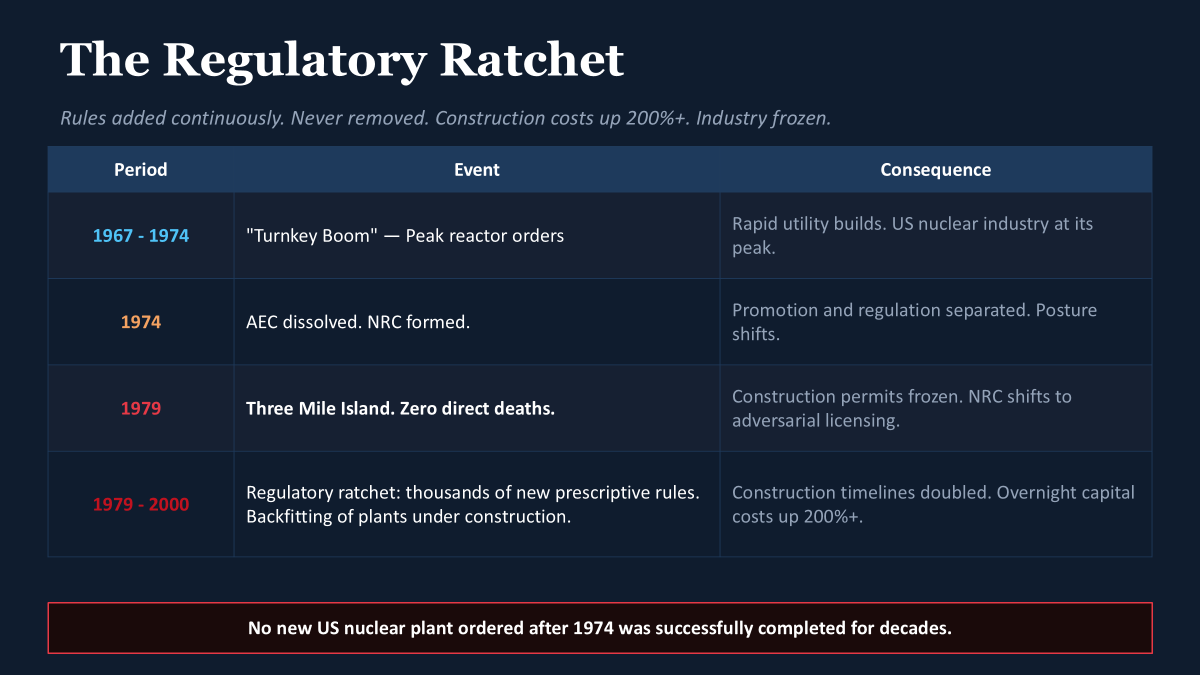
After Three Mile Island, the NRC froze construction permits and shifted to an adversarial licensing posture. Plants that were 80% complete had to be redesigned to meet new rules written after they broke ground. The rules kept changing. Cable separation distances. Concrete specifications. Redundant backup systems. Each rule issued as a response to perceived risk, none ever rolled back.
The industry has a name for it: the regulatory ratchet. Rules only move in one direction.
The result: construction timelines doubled. Overnight capital costs increased by over 200%. An industry that had been commercially viable became financially impossible.
One example makes it concrete.
The Shoreham Nuclear Power Plant on Long Island, New York. Construction started in 1973. The original cost estimate was $75 million. The plant was completed in 1984 at a final cost of $6 billion. The regulatory environment had changed so many times during construction that the finished plant was essentially built twice. After completion, the plant ran a single low-power test. It never delivered commercial electricity to a single home. In 1989, Long Island Lighting Company transferred ownership to New York State for one dollar. The plant was decommissioned.
Zero deaths at Three Mile Island. The containment worked. The response was to make nuclear power economically unbuildable for the next forty years, and to leave a completed $6 billion power plant sitting idle until it could be taken apart.
The Question the Data Left Open
The engineering question was answered a long time ago. Deaths per terawatt-hour is a clean metric. The data is consistent across multiple independent methodologies. Nuclear kills fewer people per unit of energy than any fossil fuel, and roughly the same as wind and solar. Hydro sits at 1.30, driven almost entirely by a single dam failure in 1975 that most people in the West have never heard of.
The question the data leaves open is not whether nuclear is dangerous. The data settled that. The question is why the data didn’t matter, what it cost us that it didn’t, and whether you can now look at any other technology or industry and spot the same pattern running.
Find something that scores high on the dread risk dimensions. Invisible mechanism. Involuntary exposure. Delayed effects. Prior cultural associations with catastrophe. Then look at what the data actually says about it versus what the policy response has been.
The mechanism is still running. The only variable is what it’s pointed at today.
Here is the file
M.A. Harris is a systems and mechanical engineer with 30 years in power electronics and a particular interest in how engineering data interacts with public policy. He writes hard science fiction as M.A. Harris and runs The Unretired Engineer on YouTube.
📺 YouTube: https://www.youtube.com/@Scifiengineer-09
🔗 LinkedIn: https://www.linkedin.com/in/mark-a-harris
📚 Published works (M.A. Harris): https://www.amazon.com/author/m-a-harris