Entrepreneurial Drought Limiting job and wealth creation

20130604-210243.jpgWhere are the entrepreneurs? More evidence the very heart of the US economy is failing
James Pethokoukis | June 3, 2013

In my opinion the culprits are easy to discern…..

  1. Uncertainty
  2. Regulation
  3. Taxes
  4. intellectual property law breakdown ( too much, too long, too easy)
  5. Healthcare
  6. Retirement
  7. Risk aversion by banks

I am also thinking that:

  1. the informal economy is more active than is accounted for
  2. people who are paid can in fact support more hangers on than one might expect
  3. especially away from the ‘urbs’
  4. significant numbers are hidden on disability of one sort or another

Which may be hiding lots of small scale entrepreneurial efforts.

But in the main what we are seeing is the aggregate effect of the first list which significantly suppresses the urge to grow. Many commentators miss that the way so much regulation is structured once you reach a certain size it suddenly becomes asymptotically more difficult / expensive / stressful to operate. This makes even starting much less attractive. It also means that we are suppressing companies just as they start to kick up into a realm where they could potentially quickly accelerate out of small business land into middle sized and become more consequential.

This is a socio-economic problem that has to be solved on a broad scale:

  1. Lower but still progressive taxes
  2. Brute simple tax code
  3. Individual focused health care
  4. Individual focused retirement
  5. Small business non interference focus in government rules setting
  6. Standards setting and supporting organizations for: health, safety, financial stability, etc, instead of regulatory administrations
  7. Return IP law to its small creator anti monopoly roots
  8. Support a couple of ‘international’ banks but return banking to moderate scale focus
  9. Eliminate subsidies
  10. Continue deep and wide science support with focus on stimulating commercial support like NASA’s ISS assured access program.

Both main parties need to develop their versions of this list, the massive scale, top down, big corporation supporting model both have devolved into has come to the end of its efficacy and we need to go back to our roots. Those roots are individuals acting on, in and through the small scale collective, which both Dem and Rep should be able to support. Of course the downside is that large scale pandering and petty corruption are less hide-able in such a polity.

Libertarianism – Syria, Iraq, Afghanistan… – non intervention may not be the lowest cost option

Richard A. Epstein, the Peter and Kirsten Bedford Senior Fellow at the Hoover Institution
The las paragraph:

No Libertarian Panacea
There are larger lessons to learn from these foreign policy issues. The first is that libertarians, like Chapman and myself, can both be faithful to their basic principles, yet differ strongly on what should be done. The basic principle of libertarian thought is its blanket prohibition against the use of force (including the threat of force) and fraud to achieve personal gain at the expense of others. That principle translates easily into the international context to say that one nation cannot wage war against another.
However easy it is to state that basic principle, it is just that hard to implement it, especially in a world of self-help where there is no common sovereign to stop the use of force. It is easy to allow the use of force in self-defense, but difficult to prevent that excuse from being used by scoundrels for their own ends.
It is even harder to get to the bottom of the simple question of when and where one person (or nation) should come to the assistance of another. The basic legal rule is that such intervention is permissible but not obligatory, and only on behalf of the victim of the attack. The general private law rule that there is no duty to rescue a stranger in a condition of imminent peril from natural forces, even though there is an obvious right to do, carries over to the matter of self-defense.
The great tragedy then is that the clear moral principle can easily become overwhelmed by a series of subsidiary conflicts that extend from difficult factual disputes about the past to uncertain predictions about the future, all set against a background that allows for the exercise of good faith judgment without clear guidelines on how it is best exercised. I do hope that I am wrong, and that the President is doing the right thing. But all things considered, I think that there is a serious risk that his policy of studied disengagement may well turn out, down the road, to drag us into some larger conflict against our will.

More at: http://www.hoover.org/publications/defining-ideas/article/148476
Essentially the little wars and conquests prior to WWII made that war an inevitability. Whereas earlier action by the major powers might have prevented its occurrence though I have to say that it’s unlikely to have had a happy ending, war and civil war were inevitable. It might even have lead to a less pleasant world than the one we live in, fascism might have lasted longer, communism might as well, and lord knows the ‘west’ was not what we would see as freedom loving and inclusive.

Tyranny of Data, McNamara’s whiz kids to Google’s geek culture

20130602-174541.jpg

Body count: U.S. Defense Secretary Robert McNamara briefing the press on Vietnam at the Pentagon in 1965.

Read more: http://www.technologyreview.com/news/514591/the-dictatorship-of-data/#ixzz2V67sF8kO From MIT Technology Review
Seems to me that McNamara epitomized the dark heart of the blue model industrialization, he was trying to make central planning work using the tools of capitalism. Big data has the the potential to make Stalinist (central planned top down industrial society) real like no tool before it. But at the same time the underlying technology will make centralization ever less attractive overall, ever less economically efficient. Some nations may fall to Big Data / Big Brother but they are not likely to become conquerors by economic or military coercion because the Maker States will be so much more resilient and efficient. Of course that assumes short sighted politicians/bureaucrats don’t take us all down some ‘consensus’ path because of short term returns that fools take as structural not ephemeral.

Certain elements are going to blow head gaskets on this one!

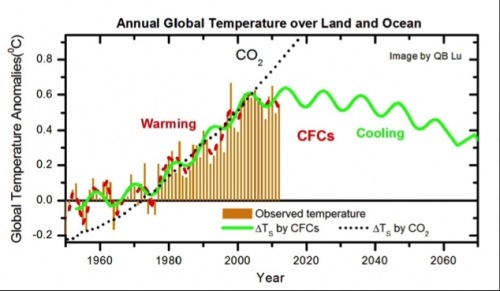
Global warming caused by chlorofluorocarbons, not carbon dioxide, new study says

20130530-212630.jpg

Chlorofluorocarbons are to blame for global warming since the 1970s and not carbon dioxide, according to new research from the University of Waterloo published in the International Journal of Modern Physics B this week. This graph shows the predicted path of global temperatures is set to continue their decline as a result of depletion of CFC’s in the atmosphere. Credit: Qing-Bin Lu, University of Waterloo

More at: http://phys.org/news/2013-05-global-chlorofluorocarbons-carbon-dioxide.html

Going to Mars, but Talk about the negative!

20130530-184745.jpg20130530-184752.jpg20130530-184758.jpgWIRED: Why We Can’t Send Humans to Mars Yet (And How We’ll Fix That)
BY ADAM MANN
This is a good article and it has an excellent recap of needed technology, but it is in my opinion reduced in power by a negative tone. It seems biased by a drum beat I have been seeing about how hard, how expensive, how risky…etc, and while I appreciate the challenges one does not open frontiers by dwelling on all the horrid ways one is likely to die. This also seems Blue centric NASA, NASA, NASA. In the end the commercial civilian drive will send us outbound not risk averse bureaucrats.

21st Century Opportunity > Making The New Everything…

MIT Technology Review : Business Report : The Next Wave of Manufacturing

You Must Make the New Machines // Economist Ricardo Hausmann says the U.S. has a chance to invent the manufacturing technology of tomorrow.
From MIT Technology : read more: http://www.technologyreview.com/news/509281/you-must-make-the-new-machines/

The basic knowledge is here, the ideas and innovation, even the entrepreneurial spirit, the problem is have we tied ourselves down with rules regulations taxes monopolies etc?

Wired BotW // Einstein Tower, Potsdam, Germany

20130524-101427.jpg

Einstein Tower, Potsdam, Germany
The 1920s-era Einstein Tower was built to prove one of general relativity’s predictions — that gravity would cause a shift in the sun’s spectrum. Although it never succeeded, it was one of Germany’s most important observatories for many years, up until its partial destruction during WWII. A fan of Einstein, architect Erich Mendelsohn molded concrete into graceful curves to evoke Einstein’s theories. Located at the Astrophysikalisches Institut Potsdam, the observatory is still in use as a solar observatory, though it splits time as a tourist attraction as well. The tower is skewered by a 1.5-meter solar telescope that visualizes solar magnetic fields and their location within sunspots.

Amazing what you can do with concrete, this sort of thing ought to be easier with 3D printing tech….

Walter Russell Mead // jobs jobs jobs

As always lots of great thought at The American Interest read more at: http://blogs.the-american-interest.com/wrm/2013/05/22/jobs-jobs-jobs-2/

First, make hiring easy and cheap.
Second, put the service economy and especially small business and entrepreneurship front and center.
Third, we need to feed the state to the people even as we individualize its services.

That third one had me puzzled till I read the explanation, which is a good description of what the statesmen of the past have done.

A characteristic of American political economy going back to colonial times has been the use of the resources of the state to promote the welfare of what today we would call the middle class. For much of our history we “fed the state to the people” by turning over publicly owned lands at low and ultimately zero cost. The public lands, which once included virtually all of the continental United States, were a possession of almost infinite value, but it seemed wiser (and more politically sustainable) to the leaders of the day to make them cheaply available to the people rather than to hoard them or try to retain a larger share of their value for the public purse.

Ludwig Von Mises Austrian school economics

Was reading some Mises and ran across this very neat aphorismReference
Sane sicut lux se ipsam et tenebras manifestat, sic veritas norma sui et falsi est, (Latin). A dictum of Spinoza (1632-1677). Translation: “Indeed, just as light defines itself and darkness, so truth sets the standard for itself and falsity.”

Spinoza:

Spinoza is one of the most important philosophers—and certainly the most radical—of the early modern period. His thought combines a commitment to a number of Cartesian metaphysical and epistemological principles with elements from ancient Stoicism and medieval Jewish rationalism into a nonetheless highly original system. His extremely naturalistic views on God, the world, the human being and knowledge serve to ground a moral philosophy centered on the control of the passions leading to virtue and happiness. They also lay the foundations for a strongly democratic political thought and a deep critique of the pretensions of Scripture and sectarian religion. Of all the philosophers of the seventeenth-century, perhaps none have more relevance today than Spinoza.

Ludwig von MisesRead more at: http://mises.org/

The Ludwig von Mises Institute was founded in 1982 as the research and educational center of classical liberalism, libertarian political theory, and the Austrian School of economics. It serves as the world’s leading provider of educational materials, conferences, media, and literature in support of the tradition of thought represented by Ludwig von Mises and the school of thought he enlivened and carried forward during the 20th century, which has now blossomed into a massive international movement of students, professors, professionals, and people in all walks of life. It seeks a radical shift in the intellectual climate as the foundation for a renewal of the free and prosperous commonwealth.