 Private space company Final Frontier Design shows off the latest orbital fashion.
Read more at: PopSci : New for Space Tourists: A Light Comfy Space Suit
PopSci | Comfortable Light Weight Space Suit for Commercial Space Travel
Reply

Private space company Final Frontier Design shows off the latest orbital fashion.
Read more at: PopSci : New for Space Tourists: A Light Comfy Space Suit

This image emphasizes the beautiful rays of Qi Baishi, in the top of the image. The crater was named for the Chinese painter, Qi Baishi, known for his whimsical watercolors. The extensive rays of the crater mimic such whimsicality, extending far from the impact, exposing new material across the scene. The bright ray system indicates that Qi Baishi is relatively young, compared to other visible features. Notice the lack of rays extending from the west of the crater. This asymmetry indicates that the impactor struck at a relatively low incidence angle from the west.
This image was acquired as a targeted high-resolution 11-color image set. Acquiring 11-color targets is a new campaign that began in March 2013 and that utilizes all of the WAC’s 11 narrow-band color filters. Because of the large data volume involved, only features of special scientific interest are targeted for imaging in all 11 colors.
More at: Wired : Colorful Mercury Rays

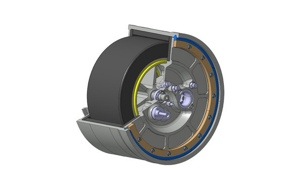
Ricardo innovated the basic flywheel in a number of ways. The flywheel is hermetically sealed in a container, with a sealed-for-life vacuum, transmitting power through a magnetic gear drive. They use high-speed rolling elements with a composite flywheel unit that allows the system to spin up to 60,000 rpm. The vacuum environment means low losses due to air friction. The demonstration system stores 0.25 kW·h and delivers maximum torque of 28 N·m (20.6 lb·ft) as measured at the flywheel. The company noted that is working on three storage units rated at 0.055 kW·h, 0.25 kW·h, and 1.25 kW·h.
Read more at : SAE : Ricardo sees a future in flywheel hybrid excavators
The Williams F1 team, however, developed a novel flywheel-electric system with a flywheel tied to a motor-generator. The flywheel is the energy storage system rather than electro-chemical battery. The race team has formed a subsidiary called Williams Hybrid Power to try and commercialize the system. Williams has now formed a consortium with Ricardo, Torotrac, Land Rover and several other companies for a demonstration project to evaluate its system as well as a flywheel magnetic system from Ricardo in commercial applications. The goal is to develop an on-the-road system for under £1000 ($2,000). The new KinerStor demonstration project is partially funded by the UK government through the technology strategy board.
More at: http://green.autoblog.com/2009/11/25/ricardo-and-williams-team-on-kinerstor-flywheel-hybrid-demonstra/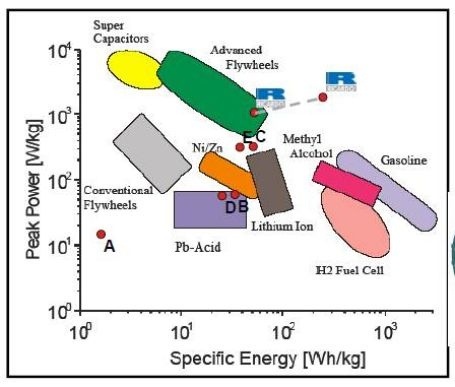
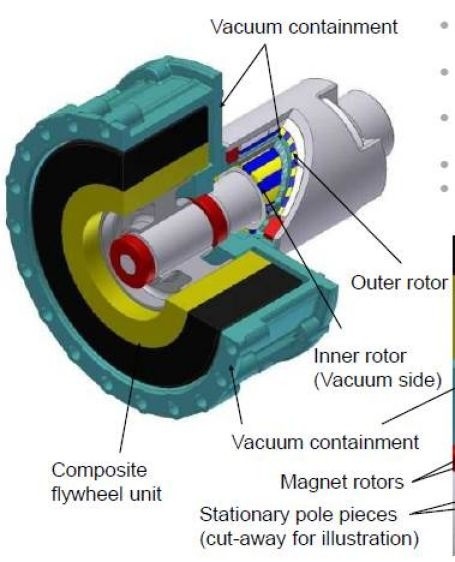
 Some background from a 2011 Economist article
The Sabre air breathing rocket and the Skylon single stage to orbit craft grow more real with time. We should all remember that England was a hot bed of jet engine development in the early years and is still a leader (Rolls Royce.)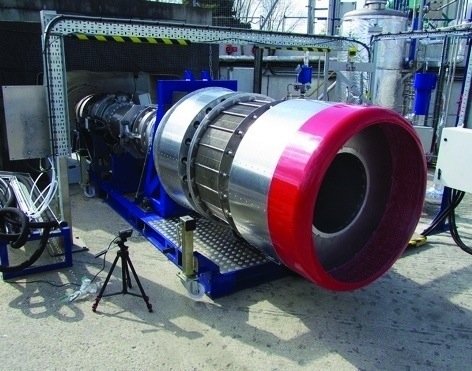


The announcement late last month that the Chancellor, George Osborne, is planning to put a chunk of the country’s meagre resources for capital expenditure behind a British project to develop a revolutionary jet engine for a reusable space plane, suggests the government has high hopes of the space engineering sector.
….
The Chancellor’s interest in Skylon centres on the hybrid air-breathing rocket engine, known as SABRE, which would power it into orbit in a single stage. The engine relies on an entirely new pre-cooling technology that allows it to function at extremely high speeds, at plus Mach 5. The project has no competitor. If successful it would offer a uniquely lightweight and therefore more affordable means of reaching space. It has already completed a series of tests and the next stage is to build a full-scale prototype.
Read more: The Engineer : Career opportunities in the UK space sector
Also the company developing the tech: Reaction Engines 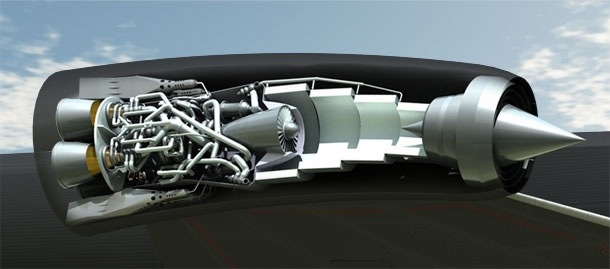
Servo technology turns press design upside down

A view inside the press showing two of the connecting rods that pull down the press slide
AWST Staff: Source: Aerospace Daily & Defense Report : NASA Calls For Private Lunar Lander Partners
Piggybacking on the Google Lunar X Prize and various commercial endeavors, NASA has offered its expertise and test facilities to potential lunar-lander partners who might be able to help mount scientific missions to the Moon’s surface as early as 2018.
A request for information published July 2 seeks concepts for “an industry-developed robotic lander that can be integrated with a launch vehicle for the purposes of supporting commercial (and potentially future NASA) missions.”
The U.S. space agency is interested in landers that can put two classes of payload on the lunar surface — 30-100 kg. (70-220 lb.) and 250-450 kg. Potential missions “of interest to NASA” include prospecting for volatiles at the Moon’s poles, sample return and setting up geophysical networks.
“U.S. industry is flourishing with innovative ideas based on NASA’s pioneering work to explore space, including low-Earth orbit and the Moon,” said William Gerstenmaier, NASA’s associate administrator for human exploration and operations (HEO) in Washington. He suggested that, data from commercial lunar landers, like space station research, could aid the agency’s plans to explore an asteroid and Mars.
“New robotic commercial capabilities on the Moon could extend that research in important ways, just as NASA expertise could help advance commercial endeavors to reach the Moon.”
The HEO directorate is proposing no-exchange-of-funds partnerships under Space Act agreements or other mechanisms, offering its technical expertise, unique test facilities, and some hardware and software to private companies willing to put up funding for lander development.
“NASA envisions that an integrated team comprised of NASA civil servants and the industry partner personnel could work together to design, develop and test landers,” the RFI says.
Responses to the RFI are due Aug. 2. Interest in private lunar landers has soared over the past three years after Google offered $30 million in prizes through the X Prize Foundation to teams that can land a robotic spacecraft on the lunar surface, have it move at least 500 meters, and send back video, images and data. Presently 22 teams worldwide are in the running, working against a deadline of Dec. 31, 2015.
‘Nuff said, really cool stuff
MIT TR: Kickstarter Campaign Wants to Send Tiny Satellites out of Earth Orbit
Space loaf: This artist’s rendering shows a three-unit CubeSat with a propulsion unit.
A mini-satellite, no bigger than a loaf of bread, could push itself out of Earth’s orbit as soon as next year if a crowdfunding campaign to support development of a diminutive propulsion system succeeds. If such small spacecraft can be made to operate far from Earth, they could one day make inexpensive expeditions to asteroids, Mars, and beyond.
Now that’s neat, the ion thruster is pretty crude and tech leaders doubt it will work, but things ‘scale’ oddly, a honeybee can only fly because at it’s scale air is much more viscous…sticky…than we experience it. So it’s possible this simple small relatively short lived little exploring skiff will sail. And just think, if we can flip out these tiny surveyors to asteroids and comets for this sort of investment the haul of new knowledge will be huge.
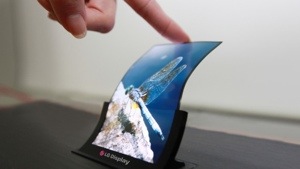
 @ TechRadar:IN DEPTH Will pliable displays ever take off? :Want to know when your phone will become your flexible friend?
Good survey of the oncoming tech…

Read more at: FPGAs, LEDs, tools and wearables, new products in the Maker Shed
…FPGAs are intimidating beasts to most makers, including myself. Thankfully, Justin Rajewski’s insanely popular Kickstarter project caught our eye. The entire goal of the Mojo is to make getting started with FPGA and digital design as easy as possible. An FPGA allows you to design digital circuits (basically a bunch of logic gates connected together to perform a specific task). The designs that you create can range from something as simple as a counter to blink an LED to something as complex as a multi-core processor (or an Audio Visualizer).
With a microcontroller (like an Arduino), you write software that gives you control of the the built-in peripherals but is limiting in that you can often only complete one action at a time. With FPGAs you are not creating software; you’re designing the hardware. Instead of writing code to run on a fixed processor with fixed peripherals, you get to design your own circuit.
Justin’s done a fantastic job of releasing new tutorials for getting started with Electronics, Logic and the Mojo on the Embedded Micro website. He’s also began work on an IDE specifically for the board, to make it even easier to develop for. Read more about this flexible, powerful board and pick one up from the product page. …
…and the other stuff they highlight is cool to!
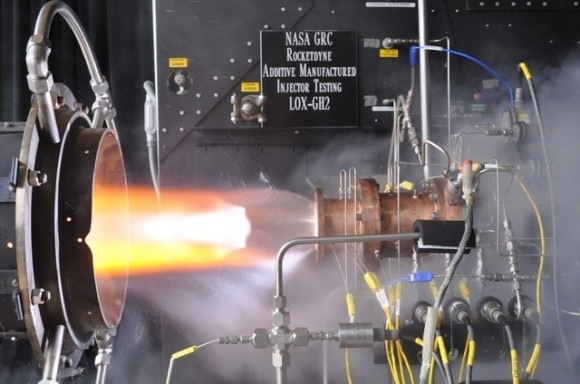
…NASA didn’t use ABS plastic that most 3D-printers use. Instead, the agency used custom 3D printers to spray layers of metallic powder using lasers. The lasers spray the powder in a specific pattern in order to come up with the desired shape for an object. In this case: a rocket engine injector.
Read more at: Slash/Gear http://www.slashgear.com/nasa-3d-printed-rocket-injector-undergoes-first-test-firing-12290238/

