Lasers and rail guns oh my

So linked at the bottom is a file by the congressional research service regarding the progress the Navy is making on laser weapons, rail guns and hyper velocity smart munitions. Not the best topic for Christmas Season but oh well.

A series of articles in the Drive and elsewhere have discussed the progress in laser weapons over the last few years. To recap, a technology that was discovered as a fairly early practical application of quantum theory evolved into an important digital communications tool where the demand for longer distance between repeaters drove the power up to a point where cutting material like paper was practical that evolved into cutting steel which provided the basis for weapons grade systems although the military R&D complex had been exploring alternative paths for decades.

Now real systems (in the sense of shooting down light weight drones or setting outboard motors on fire, as well as dazzling or spotting) are being deployed and fairly aggressive plans are being made. There still remain problems with the technology though many of them are resolvable. And like earlier many pieces are being worked on for civilian reason, not the least in the field of astronomy where light transmission through the atmosphere is important and the brain power is deep and unfettered by military R&D issues.

In the end it is not clear that at sea is the best place to locate a laser weapon but ships are (relatively) big and have (relatively) large power systems so they are a good early trial. If lasers can be of value there they are going to make it other places as the technology improves.

Rail guns…what can you say (I could say a fair amount but won’t) they are the technology of the future and have been my whole adult life. I spent a couple of years involved with them and that is enough to tell me that there are a lot of fundamental problems that appear surmountable in early hand waving but are practically insurmountable as you get closer and closer to reality.

The ‘rail’ part of the gun has most of the problems of a powder gun barrel of erosion, fatigue, stress, compounded by huge electromagnetic forces in the metal itself. Vastly more complex than a simple bang tube. The energy required is huge but not only that it has to be released in a controlled manner at several times the rate of an explosion since the energy and the power are both higher than the propellant ‘burn’ of a powder weapon. Modern power electronics can handled this but they are not light and the resultant waste heat instead of exiting the barrel in a plume of plasma is retained in the energy storage device and switching system, none of which can be dowsed with water like you can do with a gun barrel.

Every 5 years or so since the seventies the rail gun has popped up as a candidate to replace the powder cannon of the day. Each time more of the hurdles identified in the last round are knocked down. But then new hurdles appear, often more complex than those dealt with and hidden by the earlier barriers.

And at the end of the day is the result worth the price? In WWI and WWII guns of prodigious range were developed but made no difference in the end. Mostly filling in for fighter bombers when the weather was crappy or the target too diffuse to be worth risking a pilot/aircraft.

In the early days (the 1970’s) of the rail gun its potential range and rate of fire appeared very attractive especially for Naval support gunfire. 100 miles and 10 rounds a minute of lethal kinetic punch were very much of interest to the amphibious forces. Since they were powered by electricity and fuel is relatively cheap + plentiful and the rounds compact, the ‘depth of magazine’ was fantastic. And all of this is still deeply interesting. But. In the end is this really what you need? In WWII through Desert Storm this capability set would have been game changing. Today? Maybe not.

The round designed (successfully) for the rail gun, can fit in any of our current 155mm class cannons. These guns with their 52 caliber barrels can punch the round out to 40 miles or more. The round is guided and has shown the ability to shoot down a cruise missile ! So it is as accurate as you like. It’s ‘shortfall’ in modern ops game theory is that it is a bit slow for shooting down ballistic missiles or reaching the outer theater to shoot down other high performance targets. But there are missiles that can do that and the attrition cost of a missile on that sort of target is worth it.

40 miles is not 100 miles, some targets are out of reach, you cannot stand off as far or reach in as far to destroy targets. But in reality is that an issue? If you think that you are going into amphibious war against hostile beaches maybe. But you have to assume that you can destroy the enemies area denial defenses (Because otherwise why worry about 100mile standoff?) so you can get the amphibious forces in close enough to get on and over the beach at acceptable cost. None of that appears realistic today. While some kind of Eurasian Fascist Empire and air tight anti strategic defenses might create an existential threat that triggered WWIII and the concomitant bloodbath this scenario is simply not on the table now or foreseeable in the next twenty years.

For now we have Taiwan and the South China Sea as the most likely battleground for near peer conflict. ——— OK no one ever really KNOWS what is coming next, the Med, the Baltic, maybe somewhere in Oceana might go south with zingers but none of those have the deep resources required to cause an existential threat or survive an attrition campaign long enough to make the rail gun a potential player——

To continue, while T and SCS are both in their way an argument for that extended range neither is going to be resolved in any way by one weapon. Neither are any other scenarios one might game other that EFE+ATSD above and that ain’t goin to happen (yet.)

So? Lasers…full speed ahead, look to the sky, 150kW on a fighter is a game changer. Rail guns…spend some money, let the Chinese trial their barge, see if they have solved the problems, they haven’t but what do I know? Hyper (or High) velocity smart munitions,…go, go, go power rangers !

Congressional Research Service Report on Lasers, Rail Guns and Hyper Velocity Rounds, via the US Naval Institute Proceedings website.

Limitations of Pay Pal and how it’s side stepping them

I’ve used PayPal for several years now on my iDevices and PC’s, mostly for paying a few monthly subscriptions and moving money between bank and credit union. It also enables me to pay for my minor excesses out of my ‘monthly money’ rather than the family general account. I have bought a couple of big-ticket ‘toy’ items using the credit account and then paying back over a few months, or better saving up then using PP to buy the lusted after item over the net. I think PP is a useful service and I trust it more than I do big bank credit card services though that’s a little player vs. mongo player preference rather than real in-depth analysis.

Pay Pals weakness has been the network effect. In general the more members any network has the more useful it is. While PP is pretty widely spread these days it’s not getting bigger quickly enough and I have continued to use other methods of paying for most things.

PP has solved at least part of this growth problem by moving into the credit card world. Establishing a PayPal Master card in place of its own credit account. This enables users to pay through the immense existing credit card infrastructure but use the PP ‘back office.’

In one sense it’s a bit sad that PP had to just become another credit card. But they do provide a lot of other services and a way to manage and move your money around in the banking system.

iPad next?

The iPad is the premier tablet and it’s probably nearly the perfect size and weight for its form factor.  That’s not to say that within the form factor there is no room for improvement. A screen that takes up most of the face should be a near term target, as should an auxiliary screen on the back face that provides bright light reading and low power / speed interactivity for those who don’t live indoors all the time.  To support the iPad as a companion device, multi level security is a growing need.

Make the bezel the same on the iPad as minimal as possible (get rid of the push button) push the screen out to the edge, don’t change the shell size. This with continued pixel densification will put the screen on another level altogether.  Make thumb and palm detection native and intelligent enough to enable me to rest my palm on the screen and write with a stylus as if the screen were regular paper.

Put an eInk reader panel on the back to enable the display of text and graphic art, this will enable high light low power reading applications and some other limited visual bandwidth applications such as phone etc. (This will be accomplished with a smart cover but it would be cool if it were integral with the iPad.)

The radio suite & battery life along with the camera, face time, GPS, and other built in sensors are probably good enough not to call for increases in size weight, but neither should they be decremented.

The iPad is far to big a part of many people’s eLives to leave to the pitiful protection it has today.  We need multi level security, enable me to turn the iPad on as if there is no security for consuming web pages, playing games, and using certain apps.  But for other functions use face recognition, symbolic coding other than a number pad, voice recognition, retina image recognition and even finger print recognition in combination to protect various levels of data in the unit.

Enable cyber security with one or more over watch processors that is not linked to the outside world for some level of checking to make sure that the tablet has not been compromised.   A version of this ‘chip’ may be linked to a secure remote system (short-range) so businesses or organizations can disable certain functions of the iPad remotely to make sure that pictures, audio, or other data cannot be put into memory without authorization.  This Big Brother functionality is a bit daunting but at least the over watch processor is probably going to be needed.  The full BB may be an external attachment and not integral so one can shed it easily….

Catching the Watcher | NaNoWriMo 12 | Update day 6

Cover art Draft:

  • Target Word Count 50,000
  • Target Average Words Per Day 1,667
  • Words Written Today 2,181
  • Total Words Written 12,284
  • Current Day 6
  • Your Average Per Day 2,047
  • Words Remaining 37,716
  • Days Remaining 25
  • At This Rate You Will Finish On November 24, 2012
  • Words Per Day To Finish On Time 1,509

New Post 1 iPad First

iPad Mini Breakout ideas that seem really unlikely:

  1. It should have 2 (two) screens, one on the back in e-ink for pure reading and the regular one of the front for all the other things one does with an iPad. The reading screen should be able to run when the front screen and the radios are all shut down due to low battery power.
  2. It should have the same screen ratio as the iPhone 5 making it newer and svelte. 

Two worst decisions the new management could have made:

  1. offer the Mini as a Touch Maxi, i.e. without 4G
  2. cheapen it by taking out bluetooth or the higher memory options

What I expect:

  1. iPad 2 resolution machine with retina pixel size.
  2. iPad 2 cpu and gpu maybe a bit better
  3. Light with narrower side bezel, making it look like a large iPod Touch
  4. A very inexpensive basic unit but a pretty much fully rigged top end model that will offer compact footprint as competition
  5. iPhone 4 level camera on the back or better (Apple has realized that they have the point and shoot market at this point.)
  6. iPad 2 will be phased out

Electric Ships Go DC –> DC Helps Electric Ships (SAE Post)

20120909-004934.jpg

dc grid cuts cost, size of electric propulsion systems

11-Apr-2012 09:32 GMT

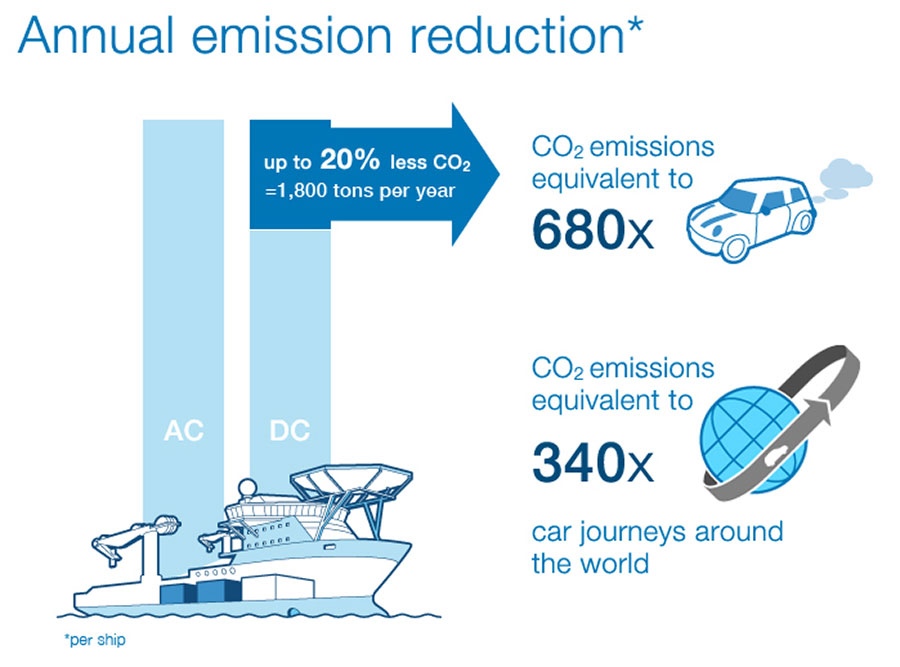
ABB’s dc grid trims the weight and size of the electrical system by nearly a third.

Norwegian ship owner Myklebusthaug Management plans to become the first company to employ a direct current (dc) power grid on board a ship. A 5000-ton (4535-t) offshore platform support vessel will deploy ABB’s Onboard DC Grid, which ABB says will improve efficiency and reduce emissions for ships with electrified propulsion.

In existing electrical propulsion vessels, more than 80% of electrical power consumption goes to thrusters and propulsion drives. They use dc connections derived from an alternating current circuit.

Rather than converting ac to dc, the Onboard DC Grid optimizes propulsion by distributing power through a single dc circuit, according to ABB. ABB predicts that once ship owners see the benefits of electric propulsion, dc grids will see rapid acceptance. Myklebusthaug Management’s 93-m (305-ft) oil field supply and construction vessel is scheduled for delivery in the first quarter of 2013.

“We believe that by 2020, approximately 20% of ships will be electrified, and quite a bit of that will be dc,” said Heikki Soljama, head of ABB’s business unit marine.

One key reason the Onboard DC Grid saves power is that the ship’s engines no longer have to run at a fixed speed. Engine speeds can be adjusted to optimize fuel consumption.

At the same time, bulky transformers and switchboards can be eliminated, reducing the footprint and weight of the electrical system by up to 30%. The main ac switchboards and transformers are no longer needed.

However, ABB’s system extends the many dc-links used in all propulsion and thruster drives. That lets shipbuilders retain the dc generators, inverter modules, ac motors, and other proven products.

The grid can be used for any electrical ship application up to at least 20 MW. It operates at a nominal voltage of 1000-V dc. The power distribution can be arranged with all cabinets in a single lineup using a multidrive approach or it can be distributed throughout the vessel by short-circuit proof dc busbars. That gives designers more freedom for locating electric components, which can result in a more functional vessel layout.

Terry Costlow

Good synopsis of why DC and to some degree why electric…this is the future but as always the path is long and takes odd jaunts that will ‘drive men(proponents) mad.’

iPad , iPad

Not sure what I think about the iPad these days, it’s still the single most used computing device I own but to be honest its the one that I would give up first as well.

Which seems odd.  But while I can do many things with the iPad (reader, Music, light blogging, internet addiction) even creative and work related if I have to, it is by its nature more limited in the depth of work that it supports.  It allows one to create a document and presentation or spreadsheet very well but linking them together is far harder than on a PC.  The scientific calculators I have worked with are simply remarkable but their results are hard to integrate with other packages.  Pictures etc are the same, it’s not that the iPad can’t it’s just that with the App model and its flat file structure you cannot organize or cross pollinate work like you can on a PC.

I am sure that many out there would argue with this, they probably feel that the iPad is liberating or does this or that better than any PC, and they could be right.  I also think that I could get used to using the iPad for many more things, but the effort to change over and figure out how to do things differently would be a very deep time sink.

Don’t get me wrong, the iPad is a remarkable development, the culmination of many attempts over a long time, but it’s not clear that it’s the be all that some, even I, thought it  to be.

That said you’d have to pry my iPad out of my cold dead fingers if you just wanted to take it away now (though if you’re thinking of mugging me for it, you can have it, gives me an excuse to go buy a newer one.)

I am disappointed that no one has developed a better stylus technology, for the iPad.  It needs a pen like system as well as the finger painting mode (the Blue Tiger device that was being hyped a few months ago seemed promising.)  And I also feel that the iPad could do with a daylight readable screen at the current or only slightly higher resolution, with a longer battery life, faster processing and graphics and better error handling (than my old iPad v1).  One cool idea would be a two-faced version.  One with eInk on one side and the existing screen on the other.  That way you could do what you most often want to do in daylight, read and interact with documents, and you still have all the capability of the main screen on the other side.

Ah well, who knows what’s to come in the months and years ahead.  Hopefully someone at Apple will think of a better way of doing the things I want the iPad to do.


Ship to Shore Connector… Landing Craft Air Cushion, only the Gov’t could make something this cool boooring

 These are the final stage of the powerful conveyor that is the Navy’s Gator Fleet, the numerous, rather ugly, remarkably capable ships that carry the Marines to the far ends of the world and deliver them on the beach when needed.  While this fleet has been mainly a humanitarian instrument for many years now it is one of the principal reasons for the US Navy to be as big and capable as it is.  The US Navy has many tasks the most obvious ones are to keep the sea lanes open for merchant traffic.  While air freight is important these days it is the vast cargo ships carrying oil, ore, containers, and vehicles that really undergird the world merchant economy.  The US Navy also provides our most secure strategic weapon the strategic missile submarine.  The US Navy and the Marines hold at risk every trouble maker with a maritime coast, providing the implicit or explicit threat that major combat boots (and tracks) can be on their ground if they provide the right (or is that wrong) stimulus.

Computer aging and user angst…

As I’ve noted before my primary writing implement is a Leonovo (nee IBM) Thinkpad T42, at the time one of the best lightweight laptops in its class and certainly (in my opinion) the LAPTOP writing tool available.  I had been using Windows 2000 on my ‘main’ machine (which I had been forced to upgrade with much cursing, from Win NT a couple of years before) but had to move to XP Professional on Writer, which caused a great deal more muttering under the breath and vibrant curses in the direction of Redmond WA and B.Gates in particular.   (By the way, probably the most maligned man on Earth and proof that curses have no effect. He being, to all appearances; healthy, happy and well off despite a {largely unearned} curse load that should have reduced him, and the local geographic, region to subatomic particles long ago.)

Writer replaced an earlier IBM Thinkpad, a black and white 3.5in floppy equipped 12+ incher that I bought at some an early Staples in the early 90’s.  It had Windows 2 if I remember correctly not the soon to be released W 95.  I typed away happily on that machine, transferred to the ‘big iron’ with its much more stable W NT then to the (even better Win 2000, –though it took at least six months for me to admit as much.)

Then of course I started buying systems for the rest of the family, I bought one with Windows Me (what a piece of trash!) and later Windows Vista (urk) and lately Windows 7, which I have to say I find to be at least as good as XP though I don’t like the increasing levels of detail they are hiding behind the magic curtain, that I have to find my way past to do anything once the wizards etc fail (though admittedly that’s pretty rare these days.)

Before and During this time, working first for the Gov’t then a Gov’t/Private partnership.  I had used several versions of DOS, rightly pooh poohed Windows 1, often used the DEC VAX operating system, a version of the other disk operating system common at the time (which I forget the acronym/name for) and then on to Win 2, Win 95, Win 2000, Win XP.  Now the age of XP is passing (I know I know, in the outside world it passed long ago but main line / old line engineering firms are extremely risk averse.)  My latest little (plastic) jewel is Win 7 which has forced me to finally learn the system (like work moving to XP made me learn XP.)

Sigh, and now they are talking about W-8! and that they are going to stop supporting W-XP!! And Writer is finally showing her age <whine, whine> but is not ready for the removal of her hard drive and consigning to the waste stream of history…but if I wait too much longer I won’t be able to get W-7 the bastards will force me to get a new system with W-8!!!  Those fould fiends in Redmond! whats’s name and all his grimy green geek gremlins, with their damned marketing plans…etc, etc, etc….(and by the way its harder to use Ballmer in a curse than it is Gates, makes it much less cathartic for some reason.

So sometime soon I will have to get another Writer…and my daughter want’s an ultrabook to replace the Gateway 15.6 incher I got her for University.  And having had fun building two computers from scratch this summer I want to play around some more…but haven’t found an excuse to build another one, or two, or three….

And the fools at Leonovo will probably not offer a regular old-fashioned 3:4 aspect screen but one of the blasted 9:16 movie screen slots…the old form is much better for writing when using a smaller screen. But ‘everyone’ seems to like the slots because they can see movies better, why do they get to pick the aspect ratio?  I’m doing creative stuff they’re just rotting their brains for crying out loud!!

And so it goes…things change, those that don’t are either perfect or dead.  Personal computer technology is evolving so fast that it is impossible for anyone to say ‘stop I want to get off for a little while.’  One just has to continue to adapt.  Just be thankful that what we are adapting to is a new and generally much better set of hardware and software….not the appearance of a new predator, plague or famine.

Cheers