Unknown's avatar

About Sci Fi Engineer

Husband Father Writer Engineer

Now for something somewhat different

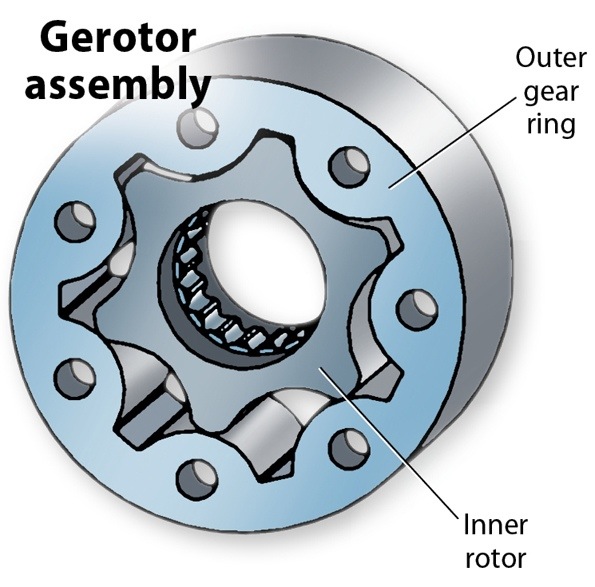
20130512-101241.jpg

In a gerotor motor, the outer ring’s gear teeth remain stationary while fluid flow turns the internal rotor. This drawing is of a six-pointed gerotor assembly. To see a motor’s internal components in action, view the YouTube video, Motion Study of the Gerotor Motor at http://www.youtube.com/watch?v=iooA0mJzEIE.

Machine Design has always been one of the best engineering teaching magazines out there and this article on hydraulic motors is an example of why. Informative and elegant graphics, straight forward, intelligent and direct (without dumbing down) explanatory prose. OK it’s about hydraulic motors but it’s cool, neat, etc, especially in this age of the maker revolution.

Another example of why important stuff should NOT be left to government bureaucrats

phys.org : Reports from “Humans 2 Mars Summit” suggest dust may prevent human settlement of Mars by Bob Yirka

…. perchlorates appear to be widespread on the planet’s surface. The fine dust material produced by perchloric acid has been known to cause thyroid problems in people here on Earth.
Just as problematic, … is gypsum…. been known to cause a condition similar to black lung in coal miners in people exposed to it for long periods of time.
… known presence of silicates on the Martian surface—if breathed-in they can cause reactions with water in the lungs and result in the creation of harmful chemicals.
Martian dust could pose health hazards because of the difficulty of removing it from space suits and boots. … fear the dust would build up in air filters and living quarters, adding yet another life threatening element to the list of other known hazards (traveling and landing safely, exposure to radiation and cosmic rays, etc.) for the people who seek to colonize the planet.

You can always find some pretext for why not to do something.

This sort of narrow thinking is why it the Mars colonization effort by somewhat older unworried warriors is a great idea, they will lead the way, they may die earlier…will almost certainly die earlier than they would on Earth but in the big picture they will be immortal.

I think that a commercial fly by of Mars possibly convoying with early colony equipment makes a lot of sense. Drop off a 3D printer to start fabbing buildings or building parts. The fly by would work on the tech of getting there and of living in space for long periods. Multiple (4 in a Bigelow Cross?) inflatable Bigelow modules would make a light weight but spacious habitat that one or two couples could live in for the time needed. I would boost and decelerate the complex with an earth orbital tug and have minimal onboard propulsion since its pointless mass to take with you. With the right kit of science and DIY they would keep busy doing various types of investigation the whole time.

Big picture:

  • Asteroid capture and exploitation
  • Refueling / reuse of space side craft
  • Asteroid mining for space side resources and drop side assets
  • L point science platforms with robo and human servicing
  • Low earth orbit hotel/spa/ops-center
  • 4 person large scale spacecraft flyby of Mars
  • Mars colony robot precursor landings
  • Mars colony crew of 6 to 8 no return, first Martians
  • Follow up resource flights to Mars, gradual build up of Mars colony
  • All possible in the next twenty years, tenish if we really pushed, and I think we could commercial/ kick start/survivor fund the whole bloody thing…


    20130510-165250.jpg

    20130510-165307.jpg

    20130510-165326.jpg

    20130510-165343.jpg

    20130510-165409.jpg

    20130510-165425.jpg

    20130510-165501.jpg

    20130510-165528.jpg

    Now this Really Is Rocket Science

    New research key to revolutionary ‘green’ spacecraft propellant at Phys.org
    Got me interested in this new material…liquid…which is REALLY cool, in a hot sort of way, look at this briefing by the Air Force Research Lab…this Rocket Fuel burns at 1600degC but it just sort of fizzles if thrown on a fire, sits there when hit by a hammer, does not create clouds of toxic fumes and while not a great ice cream topping is not wildly poisonous either…and this stuff was actively developed, not just stumbled across. Such is the power of modern research tools and materials knowledge.

    20130507-211124.jpg

    The GPIM project aims to introduce AF-M315E as a green alternative to hydrazine (Credits: NASA).

    phys.org | Do-it-yourself invisibility with 3-D printing

    20130506-220828.jpg

    “I would argue that essentially anyone who can spend a couple thousand dollars on a non-industry grade 3-D printer can literally make a plastic cloak overnight,” said Yaroslav Urzhumov, assistant research professor in electrical and computer engineering at Duke’s Pratt School of Engineering.
    Urzhumov said that producing a cloak in this fashion is inexpensive and easy. He and his team made a small one at Duke which looks like a Frisbee™ disc made out of Swiss cheese. Algorithms determined the location, size and shape of the holes to deflect microwave beams. The fabrication process takes from three to seven hours.
    “Computer simulations make me believe that it is possible to create a similar polymer-based cloaking layer as thin as one inch wrapped around a massive object several meters in diameter,” he said. “I have run some simulations that seem to confirm this point.”

    Read more at: http://phys.org/news/2013-05-do-it-yourself-invisibility-d.html

    Well ain’t that just Harry Potter cool?

    Machine Design | Local-for-local strategy drives U. S. expansion

    An artical / opinion piece in Machine design talks about how reality/ growth caught up with plans an sparked an epiphany: Local-for-local strategy drives U. S. expansion . This seems right and in line with what seems to be happening more broadly which is not a retreat to the USA but a charge into the future. This is all to the good…except in many ways the blue blues less clues have been taking advantage of the disappearance of the factories and their irritatingly outspoken managers / operators to tighten up regulation. Not that regulation is all bad but the regulatory net in blue states/ cities seems to be stifling growth in many places that could do with it.

    Eye Candy

    20130506-131540.jpg

    Wired, young Audubon works

    Living tissue 3D printed

    First fully-cellular liver tissue 3D bioprinted at Organovo

    20130503-232416.jpg

    Bioprinted human liver with CD31+ microvessels (green) forming within the tissue.

    Since liver cells are used in labs to test the toxicity and efficacy of drugs, these printed tissues will first serve that purpose. Soon though, a larger liver will be printed, and it won’t be long after that that printed organs will be tested in animals. It’s a short hop from there to humans.

    Does it whistle in the wind?

    20130503-213449.jpg

    The Met, Bangkok, Photo: Aga Khan Award for Architecture/Patrick Bingham-Hall, Each week, Wired Design brings us a photo of one of their favorite buildings

    Completed in 2009, Bangkok’s 66-story Met Tower is an attempt to build an apartment complex uniquely suited to its surroundings, rather than adapting temperate techniques to a tropical location. WOHA Architects did this by incorporating elements of more traditional tropical housing, and the results have been shortlisted for Aga Khan’s 2013 Award for Architecture. The perforated 748-foot structure is actually six columns connected by breezeways that promote cross ventilation — each unit is exposed on all four sides. The facade is inspired by traditional Thai architecture and materials, with shade and vegetation screens reaching all the way to the top.

    Cool! Hopefully in all the right ways.