
Via Meadia
October 14, 1066 King Harold of England dies in the Battle of Hastings, Viking Duke of Normandy to Blame! News in 11 centuries or so. English Language a major benefactor….(trust me its cool!)


Via Meadia
October 14, 1066 King Harold of England dies in the Battle of Hastings, Viking Duke of Normandy to Blame! News in 11 centuries or so. English Language a major benefactor….(trust me its cool!)
 From the word source section at Dictionary.Com
- c.1300, “an area, extent, expanse, lapse of time,” aphetic of O.Fr. espace, from L. spatium “room, area, distance, stretch of time,” of unknown origin.
- Astronomical sense of “stellar depths” is first recorded 1667 in “Paradise Lost.”
- “Space isn’t remote at all. It’s only an hour’s drive away if your car could go straight upwards.” [Sir Fred Hoyle, “London Observer,” 1979]
- Typographical sense is attested from 1676
- (typewriter space bar is from 1888).
- Space age is attested from 1946;
- spacewalk is from 1965.
Many compounds first appeared in science fiction and speculative writing, e.g.
- spaceship (1894, “Journey in Other Worlds”);
- spacesuit (1920);
- spacecraft (1930, “Scientific American”); space travel (1931);
- space station (1936, “Rockets Through Space”); spaceman (1942, “Thrilling Wonder Stories;”
- earlier it (spaceman) meant “journalist paid by the length of his copy,” 1892).
- Spacious is attested from 1382.
- 1703, “to arrange at set intervals,” from space (n.). Meaning “to be in a state of drug-induced euphoria” is recorded from 1968.
- Space cadet “eccentric person disconnected with reality” (often implying an intimacy with hallucinogenic drugs) is a 1960s phrase, probably traceable
- to 1950s U.S. sci-fi television program “Tom Corbett, Space Cadet,” which was watched by many children who dreamed of growing up to be one and succeeded.
I was born the year and month that Sputnik was blasted into orbit and so I grew up dreaming of the great rockets roaring into space. My dreams died a little with the end of the Apollo era and a little more with every year of the space shuttle and ISS travesties that followed. Not because of the actors in the piece but because of the dead hand of bureaucratic-management-executive risk aversion that could be seen crushing the glory out of the endeavor. It was only the glorious optical archive that is Hubbles legacy that kept a dream alive, a dream rekindled with Faster Better Cheaper and the Mars flurry and then blown to full flame in the last few years with Space X, Virgin Galactic, Bigelow, Orbital, and more.

National Novel Writing Month 2012, Starting November 1, at 00:00:00, a thing to do…
So once again November approaches and new fields of stress and invention await. The Daughter (beloved I assure you) is getting married this November but still seems to think she may actually try to do this (again) and is (kinda) urging me to as well. And maybe I should, a novel about her driving her parents NUTS!!! But besides that it might be an interesting challenge. On top of all the other writing assignments I am getting from work and the attempt to get Elgin finally Finished and into Smashwords Premium Distribution. (Elgin was last year’s NaNoWriMo entry…finished in December but a winner none the less.)
Read this, and think, I hope it’s reversible, do you?

And:
We will bankrupt ourselves in the vain search for absolute security.
Also:
And again:
Most Famously…and foresightedly:
With this as a postscript…from a man who would know:
What we need in a president is someone with these understandings. And a person who is willing to talk to the people honestly and directly about the decisions being made the trade offs necessary without diving into the cant (dialect) of economics, financiers, government (acronymophilia) or academia (grecoromanobibliophilia.)
The truth is that the president is both the most powerful person in the world and one of the most constrained chief executives in government. This is a good thing, a different combination would be very frightening.
Our president should have clear moral and ethical lynch pins, but that does not mean that he or she can or should try to enforce those views except as permitted and directed by congress and the courts. For example the president to represent the Ethics of the people of the United States needs to be anti-abortion (always) but know that in the end it has to be a choice made by the woman with her own conscience, that is the meaning of individualism in politics/society.
Much about taxation and regulation is beyond the direct control of the president but the executive does control implementation. The number of laws is so huge that there is no way to actually enforce them all. [A problem congress needs to fix by timing out old laws and replacing them with simpler laws updated every decade or so.] A president needs to follow the letter of the law but always push for the most minimal use of resources to enforce them, sometimes (a lot of the time) to the point of ignoring them except as modifiers (adders) if someone is indited for other reasons. The biggest job an executive has is to ensure that the ‘system’ is not captured by those it is supposed to regulate…or if it is (by law) to ensure that they are self regulating to the advantage of the citizens in general, not their own enrichment or more dangerously their enshrinement. Far too many of our laws at all levels of government, intended (perhaps) to protect the poor defenseless citizen, are in action a way for a small group to ensure that their way of life (money siphon) is affected (throttled or knocked from their lips), for example: medical, bar, plumbing, electrician, cosmetician, licensing laws in each state.
The famous rant by Colonel Jessep (Nicholson) from A Few Good Men:
You can’t handle the truth! Son, we live in a world that has walls, and those walls have to be guarded by men with guns. Who’s gonna do it? You? You, Lt. Weinburg? I have a greater responsibility than you could possibly fathom. You weep for Santiago, and you curse the marines. You have that luxury. You have the luxury of not knowing what I know. That Santiago’s death, while tragic, probably saved lives. And my existence, while grotesque and incomprehensible to you, saves lives. You don’t want the truth because deep down in places you don’t talk about at parties, you want me on that wall, you need me on that wall. We use words like honor, code, loyalty. We use these words as the backbone of a life spent defending something. You use them as a punchline. I have neither the time nor the inclination to explain myself to a man who rises and sleeps under the blanket of the very freedom that I provide, and then questions the manner in which I provide it. I would rather you just said thank you, and went on your way, Otherwise, I suggest you pick up a weapon, and stand a post. Either way, I don’t give a damn what you think you are entitled to.
Nicholson is able project a charismatic mix of steely conviction with righteousness and psychotic tendencies. He’s homely in a rather attractive sense but his rubber play mask of a face often seems on the brink of either maniacal rage or maniacal laughter…with the understanding that the differences are tiny.
That whole movie left me cold, there was something trite about it and the casting of the oh so cute JAG’s and the oh so over wrought marines was perhaps clever, the setting clever, the words….clever, but what was it all about?
It was all about the delivery of that one monologue and its delivery by someone who was clearly, if only slightly, over the edge, in a place that should not exist.
The movie provided depth to the speech that twists the highest meanings of honor and service into dark and dangerous threats curdled in a place and circumstance that are wholly unnecessary.
And this was long before Guantanamo took on its current gray mantle.
This can be seen as the most powerful anti war movie (without any action) that has ever been created because it says that the things a person has to take on to become a combatant are manipulations and most likely the rational behind it is a lie and the urge to protect, more about power and privilege than caring.
And yet…and yet…I came away with the weird sense, I think intentionally that Jessep was more hero than villain and the JAGs more (minor) villains than heroes though they were heroes and he was a villain who needed stopping.
In ghostly profile behind Jessep, I see Patton, Stonewall Jackson, Sherman and others, who were in their ways just as nuts, In an alternate to his fictional world Jessep could have been a great hero and the JAGS might have been slimy villains.
Was any of this the original intent? Probably and if so its probably great art, in the sense of great playwright’s work and great casting, not so much cinematography or directing or acting on anyone’s part other than Nicholson’s.
A Few Good Men and the strange mirrors it casts are more apropos today than they could conceivably have been when it was made. This movie made today, set in Iraq, Afghanistan or any one of a hundred other places, would not work as well and would create a firestorm of debate but then vanish.
It has been left alone because it says more, more subtly the way it is than it could possibly say if redone in a contemporary venue. And anyone who tried to remake it would be unable to create the remarkably fine balance that it drew between hero and villain on both sides.
I posted on Truth, Fact, Lies and Fiction some weeks ago and I find it very interesting that one of the major progressive/liberal reactions to the Romney trouncing of President Obama is that it was all Lies. And then the follow-up analysis that yes of course it was lies, see this factoid, that factoid, and this other factoid.
In the big picture though Romney didn’t lie, it is not in his temperament or interest to lie and he’s too smart and too well supported to lie by mistake (and the same can be said for President Obama.) And all those handy Factoids aren’t lies either. They are all truths that take one cut through a matrix of facts that are too complex to make into sound bites, too complex to express in an hour, let alone a few moments and in the end too complex to really ‘know’ the end results of at all.
Anything a politician says can be said to be a lie unless it is so basically simple to parse that it cannot (practically) be a lie. The statement “The dog licking my hand is alive.” is pretty damned hard to make into a lie {unless the statement’s made on radio and no one is in the studio to vouch for the dog’s existence…but never-mind that!} But the statement that ‘My Proposal to cut the tax rate for the top five percent of wage earners will not decrease government tax revenues at all, in fact it may raise them!” is impossible to prove as a fiction or as a fact.
The FACT is that many MODELS of taxation show that tax intake does rise if you decrease the tax rate. This is because those high earners leave more of their money ‘in play’ in the economy attempting to make more money and thus putting it, and any extra they take in, within reach of the taxman. Those models are pretty simple and anyone who can and will sit down and think about it will realize almost has to be true in the real world. That is unless you assume that most money is made in a black market beyond the reach of the taxing authorities, and while that may be true in Russia it is patently not true in America.
Throwing the Liar word around is in my opinion simply lazy character assassination and it has backfired on both the right and the left. The right has again and again attacked the president as a liar when any reasonable person would see the situation as one of views and values, this ticks the hardliners off and they start frothing and soon turn a lot of people who originally listened to them off (I have been one of these people though I usually calm down and come back.) The left has said the same thing about Romney and Ryan, often not overtly (but often very overtly) ever since Romney started moving ahead of the pack because many on the left who had met the man when he was Governor of Massachusetts, Savior of the Olympic games or Head of Bain Capital knew him to be a relentless, effective and innovative person of deep convictions but reasonable temperament. As has been said elsewhere when Romney was a cartoon cutout the character assassination was effective, when they saw the person in action it was a stunning revelation. The fact that the left and their enablers in much of the media had made him such a cartoon made the revelation all the more shocking, and all the more damaging to the left and the enablers.
Don’t call a politician a liar because you disagree with him. He may be mistaken in his beliefs but no politician at the national level can be fool enough to just lie because he thinks everyone else is a bigger fool.
So do politicians never lie? Of course they do. But Statesmen never lie, right? Of course they do. Statesmen have to lie more that politicians do, and while it’s usually a bad idea for a politician to lie (shading the truth or dodging being their better and most oft chosen course) it is oddly a bad idea for a Statesman to be truthful all the time (though again shading and dodging are often better choices.)
Statesmen, being very important people who know more than they probably care to, cannot tell all to the people because they know damned well that the truth is ugly, the facts poorly understood and the most basic facts are that life goes on and that good people do bad things and bad people do good things. None of which changes the truth (in the statesman’s eyes) that they are good people and bad people.
So in some ways I feel that President Obama has to be given a bye on some things that he is called a liar on. Telling the truth is not always a good option and he could well hurt many more people by telling the ugly truth than he is by dodging, equivocating or occasionally outright lying. But there are limits to the byes and a limit to the things that can pass as Statesmen’s issues. And the President seems to be skating to the edge or beyond. But then, what do I know? Not enough to judge as yet.
You say that sucks! And I agree. But think about what a little incitement based on a stupid and utterly dreadful piece of video-logy did in the Muslim world. That was truth and fact used in the pursuit of sociopolitical ends by enemies of change and development. That social reaction was pretty much universal once, the torches and pitchforks came out very quickly. That is the world where Statesmen of good standing learnt they had to lie in pursuit of a more fair and liberal world.
And that sucks. But that’s the world we live in.
I’ve been thinking about Walter Russell Mead’s Death of the Blue model meme and some of the ramifications. Also thinking back on the history of industrialization and laissez-faire economics in English and American experience. Then Meagan Mcardle had a blog piece on the Daily Beast the other day that had a tangential thoughts of interest.
To Paraphrase rather egregiously: The United States has the largest economy in the world as well as the most dynamic and creative (though there are many who are trying to change that.) It trades a more secure safety net (which might not work in a large and heterogeneous country anyway) for more vigor and growth, even though that creates a greater disparity between rich and poor. Many smaller nations could follow the US lead but if they did they would suffer because they would be competing against a vastly larger pool of potential entrepreneurs etc. This makes it much more sensible for them to curl up and ride the innovation wave the US creates while providing a more comfy and fair life style for their citizens. If the US turned and did the Comfy-Fair thing, the world would lose its innovation mainspring and everyone would suffer because to a large degree our society/economy requires innovation and change to provide the economic voltage that drives the circuits of world trade. There is some research into this and the modeling seems to support the intuition in the main. But the researchers commented that Unions and Regulations offer a buffer against the potential of corporations using up the employees and resources. And it is that thought that intersects my intuition.
Essentially the problem is, and this can be shown in history, that large operations, even if owned and run by persons of great moral character become more and more ruthless as they grow. And as the operation turns from owner/operator to corporation the inherent inhuman ruthlessness gets worse and worse. The more successful a company is the more ruthless its ‘minions’ are going to tend to be. Look at what happened in the Robber Baron era, and then again in the great multinational eras (60’s and 90’s 50’s to today in my mind.) They were (are) Big Beasts, Gray not Red, in Tooth and Claw. It was nineteenth century progressive regulation then early twentieth century unions that tamed them in regards to their employees. Then it was the regulatory state in the 60’s-80’s taking charge in the 80’s that created Monster Corporations that ‘cared’ about the externals like the environment, customer safety, etc.
But from a libertarians viewpoint, it has always been the state’s fault that these beasts came into being at all. It can be argued that the great corporations were purposely crafted to employ and control great swaths of the population (I don’t think this was actually planned ahead of time, I think it was/is an emergent pattern driven by economic and social realities of the time but I am sure some saw it ahead of time and some will say it was all a vast conspiracy on someone’s part.)
Small firms, networks of firms, partnerships, franchises, etc, are all different ways of spreading technology effectively if perhaps not as efficiently as monopolistic or oligopolistic ultra large firms that came into existence to industrialize the US and compete on the world stage. In the UK this smaller/distributed model remained more common and competed strongly for a while until the incrementally crippling damage of WWI, the interwar boom-bust, WWII and the following socialist experiment so badly damaged it that it was off the world stage for thirty years, unitl Thatcher.
It is these smaller more entrepreneurial firms that are damaged by regulation and unionization the most. Not on purpose but because both cut the small companies ability to turn on a dime and give big companies, which can support big compliance departments, a very large advantage in the ‘rent seeking’ game of playing the regulators.
So the very instruments that you need to tame the Big Beasts of large-scale corporatism are the ones that plow under the smaller firms that offer 1) growth in the economy and 2) alternatives to the big beasts.
A balance is what you seek…
Our problem is that the post WWII boom hid the damage of the Big Beasts and their Tamers for several decades, and during that time we seem to have gotten the impression that there is some natural stable state that is ‘right’ and this state has something to do with large stable corporations and their control of the markets.
It’s clear to me that the bureaucratic-regulatory-union-corporation model does not have legs in a world of real competition from Big Beasts who are not constrained to the same degree.
Sometimes I think the only real hope is that the Industrial Civilization of ‘Big Beasts’ will be supplanted by something one might call the Maker Civilization, where zero cost communications and distributed at need manufacturing cuts the legs out from under all the Big Beasts.
iPad Mini Breakout ideas that seem really unlikely:
Two worst decisions the new management could have made:
What I expect:
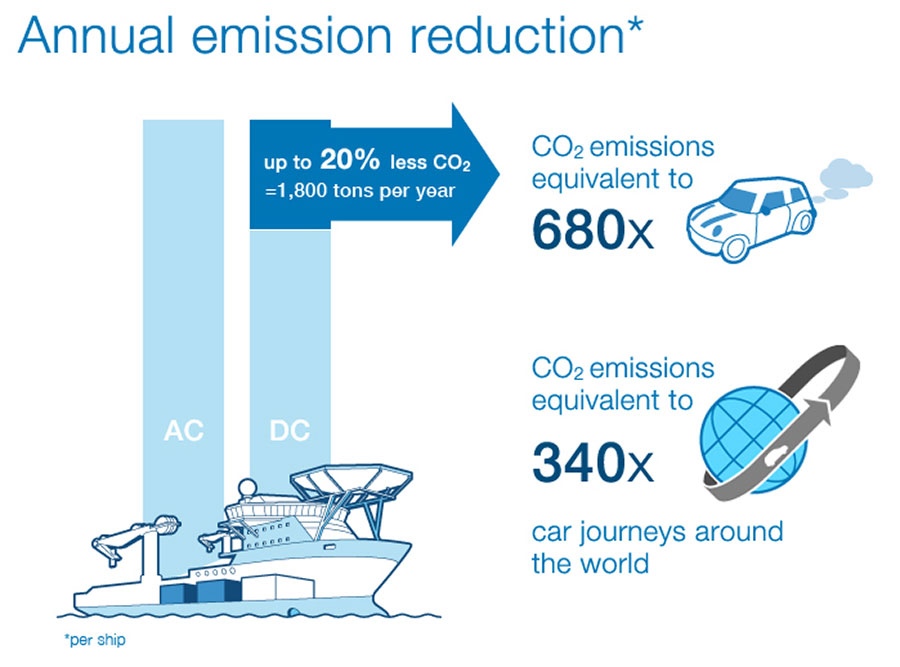
dc grid cuts cost, size of electric propulsion systems
11-Apr-2012 09:32 GMT
ABB’s dc grid trims the weight and size of the electrical system by nearly a third.
Norwegian ship owner Myklebusthaug Management plans to become the first company to employ a direct current (dc) power grid on board a ship. A 5000-ton (4535-t) offshore platform support vessel will deploy ABB’s Onboard DC Grid, which ABB says will improve efficiency and reduce emissions for ships with electrified propulsion.
In existing electrical propulsion vessels, more than 80% of electrical power consumption goes to thrusters and propulsion drives. They use dc connections derived from an alternating current circuit.
Rather than converting ac to dc, the Onboard DC Grid optimizes propulsion by distributing power through a single dc circuit, according to ABB. ABB predicts that once ship owners see the benefits of electric propulsion, dc grids will see rapid acceptance. Myklebusthaug Management’s 93-m (305-ft) oil field supply and construction vessel is scheduled for delivery in the first quarter of 2013.
“We believe that by 2020, approximately 20% of ships will be electrified, and quite a bit of that will be dc,” said Heikki Soljama, head of ABB’s business unit marine.
One key reason the Onboard DC Grid saves power is that the ship’s engines no longer have to run at a fixed speed. Engine speeds can be adjusted to optimize fuel consumption.
At the same time, bulky transformers and switchboards can be eliminated, reducing the footprint and weight of the electrical system by up to 30%. The main ac switchboards and transformers are no longer needed.
However, ABB’s system extends the many dc-links used in all propulsion and thruster drives. That lets shipbuilders retain the dc generators, inverter modules, ac motors, and other proven products.
The grid can be used for any electrical ship application up to at least 20 MW. It operates at a nominal voltage of 1000-V dc. The power distribution can be arranged with all cabinets in a single lineup using a multidrive approach or it can be distributed throughout the vessel by short-circuit proof dc busbars. That gives designers more freedom for locating electric components, which can result in a more functional vessel layout.
Terry Costlow
Good synopsis of why DC and to some degree why electric…this is the future but as always the path is long and takes odd jaunts that will ‘drive men(proponents) mad.’
 This World and Others