Wired BotW // Einstein Tower, Potsdam, Germany

20130524-101427.jpg

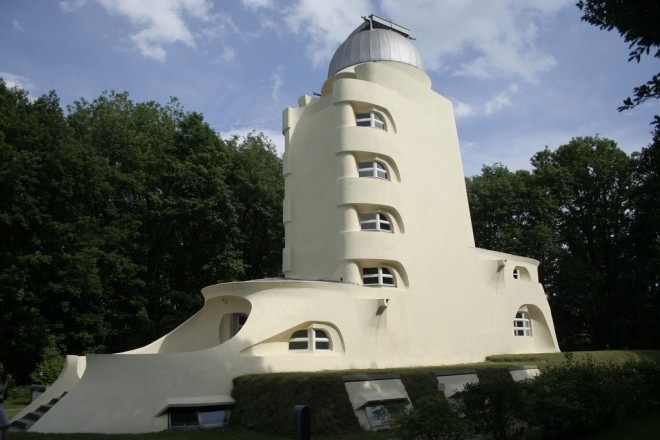
Einstein Tower, Potsdam, Germany
The 1920s-era Einstein Tower was built to prove one of general relativity’s predictions — that gravity would cause a shift in the sun’s spectrum. Although it never succeeded, it was one of Germany’s most important observatories for many years, up until its partial destruction during WWII. A fan of Einstein, architect Erich Mendelsohn molded concrete into graceful curves to evoke Einstein’s theories. Located at the Astrophysikalisches Institut Potsdam, the observatory is still in use as a solar observatory, though it splits time as a tourist attraction as well. The tower is skewered by a 1.5-meter solar telescope that visualizes solar magnetic fields and their location within sunspots.

Amazing what you can do with concrete, this sort of thing ought to be easier with 3D printing tech….

MIT TR | Synthetic Biology Could Speed Flu Vaccine Production

Read more at: http://www.technologyreview.com/news/514661/synthetic-biology-could-speed-flu-vaccine-production/

….researchers are hoping to engineer entirely new circuits into cells to help diabetes patients. Martin Fussenegger, a bioengineer at the Swiss Federal Institute of Technology, described a molecular system in which cells are modified with genes that can detect low pH levels in the blood, a sign of a diabetic state. In response, he says, the engineered cells will produce insulin to better regulate blood sugar levels and calm the diabetic state.
This kind of engineering typically depends on viruses to modify genes so that cells will perform useful tasks. But that method is risky: the introduced DNA could integrate into the genome at an unfortunate location that might lead to cancer. Harvey Lodish, a cell biologist at MIT, is working on a technology that could avoid that problem: lab-made red blood cells. After these cells are modified, they will kick out the virus in the course of their natural development process.
“The beauty of red blood cells is they are pretty much the only cell in body without a nucleus,” says Lodish. “By the time they get into circulation, they have lost their DNA and are stable for 120 days with no risk of tumors.”
In Lodish’s method, a retrovirus carries a new gene into the genome of progenitor cells that will eventually produce red blood cells. The cell uses that new gene to produce a modified version of proteins that sit on the surface of the mature red blood cell even after the cell has lost its DNA. The modified surface protein has been engineered so that other compounds can easily be attached to it—antibodies that could mop up toxic substances in the blood, or small-molecule drugs to attack cancers or other diseased cells. Lodish believes the technology is a safer approach to putting synthetic biology to use in the human body.

As Glenn Reynolds of Instapundit says, “faster please”

Titan, Cassini still exploring the moons of Saturn

20130515-172924.jpg

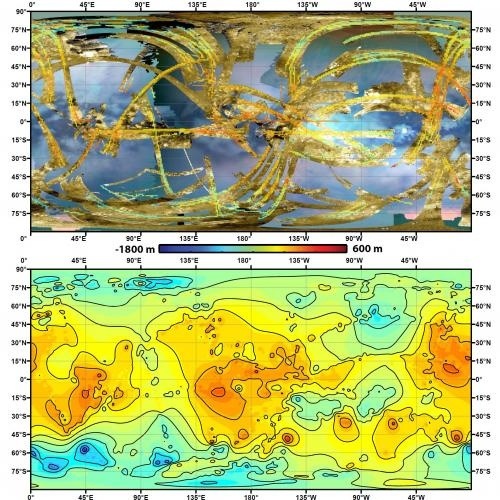
To create the first global, topographic map of Saturn’s moon Titan, scientists analyzed data from NASA’s Cassini spacecraft and a mathematical process called splining. This method effectively uses smooth curved surfaces to “join” the areas between grids of existing topography profiles obtained by Cassini’s radar instrument. In the upper panel of this graphic, gold colors show where radar images have been obtained over almost half of Titan’s surface. Image credit: NASA/JPL-Caltech/ASI/JHUAPL/Cornell/Weizmann

Read more at: http://phys.org/news/2013-05-cassini-global-topographic-titan.html#jCp

Planet hunting techniques expand

Planet hunting techniques expand:http://phys.org/news/2013-05-method-planets-scores-discovery.html
20130513-091049.jpg

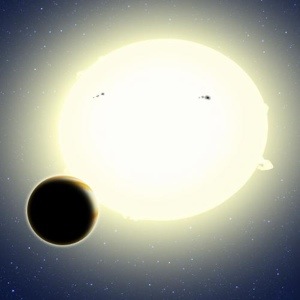
The new method looks for three small effects that occur simultaneously as a planet orbits the star. Einstein’s “beaming” effect causes the star to brighten as it moves toward us, tugged by the planet, and dim as it moves away. The brightening results from photons “piling up” in energy, as well as light getting focused in the direction of the star’s motion due to relativistic effects.
“This is the first time that this aspect of Einstein’s theory of relativity has been used to discover a planet,” said co-author Tsevi Mazeh of Tel Aviv University.
The team also looked for signs that the star was stretched into a football shape by gravitational tides from the orbiting planet. The star would appear brighter when we observe the “football” from the side, due to more visible surface area, and fainter when viewed end-on. The third small effect was due to starlight reflected by the planet itself.

Another example of why important stuff should NOT be left to government bureaucrats

phys.org : Reports from “Humans 2 Mars Summit” suggest dust may prevent human settlement of Mars by Bob Yirka

…. perchlorates appear to be widespread on the planet’s surface. The fine dust material produced by perchloric acid has been known to cause thyroid problems in people here on Earth.
Just as problematic, … is gypsum…. been known to cause a condition similar to black lung in coal miners in people exposed to it for long periods of time.
… known presence of silicates on the Martian surface—if breathed-in they can cause reactions with water in the lungs and result in the creation of harmful chemicals.
Martian dust could pose health hazards because of the difficulty of removing it from space suits and boots. … fear the dust would build up in air filters and living quarters, adding yet another life threatening element to the list of other known hazards (traveling and landing safely, exposure to radiation and cosmic rays, etc.) for the people who seek to colonize the planet.

You can always find some pretext for why not to do something.

This sort of narrow thinking is why it the Mars colonization effort by somewhat older unworried warriors is a great idea, they will lead the way, they may die earlier…will almost certainly die earlier than they would on Earth but in the big picture they will be immortal.

I think that a commercial fly by of Mars possibly convoying with early colony equipment makes a lot of sense. Drop off a 3D printer to start fabbing buildings or building parts. The fly by would work on the tech of getting there and of living in space for long periods. Multiple (4 in a Bigelow Cross?) inflatable Bigelow modules would make a light weight but spacious habitat that one or two couples could live in for the time needed. I would boost and decelerate the complex with an earth orbital tug and have minimal onboard propulsion since its pointless mass to take with you. With the right kit of science and DIY they would keep busy doing various types of investigation the whole time.

Big picture:

  • Asteroid capture and exploitation
  • Refueling / reuse of space side craft
  • Asteroid mining for space side resources and drop side assets
  • L point science platforms with robo and human servicing
  • Low earth orbit hotel/spa/ops-center
  • 4 person large scale spacecraft flyby of Mars
  • Mars colony robot precursor landings
  • Mars colony crew of 6 to 8 no return, first Martians
  • Follow up resource flights to Mars, gradual build up of Mars colony
  • All possible in the next twenty years, tenish if we really pushed, and I think we could commercial/ kick start/survivor fund the whole bloody thing…

    20130510-165250.jpg

    20130510-165307.jpg

    20130510-165326.jpg

    20130510-165343.jpg

    20130510-165409.jpg

    20130510-165425.jpg

    20130510-165501.jpg

    20130510-165528.jpg

    Now this Really Is Rocket Science

    New research key to revolutionary ‘green’ spacecraft propellant at Phys.org
    Got me interested in this new material…liquid…which is REALLY cool, in a hot sort of way, look at this briefing by the Air Force Research Lab…this Rocket Fuel burns at 1600degC but it just sort of fizzles if thrown on a fire, sits there when hit by a hammer, does not create clouds of toxic fumes and while not a great ice cream topping is not wildly poisonous either…and this stuff was actively developed, not just stumbled across. Such is the power of modern research tools and materials knowledge.

    20130507-211124.jpg

    The GPIM project aims to introduce AF-M315E as a green alternative to hydrazine (Credits: NASA).

    phys.org | Do-it-yourself invisibility with 3-D printing

    20130506-220828.jpg

    “I would argue that essentially anyone who can spend a couple thousand dollars on a non-industry grade 3-D printer can literally make a plastic cloak overnight,” said Yaroslav Urzhumov, assistant research professor in electrical and computer engineering at Duke’s Pratt School of Engineering.
    Urzhumov said that producing a cloak in this fashion is inexpensive and easy. He and his team made a small one at Duke which looks like a Frisbee™ disc made out of Swiss cheese. Algorithms determined the location, size and shape of the holes to deflect microwave beams. The fabrication process takes from three to seven hours.
    “Computer simulations make me believe that it is possible to create a similar polymer-based cloaking layer as thin as one inch wrapped around a massive object several meters in diameter,” he said. “I have run some simulations that seem to confirm this point.”

    Read more at: http://phys.org/news/2013-05-do-it-yourself-invisibility-d.html

    Well ain’t that just Harry Potter cool?

    Living tissue 3D printed

    First fully-cellular liver tissue 3D bioprinted at Organovo

    20130503-232416.jpg

    Bioprinted human liver with CD31+ microvessels (green) forming within the tissue.

    Since liver cells are used in labs to test the toxicity and efficacy of drugs, these printed tissues will first serve that purpose. Soon though, a larger liver will be printed, and it won’t be long after that that printed organs will be tested in animals. It’s a short hop from there to humans.

    Modeling distant Earths

    20130503-210339.jpgModeling of various atmospheric pressures shows that Exo earths could have life friendly atmospheres across a broader range of orbital distances than our thin aired original. Since we are ‘seeing’ a lot of big worlds out there this is promising, though of course too much of a good thing is bad, as our sister world Venus shows.

    20130503-210351.jpg

    A figure from Vladilo’s paper summarizing the general findings. The area of the circles is proportional to their habitability. The bottom axis shows the virtual worlds’ distance from their Sun-like star, with 1 AU (astronomical unit) representing the average Sun-Earth distance of approximately 150 million kilometers (93 million miles). The top axis (insolation) shows solar radiation (in watts) received on a unit area (a square meter). Surface pressure is on the y axis to the left. Credit: Vladilo et al. 2013, ApJ, 767, 65; http://wwwuser.oats.inaf.it/astrobiology/planhab/

    Read more at: http://phys.org/news/2013-05-pressure-density-exoplanets-atmospheres-odds.html#jCp

    Eyeball Earths…Red or Brown Dwarf Life Worlds?

    20130503-210405.jpg

    Artist’s concept of a planet where one side always faces its star, with the dark side covered in ice. Credit: Beau.TheConsortium

    Red dwarfs are small, faint stars about one-fifth as massive as the Sun and up to 50 times dimmer. They are the most common stars in the galaxy and make up to 70 percent of the stars in the universe, vast numbers that potentially make them valuable places to look for extraterrestrial life. Indeed, the latest results from NASA’s Kepler space observatory reveal that at least half of these stars host rocky planets that are half to four times the mass of Earth.

    Read more at: http://phys.org/news/2013-05-eyeball-earths.html#jCp