21st Century Opportunity > Making The New Everything…

MIT Technology Review : Business Report : The Next Wave of Manufacturing

You Must Make the New Machines // Economist Ricardo Hausmann says the U.S. has a chance to invent the manufacturing technology of tomorrow.
From MIT Technology : read more: http://www.technologyreview.com/news/509281/you-must-make-the-new-machines/

The basic knowledge is here, the ideas and innovation, even the entrepreneurial spirit, the problem is have we tied ourselves down with rules regulations taxes monopolies etc?

Machine Design | Local-for-local strategy drives U. S. expansion

An artical / opinion piece in Machine design talks about how reality/ growth caught up with plans an sparked an epiphany: Local-for-local strategy drives U. S. expansion . This seems right and in line with what seems to be happening more broadly which is not a retreat to the USA but a charge into the future. This is all to the good…except in many ways the blue blues less clues have been taking advantage of the disappearance of the factories and their irritatingly outspoken managers / operators to tighten up regulation. Not that regulation is all bad but the regulatory net in blue states/ cities seems to be stifling growth in many places that could do with it.

Eye Candy

20130506-131540.jpg

Wired, young Audubon works

Meta material technique allows for high efficiency coupling of light on a surface AND the ability to switch direction via polarization

20130428-161227.jpg
An electron micrograph shows the nanoscale perforations at the surface of the plasmonic coupler. Credit: Jiao Lin and Balthasar Müller.
(Phys.org) —A Harvard-led team of researchers has created a new type of nanoscale device that converts an optical signal into waves that travel along a metal surface. Significantly, the device can recognize specific kinds of polarized light and accordingly send the signal in one direction or another.

Read more at: http://phys.org/news/2013-04-physicists-left-solution-on-chip-optics.html

Pretty important stuff, ducting light around on chips is an important ability for future electronics…or maybe one should say, nano- electro- optic- systems. Cool stuff…

Graphene conductor is ink-jet-able, flexible, what about 3D enabled?

Inkjet-printed graphene electrodes may lead to low-cost, large-area, possibly foldable devices at phys.org by Lisa Zyga

This is the sort of technology that could enable 3D electronics for all sorts of applications from industrial and maker shops.

20130424-214235.jpg

‘Just’ eye candy

Engineering, science, technology, art

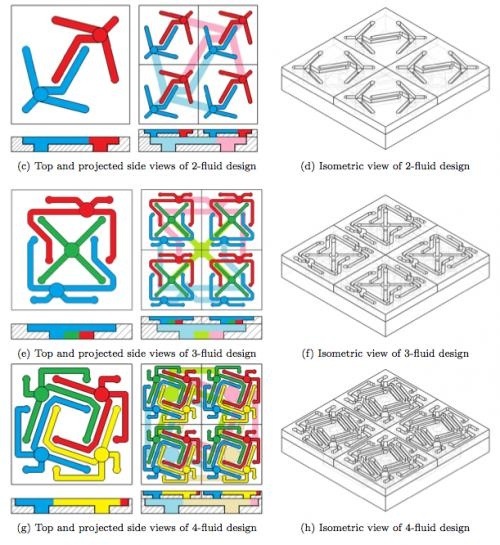
From molecules to gallons: Scaling up fuels created by artificial photosynthesis: Sabin Russell @ :phys.org
Ok so I’m a geek but I see this a neat and a form of artistry.

Self similar patterns, derived from nature’s models, provide a route to scale from meters to sub micron with features of self assembly and ‘natural’ scaling. Allowing fluids to flow in and out of a microscopic reaction site at macro-scales.

20130424-074717.jpg

20130424-074730.jpg

Wind vs. Solar … Advantage … Solar

To me it looks like wind power is a long term loser, I think the capital intensive and land intensive technology may be overtaken by solar…partly because solar seems much more amenable to new nanotechnology ‘helpers’ in comparison to the relatively old school large scale engineering materials tech that dominate wind … And it seems like their are many more complex scaling issues with wind in comparison to solar.20130420-131727.jpg

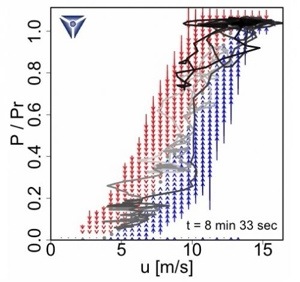
Screenshot … showing the power output vs. wind speed signals for a wind turbine. Credit: Patrick Milan, et al. ©2013 American Physical Society

20130420-132025.jpg

Shifting winds: A simulation shows the effects of turbulent wakes on downstream wind turbines. The turbulence affects air as high as a kilometer above the ground.
20130420-132339.jpg

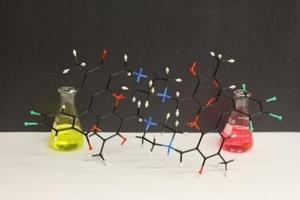
University of Chicago researchers have created a synthetic compound that mimics the complex quantum dynamics observed in photosynthesis. The compound may enable fundamentally new routes to creative solar light harvesting technologies. Credit: Graham Griffin

20130420-132625.jpg

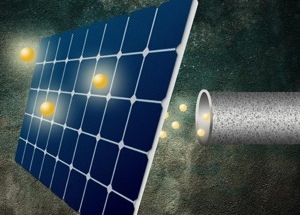
In a standard photovoltaic (PV) cell, each photon knocks loose exactly one electron inside the PV material. That loose electron then can be harnessed through wires to provide an electrical current. But in the new technique, each photon can instead knock two electrons loose. This makes the process much more efficient: In a standard cell, any excess energy carried by a photon is wasted as heat, whereas in the new system the extra energy goes into producing two electrons instead of one.

20130420-132902.jpg

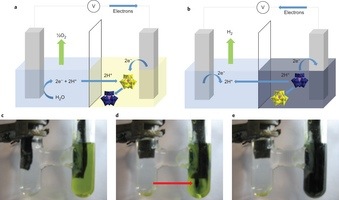
Schematic of the ECPB-based approach to water splitting. Credit: Nature Chemistry.
The process by which plants convert energy from the sun’s rays into chemical ‘fuel’ has inspired a new way of generating clean, cheap, renewable hydrogen
20130420-133252.jpg

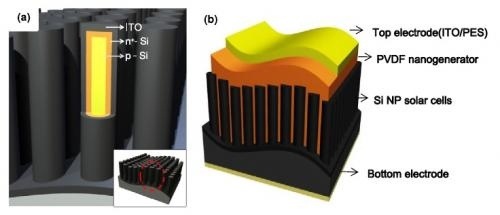
(a) Diagram of the silicon nanopillar solar cell. (b) Diagram of the hybrid energy harvester consisting of a piezoelectric nanogenerator integrated on to of a silicon nanopillar solar cell. Credit: Dae-Yeong Lee, et al. ©2013 IOP Publishing Ltd
20130420-133719.jpg

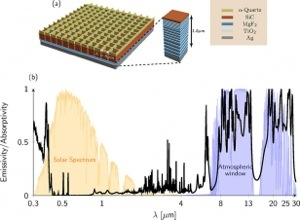
Stanford researchers are developing rooftop panels that cool buildings by sending heat back into space, a technique that could be more efficient than running an air conditioner from solar panels.

And if you look you will find much more of the same…in some areas of the world Solar is more cost effective than other albeit expensive sources and the tech tends to be small scale he scale-able and independent of higher level infrastructure, be it a national grid link or capital level finance, and it tends towards robust systems with local failures isolated … It seems likely this is the future and wind will be relegated to niche plays. Which could still be important…. 20130420-134815.jpg
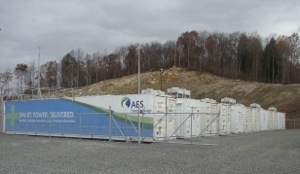
Batteries: Cheapest Form of Grid Power? Using a wind energy and expensive lithium-ion batteries, AES Energy Storage is making money by stabilizing the grid.

Why Tesla thrives while Fisker dives | MIT TR

20130406-093422.jpg

Tesla Model S

Tesla has had it’s ups and downs while Fisker has had it’s blips and boops, but Elon Musk’s (Tesla and SpaceX) has proven to be a serial innovator with a bloodhound nose for the right technical – business mash up. This MIT Technology Review piece comparing these two iconic eCar companies seems right on. And points to the government force fed A123 battery company as a compounding problem.

20130406-093432.jpg

Fisker Karma

Edited the title only…