The Physics Produced the Ship

The Dagger Design

Most fictional spacecraft are designed backwards. The writer decides what the ship needs to do dramatically, then invents a reason it can do that. The result is technology that serves the plot. Which is fine, until you need it to do something different in book three, at which point you quietly bend the rules and hope no one notices.

Engineers don’t do that. Not because we’re more disciplined — because we can’t. You don’t change the spec because the schedule is tight. You re-examine the architecture or you live with the constraint.

That instinct, applied to fiction, produces something different.


The principal auxiliary warship in the Sea of Suns universe is called a Dagger. Here’s how it got its name — and it wasn’t because I thought “dagger” sounded good.

The Transit system — the FTL drive in this universe — works through a rail. The rail is a linear gravity generator that manipulates quantum foam to open a wormhole large enough for the ship to pass through. The rail controls volume you can push through: the more mass you want to move between stars, the more rails you need. Compute controls speed: the transit step is a calculation, and the faster you want to step, the more computing capacity you need.

That trade-off isn’t decoration. It’s the architecture.

An auxiliary warship needs to be fast. In this universe, fast means compute capacity. Compute capacity takes up volume inside the vessel. So a fast warship is, almost by definition, a ship that has traded its interior for processors. Twin rails — enough to move a meaningful crew and weapons load — with almost every remaining cubic metre given over to compute. Crew of two to five on a thousand-foot vessel. Not much else aboard.

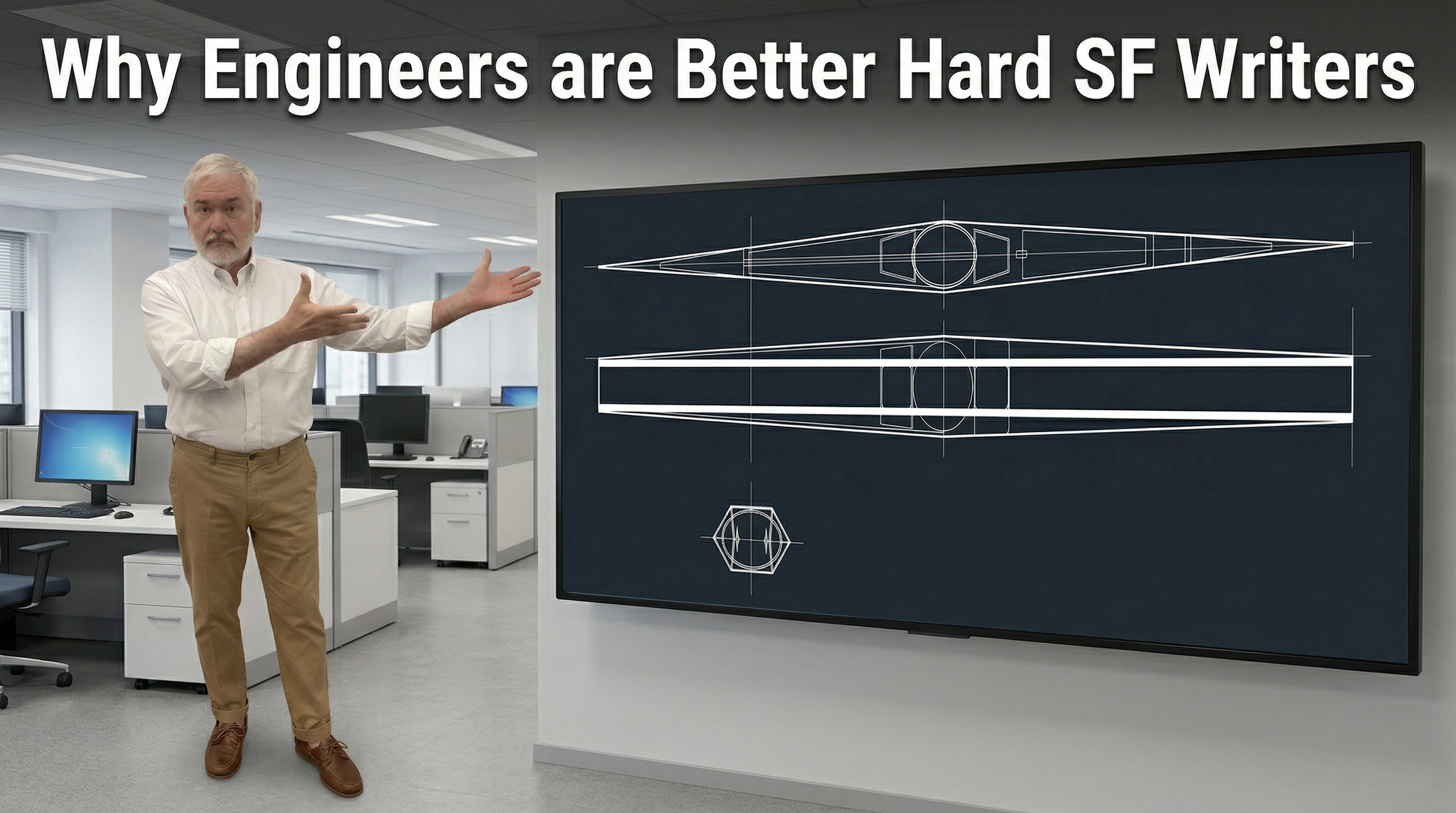
Now you have a ship that’s fast, carries almost no cargo, and spends all its operational time in real space. Real space means it’s detectable. A detectable warship needs stealth. The most effective passive stealth for a vessel in this universe is minimising cross-section — flat surfaces, minimal radar return. You sheath the hull in flat panels that force the profile into a long, slender blade shape.

The name isn’t metaphor. It’s a description of what the physics produced.

I didn’t design a cool warship and retrofit a justification. The constraints generated the vessel, and then the vessel generated scenes I hadn’t planned, because once you know what a Dagger can and can’t do, certain tactical situations become inevitable.


That’s the engineer’s advantage in hard SF, and it’s not what most people think it is.

It’s not technical accuracy. You’ve invented the technology — accuracy isn’t really the point. It’s that engineering training gives you a specific habit of mind: ask what the constraints produce, not what you need them to produce. Follow the logic. Let the system build itself.

When the system is honest, the world it generates is consistent without effort, because everything follows from the same rules. The Dagger’s tactical role, its crew size, its limitations, the scenarios it enables — none of that required invention. It came out of the trade-off.

The reader doesn’t need to understand the Transit physics to feel that the Dagger is real. They just need to encounter it behaving consistently with itself across the whole story. That consistency is what creates the texture that makes a fictional universe feel inhabited rather than constructed.

Thirty years of engineering taught me that coherent systems generate their own logic. Turns out that works in fiction too.


Why Engineers Write Better Hard SF is on The Unretired Engineer YouTube channel —

Stranded in the Stars, Book One of the Sea of Suns Trilogy, is available on Kindle. The Dagger appears early and often. https://www.amazon.com/Stranded-Stars-M-Harris-ebook/dp/B0GT123PLP

The Engineer’ Return to the Keyboard

Optimization, Systems, and Storytelling: Why I’m Back

It has been a while—twenty years by some counts—since I first sat down to bridge the gap between “This World” of high-tech engineering and the “Others” I build in my fiction.

For four decades, my world was defined by electronic packaging, power electronics, and project engineering for EVs in both the commercial and defense sectors. I’ve spent my time in the trenches of “Dilbert’s world,” working the real details that make everything from electromagnetic guns to nuclear electric space probes real. But as any engineer knows, a system is only as good as its last optimization.

During those 40-plus years, I was an intermittent author of fiction and science fiction, though at times the projects I worked on felt like fiction as well.

At 68, I was “unretired.” (You can see the genesis of this in my YouTube video, EVs Ate My Job.) Through my channel, The Unretired Engineer, I explore how a lifetime of technical rigor applies to the modern world. Now, I am bringing that same focus back to this blog and my novels. Writing is, after all, the ultimate engineering challenge: building a world from scratch that doesn’t collapse under the weight of its own physics.

What to Expect Moving Forward:

Technical Deep Dives: The “how-to” behind the tech in my books, like the propulsion systems in The Sea of Suns.

The Editing Trench: Updates on my current copy-editing passes for The Sea of Suns and the structural work on Under Siege.

System Reflections: Thoughts on remote work, optimization theory, and the reality of a 40-year career.

World Reflections: Perspectives on technology, civilization, and war based on four decades of study.

The Workshop: Occasional updates on making with wood, resin, and whatever else I’m tinkering with.

I’m no longer just “tinkering.” I’m building. Whether you followed me here from YouTube or found my work on Smashwords, I’m glad you’re part of the system.

Let’s see what we can build next.

Exotic Contraband – Lost among the stars…now on Smashwords and soon to be at iBooks, Nook Books, and more

The blade Stonewall approaching the spindle Athena making for a sungate

The blade Stonewall approaching the spindle Athena while making for a sungate jump point

Exotic Contraband:  Lost among the stars:  Aliens are real and they’re here. Unfortunately they aren’t here for intellectual stimulation, they’re here to make cold hard cash. And they aren’t interested in letting the authorities, theirs or ours, in on their racket.

This is the story of survivors lost in a universe that they hadn’t imagined, and the story of their rescue and return.

It’s only 99cents and a steal at many times the price if you enjoy a good read with a mix of hard and space opera sci fi with a little action and romance thrown in.  And why is that ship called the Stonewall?

See it all at Smashwords.

Mirasol (Butterfly Wing eReader Screen) out in Asia

An update from TechnologyReview regarding the Qualcom Mirasol based products.  Only in 5.3″ and all obviously based on the same hardware platform right now.  5.3″ is more in line with Asian tastes than US so it makes sense to focus there first  The long hang time (4 years from first hoopla) and small size indicate issues with the manufacturing technology, but nothing helps ManTech more than going to volume.  Hopefully 7, 9 and 11 inch units will follow soon.

Amazon and the law of the jungle

Mark Cooker the founder of Smashwords is also an epubs apostle, he’s out there selling the eBook revolution to the readers, writers and everyone in between.  He’s got a post up on Amazon’s new Kindle Direct Platform (KDP) is a Kindle only eBook platform that promises the author some part of a 500K / month pot depending on your percentage of downloads from KDP inventory, I suppose on top of the direct sales.  Now as he says himself he has a bit of a vested interested in dissing this because KDP because it cuts Smashwords out of part of the market but his point is that in essence its subtly anti author. Once on KDP you cannot sell through any other venue so you have to depend on Amazon being the principal sales channel for eBooks.  And this 1 limits your market, and 2 in the long term if Amazon ‘wins’ puts the author at the mercy of Amazon. 

Mark also points out that Amazon is pushing changes to the law about who can set the price on a book.  It appears as if Amazon has always wanted this power, rather than the publisher.  Now that may seem reasonable with Smashwords the author is the publisher, why shouldn’t the author of an eBook set the price?  If it’s too high then perhaps that’s the authors problem, not the distributor. The distributor still gets their cut for the books that are sold.

NaNoWriMo Day 17 Status

So todays version of Elgin is up at Smashwords, or should be shortly.   As before please have a look and let me know what you think. If you can plow through all the bad grammar, fumble finger mistakes, cut and paste snafu’s etc.   You can follow the links to the side they should get you there, and they also give you access to the Moon Dreams a sci fi thriller about the year after next year, and if you like that, Under Siege, a novel of the far distant future, where humans are still human far from the wreckage that was Earth.
  Cheers
 
Status from NaNoWriMo:
Target Word Count 50,000 Target Average Words Per Day 1,667
Words Written Today 1,071
Total Words Written 45,541  Current Day 17

Your Average Per Day 2,678

Words Remaining 4,459  days Remaining 14
Words Per Day To Finish On Time 319
At This Rate You Will Finish On November 18, 2011
 

NaNoWriMo Day 14 Status

So I’ve always had this problem, I have a picture of the arc of the story now, have various characters in place, more things to reveal.  etc, etc but I begin to wonder is it all too damn predictable.  If some has read to this point are they going to say, ‘oh I know how this all ends up, BORING.” I don’t think so but it niggles at me. 
 
NaNoWriMo Day 14:
Words Written Today  1,448
Total Words Written  41,414  Current Day  14
Your Average Per Day  2,958
Words Remaining  8,586 Days Remaining  17
Words Per Day To Finish On Time  506

At This Rate You Will Finish On  November 16, 2011

Target Word Count  50,000  Target Average Words Per Day  1,667


Elgin is up on Smashwords

Cover to my newest Novel
Cover to Elgin By M.A.Harris

So here is the cover I whined about spending a lot of Saturday working on, I think its pretty good. 

 
You should be able to click-through and get to the Smaswords page for the book and download the most current version.  I pulled up the ePub version, seems to work pretty well.  Saw several issues already but that’s what you get for getting the raw unedited form.
Don’t feel bad if you can’t make progress because of all the bad grammar and spelling.  But if you can plow through, suggestions would be welcome, I just won’t guarantee I’ll take them up.
 
Anyway here is the link to Elgin, again
 
 Regards
 

NaNoWriMo Day 12 Update

So I spent most of the day on this and only got 2,628 words written.  Yesterday I spent less time overall and put out a lot more words.  As per typical there is more than one reason, and writers block per se  was not one of them.  Mainly it was because I spent a lot of today doodling on my iPad creating a ‘professional quality’ (per Smash Words Style Guide) cover for Elgin. I love doodling on graphical projects, and especially on the iPad.  I started out trying to do a typical (atypical) swords and sorcery type cover with Elgin the Iffrit and Elgin the Cowboy etc, and this was stupid, I’m not an artist.  Then I started playing around with scenery and graphics do-dads and came up the the pretty cool cover you’ll all be seeing soon. 
While I was doing that I was pondering shifting the ‘publishing’ of the ongoing work the Smashwords, who have kindly made Meatgrinder and their site available to NaNoWriMo works.  Trying to do it on the web page is a bit of a pain since there is something hinky with the import of large blocks of word text into WP, almost undoubtedly me not the site but not something I’m going to bother fighting right now. 
Then of course was the fact that I was mucking around in my mind with the usual….you’re getting too long, too wordy, too discursive.  But then I went back and as of this time I really don’t know that I am.  Oh I can see sections an editor would say cut out, and they’d be right technically, but I have to wonder if the shibboleths of the day of physical type setting, or even physical paper and binding, should come across full force into eBooks, I like books that flesh out the character, that spend some time explaining things, describing things.  As long as they’re not boring.
 
Status from NaNoWriMo
Words Written Today  2,628
Total Words Written  34,332  Current Day  12
Average Per Day   2,861
Words Remaining  15,668  Days Remaining  19
At This Rate You Will Finish On November 17, 2011
Words Per Day To Finish On Time  82

Target Word Count  50,000  Target Average Words Per Day 1,667