The proposed Juno extended mission (EM) would take advantage of the natural northward progression of the periapsis of the spacecraft’s orbit and the consequent lowering of spacecraft altitudes over Jupiter’s high northern latitudes. The EM would run until the end of the mission, with an expected duration of approximately four years. Under the High and Medium Scenarios, propulsive maneuvers would be utilized not only to target Jupiter-crossing longitude and perijove altitude, as during the prime mission, but also to target close flybys of Ganymede, Europa, and Io. The flyby maneuvers would act to shorten the spacecraft orbital period, yielding more close passes of Jupiter within a given time interval, and increase the rate of northward movement of spacecraft perijove. Under the Low scenario for EM operation, the satellite gravity assists and close satellite flybys would not be attempted.
from the Senior Review
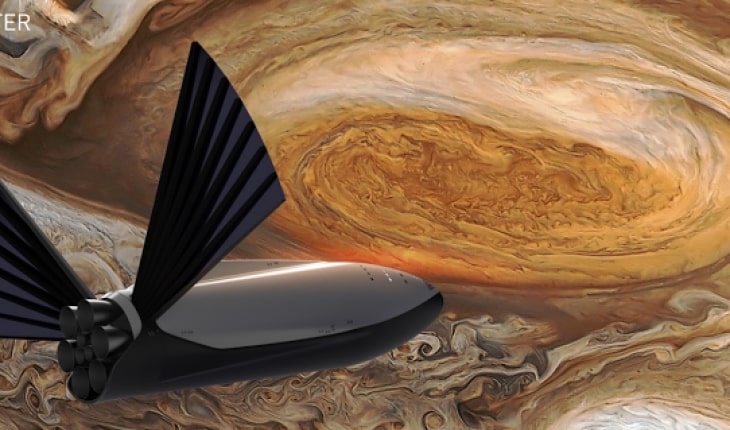
Exciting new data from Jupiter inbound over the next 5 years. Just in time for this….
I follow Centauri Dreams closely, it is a very good source on fascinating articles about what might be called the near universe and our ability to explore it. Dealing with the outer solar system and beyond, near future realistic interstellar exploration in all its technical gore.
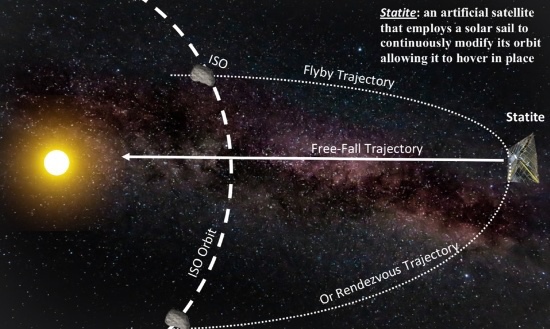
A recent article (A Statite ‘Slingshot’ for Catching Interstellar Objects by PAUL GILSTER on JANUARY 5, 2021) dealt with how to intercept/flyby interstellar objects (ISO) like ‘Oumuamua’ the icicleoid. This is very much in line with Arthur C. Clark’s classic (and my near all time favorite Science Fiction) Rendezvous with Rama, about the passage of a vast interstellar space ship through Sol system and a desperate dangerous mission to intercept and explore.
With current technology this appears impossible, you’d have to plan and launch a mission with a Falcon Heavy class craft in a few months to have any kind of chance. But there is a near term possible technology that makes it almost easy. The Statite is a ‘satellite’ that uses a solar sail to ‘hover’ instead of kinetic energy to orbit. Essentially this is storing energy and either the main vehicle or a cube sat sized sub satellite can be dropped straight down the gravity well to gain the velocity required to get the flyby in time. This is REALLY COOL stuff….
From the article, A Statite ‘Slingshot’ for Catching Interstellar Objects.
In the early days of space exploration it was the rocky planets, particularly Mars and Venus that held some hope of significant life. Though those with the tools of observation and analysis were pretty negative and life in the rest of the solar system looked impossible. But as our knowledge and tools expanded the icy moons quickly became of interest because as cold region natives know, ice is not a bad insulator and a couple of miles of it would protect a lake. These days it seems pretty clear that Icy Moons often have oceans, seas or lakes inside, and the heat that melts the ice from underneath (from orbital stresses and or radioactive decay) could quite conceivably support life.
The article linked discusses model based research based on data from earlier orbiters and flybys. It shows that notionally their are several mechanisms that could be feeding nutrients and energy sources into the ocean of Enceladus, at a rate suffient to support a significant biome.
There are lots of other interesting articles on space at universe today website, take a look.
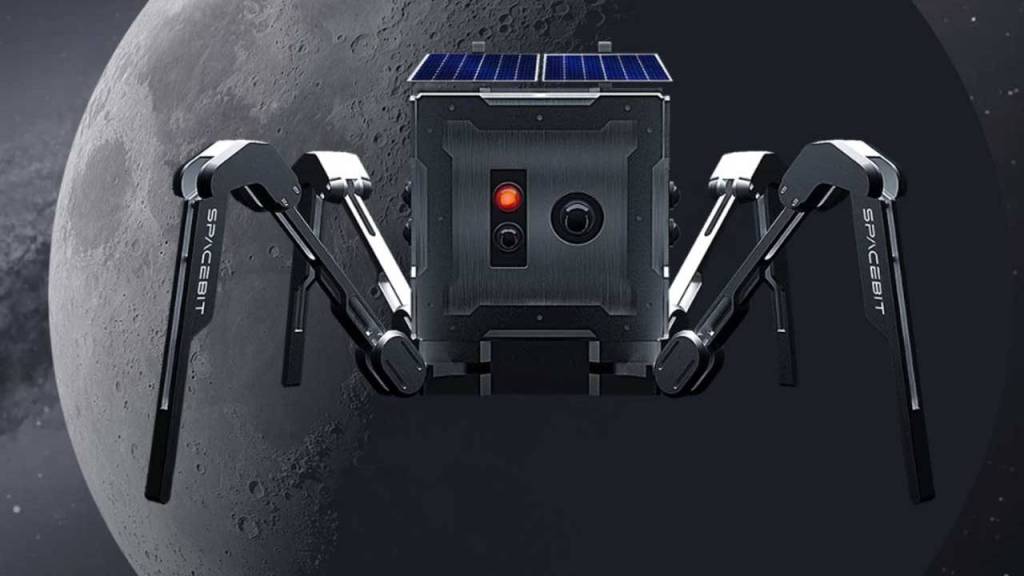
A really cool concept. Miniature walking rovers that can explore tiny spaces, a single test to the moon this year with plans for swarms (small ones) in the not too distant future. Tbe video animation from Spacebit is worth a couple of minutes.
So this seems crazy but in all honesty it has actually been a thing for a long time. It is mentioned in a lot of sixties/seventies SF not focused on space flight. It was seriously studied several times as a sort of replacement for parachute insertion of military force. And like most of those sorts of efforts there was a commercial concept to support the technology since the folks in the defense industry understood that military programs cannot support a robust industry on its own.
Just look at nuclear power, there was a reason that nuclear power stations evolved as the Navy came to realize they wanted nuclear ships. And there is a reason that small aircraft carriers and non nuclear submarines are anathema to certain parts of the Naval establishment. They know that if non nuclear CVs and SSs became common the industry required to support the nuclear fleet would become unaffordable.
People have already talked about the DoD buying Starships and using them as bombers / hypersonic weapons platforms. This is just turning the model above around.
Back in medieval times freighters and warships were the same thing, they just tacked on some fighting platforms and went at it with bows, crossbows, catapults, swords, etc. Even the Vikings probably started out as traders though always ready to ‘raise the black flag and slit a few throats’ if that looked like the right business strategy.
Anyway…sorry for the side commentary, it’s evening and I had a good dinner so I’m wandering a bit.
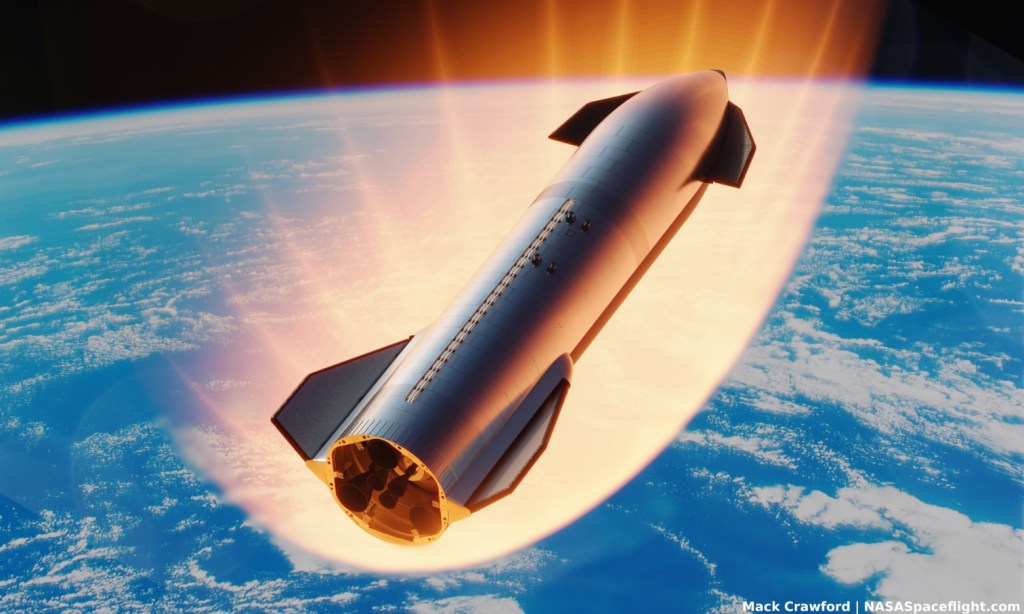
So, again anyway…if you look at it, a craft like the Starship, which has the performance as a single stage vehicle to haul 100 tons 10,000 miles in less than an hour has some attraction on its face….but in reality?
To my mind the most value dense time sensitive cargo is people but that’s years out at the least.
In the meantime are there cargos that are so time sensitive that something like a starship might make sense?
Couriered documents. Maybe
Mail. Does not seem like it.
Medical supplies only if the ship could land almost anywhere and take off again.
High value tech like chips? Maybe but 100 tons is overkill.
In fact most of the above are not 100 ton class cargos and frequency and flexibility of landing seem critical.
So dead on arrival? No there are customers who might pay for a a limited 100 ton capability. I think it would need to be anywhere in the world which is more than 10,000 miles but is probably within the capability of a modified Starship with more fuel and less cargo…or maybe an extended tank Starship could do 100 tons out to 18,000 miles (my wag of anywhere in the world from anywhere in the world.)
A somewhat smaller starship could do 10 tons 18,000 miles and probably land at just about any port or airfield as long as you can supply LOx and LNG, which is not that uncommon.
Go back to the start. If you burn a couple of hundred tons of LOx/LNG what is the cost? Does it make economic sense? Is it safe, is it going to be acceptable?
Economics:
LOx/LNG are in the same $/ton range as Jet fuel, you are burning a couple of times the fuel since you have to haul up the oxidizer with you and pay for that as well so say 4x the fuel bill.
The hull is in line with a modern airline.
If you can do a trip a day or so with support costs in the same range as a jet, it would appear to me that for the right cargo you could make it work.
Is it safe?
Well not right now but once the tech is wrung out ?? I think so.
the big difference is much higher energies than a jet.
But…your exposure time is a fraction of that of a jet over the same range. Accidents in mid flight are rare but generally lead to complete loss. Exposure time is probably the most important difference…advantage Point to Point
Ok so the major threat time is when you are near the ground around take off and landing, Those are shorter for the Point to Pointer.
And to me the difference in energy involved is immaterial…dead is dead and most of the time accidents of any magnitude in those phases are not survivable.
Accidents on the runway often have survivors but that is eliminated in the Point to Point case…up and down…no in between…
Acceptable?
Only time will tell, my guess is YES.
It will be a bit like the glamor days of the early airliners I would expect point to point for certain segments to be a real elite punch card
Especially as near earth space becomes an exotic but achievable location.
Sunrise at Boca Chica, SN9 on Launch Mount B being readied for the test campaign. Thanks to Mary and all the gang for keeping me sane.
So one of the things that has kept me a little bit sane this last 9 months is SpaceX, Starship, and 24 Falcon launches… All I have to say is WOW and thank you Elon!
I’m in the periphery of the electric car business and have been for over twenty years now. The only thing that made me a believer was Tesla.
I’ve been watching space since I sat in front of the telly as Armstrong stepped off the lunar lander. The first time I believed that the final frontier finally within grasp was watching SpaceX doggedly pursuing landing Falcon boosters.
I’ve been a big believer in sub surface transportation, in particular for cargo and rapid medium distance, since high school! And the first time I saw it really taken seriously was Elon’s Boring Company.
It is really hard to think of another great innovator who had such a broad impact in the world. Brunel maybe (Victorian England) Edison, Tesla, Marconi, the Wrights, Sikorsky, Johnson…they all did great things only Brunel had as broad as Elon Musk. Maybe some of the other engineer entrepreneurs of the 1850’s to 1950’s working in what would become industrial powerhouses might have been similar but a different time and public culture hid them…maybe it’s just that Elon’s working today and as a geek I gravitate to him and the search engines feed my observer bias.
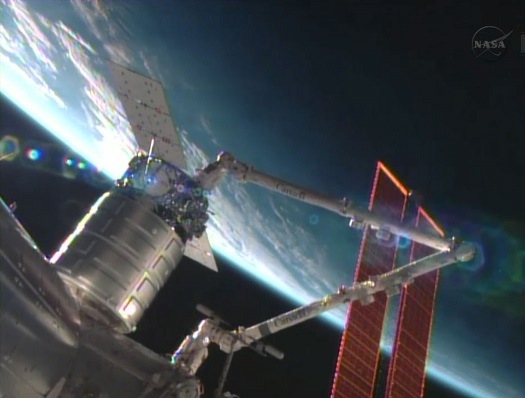
An Orbital Sciences Cygnus cargo ship reached the International Space Station early Sunday and was captured by the lab’s robot arm. The successful rendezvous marked a major milestone for NASA and a program to fund development of commercial cargo carries to replace capacity lost with the space shuttle’s retirement. (Credit: NASA TV)








 This World and Others