I follow Centauri Dreams closely, it is a very good source on fascinating articles about what might be called the near universe and our ability to explore it. Dealing with the outer solar system and beyond, near future realistic interstellar exploration in all its technical gore.
A recent article (A Statite ‘Slingshot’ for Catching Interstellar Objects by PAUL GILSTER on JANUARY 5, 2021) dealt with how to intercept/flyby interstellar objects (ISO) like ‘Oumuamua’ the icicleoid. This is very much in line with Arthur C. Clark’s classic (and my near all time favorite Science Fiction) Rendezvous with Rama, about the passage of a vast interstellar space ship through Sol system and a desperate dangerous mission to intercept and explore.
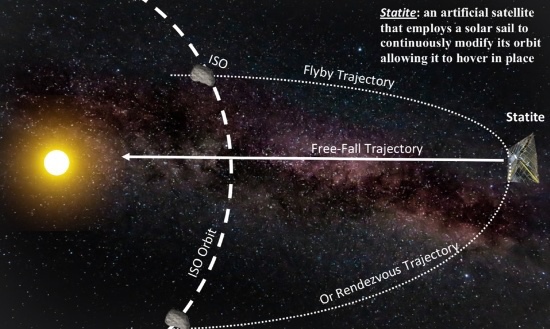
With current technology this appears impossible, you’d have to plan and launch a mission with a Falcon Heavy class craft in a few months to have any kind of chance. But there is a near term possible technology that makes it almost easy. The Statite is a ‘satellite’ that uses a solar sail to ‘hover’ instead of kinetic energy to orbit. Essentially this is storing energy and either the main vehicle or a cube sat sized sub satellite can be dropped straight down the gravity well to gain the velocity required to get the flyby in time. This is REALLY COOL stuff….
From the article, A Statite ‘Slingshot’ for Catching Interstellar Objects.
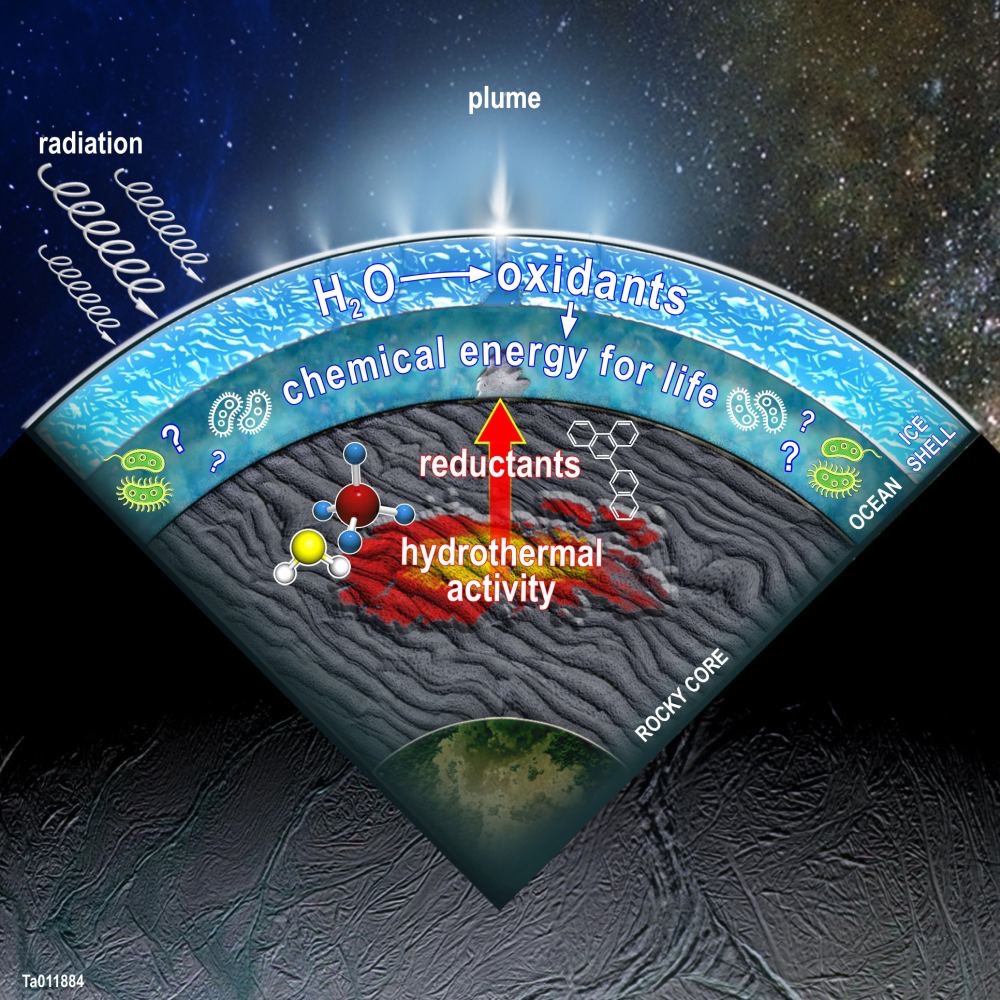
In the early days of space exploration it was the rocky planets, particularly Mars and Venus that held some hope of significant life. Though those with the tools of observation and analysis were pretty negative and life in the rest of the solar system looked impossible. But as our knowledge and tools expanded the icy moons quickly became of interest because as cold region natives know, ice is not a bad insulator and a couple of miles of it would protect a lake. These days it seems pretty clear that Icy Moons often have oceans, seas or lakes inside, and the heat that melts the ice from underneath (from orbital stresses and or radioactive decay) could quite conceivably support life.
The article linked discusses model based research based on data from earlier orbiters and flybys. It shows that notionally their are several mechanisms that could be feeding nutrients and energy sources into the ocean of Enceladus, at a rate suffient to support a significant biome.
There are lots of other interesting articles on space at universe today website, take a look.
Boston Dynamics Atlas doing parcur from an article in The Verge
The Boston Dynamics robots are at the point that they can do most things a human can in regards to locomotion. It is unclear how much beyond balance and moving is local to the robots as the thoroughly bounded arena makes clear but the basics of the body frame is there. Ability to manipulate the environment other than in the most basic way has not been demonstrated by Boston Dynamics but other companies are making huge strides in manipulators. Ability to sense and understand the environment is another huge step. Except that the sensors exist (autonomous cars etc). Leaving understanding the environment beyond a very limited ‘world.’ And that takes a brain, and that seemed a long way off….except is it?
From the article The picture above shows an inverted dome with a waterfall at is base pouring water into another circular waterfall. An interesting visual metaphor for the reinforced learning of many modern AI systems.
GPT3 would appear to be on the threshold of general purpose artificial intelligence. In the article it is noted that GPT3 is a brain in a box with no ability to sense or manipulate the environment without human intervention. But ‘wrapping’ those abilities ‘around’ GPT3 appears all but trivial. Given its ability to learn on its own would a Boston Dynamic’s wrapped GPT3 become something close to the robot of our dreams and nightmares. It certainly appears so.
Atlas’s is battery powered, I think, to the tune of an hour or so. GPT3 is instantiated on a huge computer network but both of those limitations are receding every day as computing power and battery storage continue to improve driven by their broad application across the tech scene.
Five years from now it would seem likely that the general purpose android robot will be a real thing. If built in quantity like say a Tesla 3 are you looking at $30K a pop? What does that lead to?
I want to make sure they understand that I for one welcome our dancing robot overlords.
So this seems crazy but in all honesty it has actually been a thing for a long time. It is mentioned in a lot of sixties/seventies SF not focused on space flight. It was seriously studied several times as a sort of replacement for parachute insertion of military force. And like most of those sorts of efforts there was a commercial concept to support the technology since the folks in the defense industry understood that military programs cannot support a robust industry on its own.
Just look at nuclear power, there was a reason that nuclear power stations evolved as the Navy came to realize they wanted nuclear ships. And there is a reason that small aircraft carriers and non nuclear submarines are anathema to certain parts of the Naval establishment. They know that if non nuclear CVs and SSs became common the industry required to support the nuclear fleet would become unaffordable.
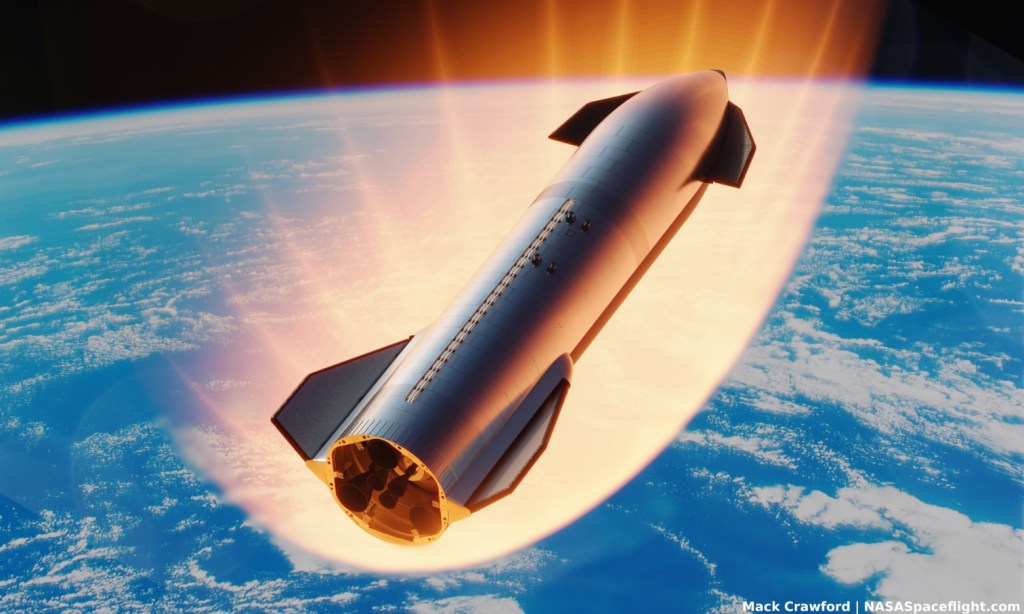
People have already talked about the DoD buying Starships and using them as bombers / hypersonic weapons platforms. This is just turning the model above around.
Back in medieval times freighters and warships were the same thing, they just tacked on some fighting platforms and went at it with bows, crossbows, catapults, swords, etc. Even the Vikings probably started out as traders though always ready to ‘raise the black flag and slit a few throats’ if that looked like the right business strategy.
Anyway…sorry for the side commentary, it’s evening and I had a good dinner so I’m wandering a bit.
So, again anyway…if you look at it, a craft like the Starship, which has the performance as a single stage vehicle to haul 100 tons 10,000 miles in less than an hour has some attraction on its face….but in reality?
To my mind the most value dense time sensitive cargo is people but that’s years out at the least.
In the meantime are there cargos that are so time sensitive that something like a starship might make sense?
Couriered documents. Maybe
Mail. Does not seem like it.
Medical supplies only if the ship could land almost anywhere and take off again.
High value tech like chips? Maybe but 100 tons is overkill.
In fact most of the above are not 100 ton class cargos and frequency and flexibility of landing seem critical.
So dead on arrival? No there are customers who might pay for a a limited 100 ton capability. I think it would need to be anywhere in the world which is more than 10,000 miles but is probably within the capability of a modified Starship with more fuel and less cargo…or maybe an extended tank Starship could do 100 tons out to 18,000 miles (my wag of anywhere in the world from anywhere in the world.)
A somewhat smaller starship could do 10 tons 18,000 miles and probably land at just about any port or airfield as long as you can supply LOx and LNG, which is not that uncommon.
Go back to the start. If you burn a couple of hundred tons of LOx/LNG what is the cost? Does it make economic sense? Is it safe, is it going to be acceptable?
Economics:
LOx/LNG are in the same $/ton range as Jet fuel, you are burning a couple of times the fuel since you have to haul up the oxidizer with you and pay for that as well so say 4x the fuel bill.
The hull is in line with a modern airline.
If you can do a trip a day or so with support costs in the same range as a jet, it would appear to me that for the right cargo you could make it work.
Is it safe?
Well not right now but once the tech is wrung out ?? I think so.
the big difference is much higher energies than a jet.
But…your exposure time is a fraction of that of a jet over the same range. Accidents in mid flight are rare but generally lead to complete loss. Exposure time is probably the most important difference…advantage Point to Point
Ok so the major threat time is when you are near the ground around take off and landing, Those are shorter for the Point to Pointer.
And to me the difference in energy involved is immaterial…dead is dead and most of the time accidents of any magnitude in those phases are not survivable.
Accidents on the runway often have survivors but that is eliminated in the Point to Point case…up and down…no in between…
Acceptable?
Only time will tell, my guess is YES.
It will be a bit like the glamor days of the early airliners I would expect point to point for certain segments to be a real elite punch card
Especially as near earth space becomes an exotic but achievable location.
Sunrise at Boca Chica, SN9 on Launch Mount B being readied for the test campaign. Thanks to Mary and all the gang for keeping me sane.
So one of the things that has kept me a little bit sane this last 9 months is SpaceX, Starship, and 24 Falcon launches… All I have to say is WOW and thank you Elon!
I’m in the periphery of the electric car business and have been for over twenty years now. The only thing that made me a believer was Tesla.
I’ve been watching space since I sat in front of the telly as Armstrong stepped off the lunar lander. The first time I believed that the final frontier finally within grasp was watching SpaceX doggedly pursuing landing Falcon boosters.
I’ve been a big believer in sub surface transportation, in particular for cargo and rapid medium distance, since high school! And the first time I saw it really taken seriously was Elon’s Boring Company.
It is really hard to think of another great innovator who had such a broad impact in the world. Brunel maybe (Victorian England) Edison, Tesla, Marconi, the Wrights, Sikorsky, Johnson…they all did great things only Brunel had as broad as Elon Musk. Maybe some of the other engineer entrepreneurs of the 1850’s to 1950’s working in what would become industrial powerhouses might have been similar but a different time and public culture hid them…maybe it’s just that Elon’s working today and as a geek I gravitate to him and the search engines feed my observer bias.
This image shows a drill core of volcanic ash-hydrated lime mortar from the ancient port of Baiae in Pozzuloi Bay. Yellowish inclusions are pumice, dark stony fragments are lava, gray areas consist of other volcanic crystalline materials, and white spots are lime. The inset is a scanning electron microscope image of the special Al-tobermorite crystals that are key to the superior quality of Roman seawater concrete. (Credit: Lawrence Berkeley National Laboratory and University of California at Berkeley)
From EDN(electronic Design News) a fascinating history of a WWII bomber remote control gunsight, and it’s failure, repeatedly, while the bureaucrats insisted on pushing it forward. Great things were done during WWII but not without cost and not without clearly showing the strengths an weaknesses of the bureaucratic ‘blue model’ way of doing complex programs (at the time the only practical method of management.)
An interesting discussion, at least for a futurist / SciFi writer.
If you know someone is x years old then you can know (generally) that they will almost certainly live y more years and will be almost certainly dead in z years.
However if you know a technology (defined almost as you like but embodying knowledge) is x years old then you can (generally) expect it to last at least x more years.
So as x gets larger Tlife gets longer but Plife stays the same…so aging, that is the rough measure of, age/life, is opposite for tech vs us biotypes… An interesting idea to roll into a story sometime.
A DUAL-USE technology is one that has both civilian and military applications. Enriching uranium is a good example. A country may legitimately do so to fuel power stations. Or it may do so illegitimately to arm undeclared nuclear weapons. Few, however, would think of concrete as a dual-use technology. But it can be. And one country—as it happens, one that is very interested in enriching uranium—is also good at making what is known as “ultra-high performance concrete” (UHPC).
Iran is an earthquake zone, so its engineers have developed some of the toughest building materials in the world. Such materials could also be used to protect hidden nuclear installations from the artificial equivalent of small earthquakes, namely bunker-busting bombs.
The above quote is from this wonderful Economist article, read it, as always clear prose, useful info well presented and minimal spin (&despite what some say that’s about as good as it gets spin wise if you want to explain/make a point.). It’s actually of general interest if you are interested in Civil Engineering or modern buildings and structures.
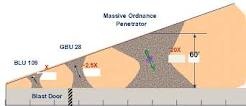
The point is that the US and others have been working on bunker busting for decades. The Massive Ordinance Penetrator shown dropping from a B52 above and in more detail below are the king of the hill right now.
Their reason for existence right now is to hold Iran’s nuclear bunkers at risk. The MOP is supposed to penetrate up to 200 ft of concrete:
The problem is that the work of Iranian engineers on tough concrete could mop up the MOP. The Iranians have added metal nano fibers and particles as well as fairly ordinary metallic, plastic and ceramic, whiskers, flakes etc to the mix to toughen the concrete in various ways. This work is being done to save lives world wide, including the US since it’s focus is on Earthquake damage reduction. But this is a wonderful example of dual use since exactly the same technology could make future bunkers all but impregnable to conventional weapons, which big as it is the MOP still is.
Bottom line if the best of the best tech were used they might get 6 or more times the strength and testing has shown just doubling concrete strength reduces penetration by more than half!
This is not good news and probably explains this: Congress ‘Urgently’ Approves $82 Million To Improve Its Biggest Bunker-Buster
Despite this: The 30,000-lb Massive Ordnance Penetrator Bomb Works So Well It Earned A Rare Honor
It would seem we may soon get a chance to see if the Iranians were smart enough to use the super concrete vs if our super bunker busters can slam, blast, burrow their way in. There is also the question of corruption, in a vastly corrupt civil society using expensive concrete which probably looks like any other concrete is an invitation for shaving. Many is the time when a fortress has fallen because of under spec materials. Also you have the long term espionage and internal strife driven sabotage the story is that bunkers for Nazi super Vengeance weapons were sabotaged by the addition of small amounts of sugar to the mix drastically weakening it.
This would all be a wonderful background for a comedic farce, if so many people’s lives were not at risk.










 This World and Others