Heck!? Why didn’t ______ think of that before? Care of: WIRED
Reply


Falcon 9 first stage burns an engine during a controlled descent to the Pacific Ocean. (Credit: SpaceX)

Falcon 9 first stage in a controlled descent toward the Pacific Ocean. At this point, the stage was about 3 meters (9.8 feet) above the water. (Credit: SpaceX)
“SpaceX then lit the center engine for a single engine burn. That relight also went well, however we exceeded the roll control authority of the attitude control thrusters. This particular stage was not equipped with landing gear which could have helped stabilize the stage like fins would on an aircraft. The stage ended up spinning to a degree that was greater than we could control with the gas thrusters on board and ultimately we hit the water relatively hard.
from the picture above it looks like it came pretty damn close! WOW!


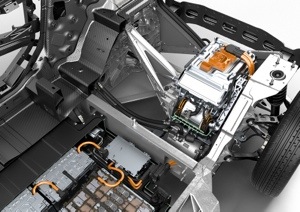 The i3 is BMW’s Ultimate Electric Driving Machine: BY DAMON LAVRINC 07.29.13
Wired question the “new age refrigerator” look but I like it.
Continues the trend showing that you need to design from the ground up…and know what you are doing…and what you want to emphasize when designing eCars.
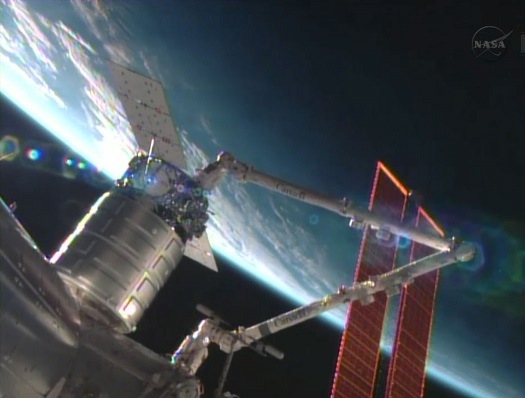

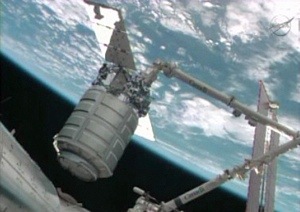
An Orbital Sciences Cygnus cargo ship reached the International Space Station early Sunday and was captured by the lab’s robot arm. The successful rendezvous marked a major milestone for NASA and a program to fund development of commercial cargo carries to replace capacity lost with the space shuttle’s retirement. (Credit: NASA TV)



4 Big Ideas in the New iPhones That No One’s Talking About : BY KYLE VANHEMERT : 09.11.13
Not sure no ones talking about them but they are not looking at it from the right perspective…or not consistently. The 5C points out that personalization is a critical element but does not require a plethora of hardware versions to accomplish. Look at where Google/Motorola went with their customizable shell. The 5S finger print sensor, activity monitoring sub system and stepped up camera all point to the iPhones purpose as the center of your digital life.
Apple continues to lead even as the handset proliferation continues apace. The phone you own if you are serious these days is the iPhone and while others will backfill in the wake its Apple that still leads.
The 5 family is probably still in line with the concepts that Apple evolved under Jobs’ leadership. Not to say the team at the helm are only turning the crank. It’s also not to say that Apple couldn’t stumble, could miss a new wave, but right now they are in the lead and I don’t see much in the way of useful Tech they have missed yet. The iWatch and iTV, so far as I can see, have no traction because the technology is not here to make them special in the way Apple needs for their brand identity.
The iPhone/iOS is the anti Android and it will remain that way, while others like Nokia/MS, Motorola/Android and I think Samsung, SONY and even maybe HTC and LG, will evolve towards a more Apple like model. In the end the serious contenders will be variations on the Apple model with highly secure products that are your digital core.

L. Brad King’s prototype of a ferrofluid ion thruster. When subjected to magnetic field, the points of the crown arise from a ring-shaped trench circling a one-inch block of aluminum. (Credit: Sarah Bird)
then an electric field is applied which makes the ‘points’ extend to nano scale and then emit ionic molecules at high velocity. Very neat, self forming, self healing, some scaling details to work out but this looks very promising. Another tech breakthrough from Air Force R&D.
AUGUST 30, 2013 Care of: Carnival of Space #317Billionaire Peter Thiel funds Positron Dynamics who are developing a 10 microgram per week antimatter factory
For planetary, early interstellar precursor and simple omniplanetary applications, ACMF (antimatter catalyzed fusion) exhibits the best performance. The reference case of a 1-year human round-trip mission to Jupiter with a 10 to 100 metric ton (mT) payload requires an antimatter quantity of 1 to 10 micrograms (μg). It appears as though this requirement could drop into the 1 to 10 ng range for payloads consistent with unmanned, planetary missions.
So fuel for a trip to Jupiter (in one year!) every week.
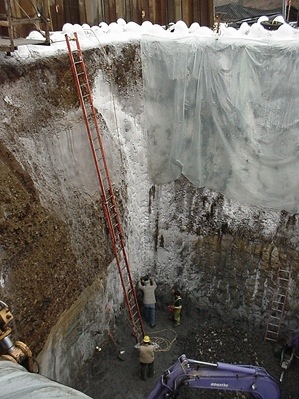 Cold storage: A freeze wall created for a construction project by the company SoilFreeze
How the Fukushima Ice Barrier Will Block Radioactive Groundwater
Japan plans to stop leaking radioactive groundwater at Fukushima with an underground wall of ice. Here’s how it would work. … Vertical pipes are to be drilled or driven into the ground at one-meter intervals, creating what looks like an array of sub-soil fence posts. Fourteen 400-kilowatt refrigeration plants would pump -20 °C to -40 °C coolant down each pipe to absorb heat from the ground, producing an expanding cylinder of frozen earth.
In roughly six weeks, those cylinders would fuse together to form a continuous barrier that keeps groundwater out and contaminants in. The result would be a solid barrier from the surface extending approximately 95 feet down to meet a low-permeability layer of clay and rock. And while it would require long-term chilling to endure, the wall is immune to power outages lasting days or weeks. “It would take months or years to thaw the wall out,” says Daniel Mageau, vice president and design engineer for Seattle-based contractor SoilFreeze.

“We have identified that the biggest barrier to commercialization of an innovation is confirming the competitive advantage for a customer when every factor is taken into account,” Deering told AEI. “So we refocused our engineering capability to provide precisely the expertise and resources required during this critical stage.”
Being small can be an advantage for the innovators. Torotrak itself doesn’t have volume manufacturing capability, but it has greatly increased its ability to supply prototype and pilot volumes to help its Tier 1 customers bridge this gap. “This helps a Tier 1 establish the technical and commercial viability of the technology while also creating a growing income stream for Torotrak,” explained company Chairman John Weston. “It’s an approach based on the commercial needs of Tier 1s, moving away from the traditional approach of trying to sell them a relatively unproven idea.”
But the tech applications are cool:
(1)For car applications, Torotrak’s technologies are aimed at downsized engine solutions and hybridization (via flywheel systems) where the designs offer cost and packaging benefits. Its V-Charge variable-drive supercharger for gasoline and diesel engines, now entering a new test and demonstration phase of the latest V2 version, is claimed to be capable of boosting torque from zero to 95% in less than 400 ms, which overcomes one of the liabilities of engine downsizing.
(2)A flywheel-based energy storage system developed by Flybrid Automotive, a company in which Torotrak holds a 20% share, is claimed to deliver performance that is similar to established HEV powertrains with superior packaging, at about one-third the cost.
…(though) “An electric system typically has a large battery and a useful range with the IC engine completely switched off; a flywheel application does not.”
… Flybrid’s flywheel system will propel a vehicle for about half a mile – not impressive per se but very useful in managing the engine operating point. The flywheel could be used to power the car in parts of the drive cycle where the engine would be inefficient…
Ars techica: NASA test-fires 3D printed rocket parts: low cost, high power innovation
Propulsion engineers focus on R&D and pushing new tech into private industry.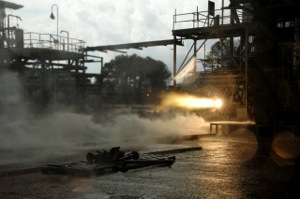
A 3D-printed injector plate delivers 20,000 lbs of thrust in a hot-fire test on August 22.
NASA
Fidelity is an issue with 3D printed parts, even using advanced techniques like DMLS. (direct metal laser sintering) Greg Barnett, the lead propulsion engineer on the project, … “The surface is a little rougher,” he explained; however, those variations are within a consistent range and can be compensated for in the design. …
The test results on the 3D printed components have been extremely positive; Barnett and Williams told Ars that the 3D printed injector is equivalent in performance to the traditional machined one. The next step is to move on to an injector with more elements, which will mean testing with more power.
3D printing—or “additive manufacturing,” as it’s called when you get industrial like this—is seen by NASA as a vital way to keep rocket component development costs down. In a lot of ways, the ability to rapidly prototype via DMLS harkens back to the Apollo-era development method of fast physical iteration. Rather than spending a tremendous amount of time performing deep, computer-based analyses of rocket components, NASA can rough in a design and then print and test a component within hours or days.
The deep analysis and simulation tools are still available and still used, but the months- or years-long physical manufacturing time is drastically reduced. This gives engineers the flexibility to design and build in the most optimal fashion. They can use complex software analysis where necessary, but they don’t have to rely solely on computer modeling.
In the days of Apollo, NASA operated with effectively unlimited funding, which it used to create a nation-wide army of contractors with tremendous manufacturing capabilities. Design-by-iteration was feasible because there was so much design going on. These days, the picture is entirely different. “It’s almost a cultural issue,” explained Williams, “where a part can cost so much, you get into what I call ‘analysis paralysis.'” Without additive manufacturing, prototype rocket parts that can withstand actual hot-firing can cost so much and take so long to produce that when you finally get a physical component to test, you’re already hoping the tests show that it’s perfect—otherwise it would take too long to redesign. With additive manufacturing, that paralysis goes away, and engineers can iterate as needed on actual physical components.
Ingenuity unleashed, development accelerated, designs simplified…the power of 3D printing.
 This World and Others