So I love the old StarGate series and one of the icons of the series was the use of the FN P90 bull pup machine pistol with its 50 round transparent plastic magazine on the top of the barrel, just popping off the bad Egyptian dudes by the dozens.
The reality was that this French sponsored weapon was not just a prop. Developed in the 80’s as better than a pistol, sub machine gun or rifle for vehicle crews and security forces . Something with the ability to penetrate bullet proof vests, carry a lot of rounds, but not load the soldier down or make a big visual impression.
The core of this is the 5.7×28 mm round…a center fire 22 pistol round. With the ability to accurately hit and penetrate at moderate range. A 9in (ish) barrel in a bull pup kept the weapon short. The plastic magazine was bizarre but worked, stacking the rounds sideways with a ramp/pivot to feed the rounds into the chamber. It doesn’t sound like a great idea but apparently it was engineered well and does the job reliably while providing 50 rounds.
The 5.7×28 round has started to make an impact with the current interest in self defense and concealed carry. The Ruger 57, the FN 57 pistol both are modest successes and deservedly so. Now KelTec kicked it up a whole lot with this 5.7x28mm Maxi Pistol…really a bit of a competitor to the P90 which may be out of print now. It is a wild take on what is supposed to be a personal ‘side arm’ but it certainly makes an impression.
A blog tag to an article I did not read set me to thinking today. Read on if you think that the Net today is fraught with societal risk.
I have been using the WWW, Internet, since a couple of years after its start as ARPANET and MilNet for email and data transmission. Following it through the years I saw the slow exploration then the exuberant exploitation through the 80’s and 90’s even the 0ughts.
One of the things I had a hard time understanding was the effervescent froth about how this was freedom and that governments could never control it. When governments where the entity that installed it and ran it in many places. There are arguments in support of a weakish case for net freedom but for the masses it is not and will never be a truly open commons.
A big part of this is because of the way most people interface with the Net. They use it like they use a car, get in and drive, many times not knowing a thing about internal combustion engines, transmissions, etc. They are not technically savvy people, but then even people like me, an engineer, thirty plus year user of the Net, do not understand the ‘stacks’ on ‘stacks’ that are the interwoven hardware, firmware, protocols and software that makes the Net hum.
In the early days the Net was about Protocols, eMail and Hyperlink were two critical protocols that enabled communication and the creation of documents (Still, though they are called, Blogs, or Sites) that could be read out of sequence and include incredible depths of information that were simply impossible with a book or the like.
This early Net was dynamic and boisterous but largely a land of technical folks, academics, geeks and nerds. It was a natural environment for them in a way only the still evolving desktop computer had been until then.
After a while businesses started to move in and the media started to look at this as a way of distributing their content without the cost and logistic drag of newsprint, TV stations or even radio. Of course what most did not see coming was that the net would make their old advertiser supported business model very difficult to support over the long term while giving new Platforms (AOL and their ilk, now TWITTER, FACEBOOK etc) a leg up as essentially the new middle man between the consumer and ‘the content.’
But even at the start with AOL et al, some philosopher technical types pointed out that these Platforms ,while they gave Joe User an easy path to the internet, put a barrier between the user and the broader Net. Some like me never went down the platform path because we wanted the depth of the Net in the raw as it were but we pay the penalty of having to work harder to get things that Platform users get for free.
Twenty years on Facebook and Twitter have paved over the Net to a very significant degree. They started as just social networks with different focuses. But they have become the principle distributor of news and opinion. They have sucked up adjacent Net onramps in their fight to gain share and suppress competition. Now they lust after your data so they can sell it to the highest bidder, while using it, somewhat unintentionally to wrap the users in ever thicker cocoons of confirmation bias. They have also strangled the legacy media in its bed by stripping away the advertiser revenue.
Why?
I see 3 main reasons, ease of use, addictive content and the network affect. Ease of Use: You might argue that some of them are not that easy today but in the beginning essentially each of them was drop dead simple, so simple a tweener cheerleader could use it in ten seconds or less. Addictive Content: Most of these tools make something you want to do easy and provide reinforcing feedback, if your tweet goes viral to a 1000 people, woohooo! If your facebook post gets a like from a dozen friends, charge UP! This is addiction. Network affect: Simply stated, a network of 10 people has 100 interconnects, 100 people have 10,000 interconnects, the more people on a platform the more valuable it is to the user as well as the owner. Since you have limited time in your life, you cannot copy identical on multiple platforms going along. Then the platforms will make it hard for you to migrate from them with your list of friends, follows, photos, blogs, whatever.
So?
The title of the article I mentioned at the start said something about Protocols vs Platforms and this was one of those epiphany things you hear about. AHA!
Platforms are largely just Net hubs and they hate open protocols because it will reduce them to pipes and strip away their ability to siphon off value from the users, both consumer and creator.
Facebook or Twitter are just Protocols of Protocols with a software wrapper. Their core are proprietary protocols & software, not open protocols so that competition is impossible. The network affect and the users addiction to the particular flavor of Platform makes changing essentially impossible.
But if the Platforms are required to open their protocols and enable users to migrate their core identity the monopoly would be broken without destroying the user side value. One could even see an anti monopoly order that required some kind of Baby Twitter / Baby Facebook disaggregation that requires the ‘Babies’ interlink and compete.
This seems relatively clear cut process . It would provide the users with competition for their core value that is simply not there today. And while it will hurt the stockholders (who are earning monopolist profits today) it does not strip their assets while providing the opportunity to earn significant returns going forward.
The NonCommons of today, the Platforms, are a tragedy for the users in that their value is stripped without much recompense beyond ease of use. If we go back to the roots of the Net, open protocols, and user value, we have a chance to build back better….and make the Net great again.
“Thus, gene therapy treatment of only a few nervecells stimulated the axonal regeneration of various nerve cells in the brain and several motor tracts in the spinal cord simultaneously,” says Dietmar Fischer. “Ultimately, this enabled the previously paralyzed animals that received this treatment to start walking after two to three weeks. This came as a great surprise to us at the beginning, as it had never been shown to be possible before after full paraplegia.”
So the Naval Strike Missile, a middle weight anti ship missile will be mounted on an Amphib to provide integral defense and a little bit of offense capacity. The main purpose of this deployment is for experimentation with the fleet, to see if it changes the nature of the game when at sea. The Amphib is a big ship but is in essence a sea going ferry for the marines, a fast freighter. But these ships are big and impressive and sometimes used to show the flag. They have defensive weapons but nothing to ‘shoot the archer’ usually that is left to an escort. Having some rounds on board would change the dynamics and utility perhaps in a positive way.
While the preliminary deployment will have the missile amidships like a warship might. But the missile could be mounted on a truck that is being transported, just drive it out onto the flight deck, lock it down and shoot. With all sorts of truck mounted ordinance such as Hellfire, 155mm Cannons, HIMARS GPS Guided Rockets, there are a lot of options that this could provide for protection or force projection.
With the continued growing cost of specialized warships this sort of flexible tactical utilization looks like a good use of modern precision weapons. One can and should argue that it does not provide any kind of one for one replacement for a warship. But is a warship; a frigate, destroyer, cruiser… really what we need? Maybe its a combination of gnat weight autonomous missile slingers supporting heavy flex fighters like this Amphib.
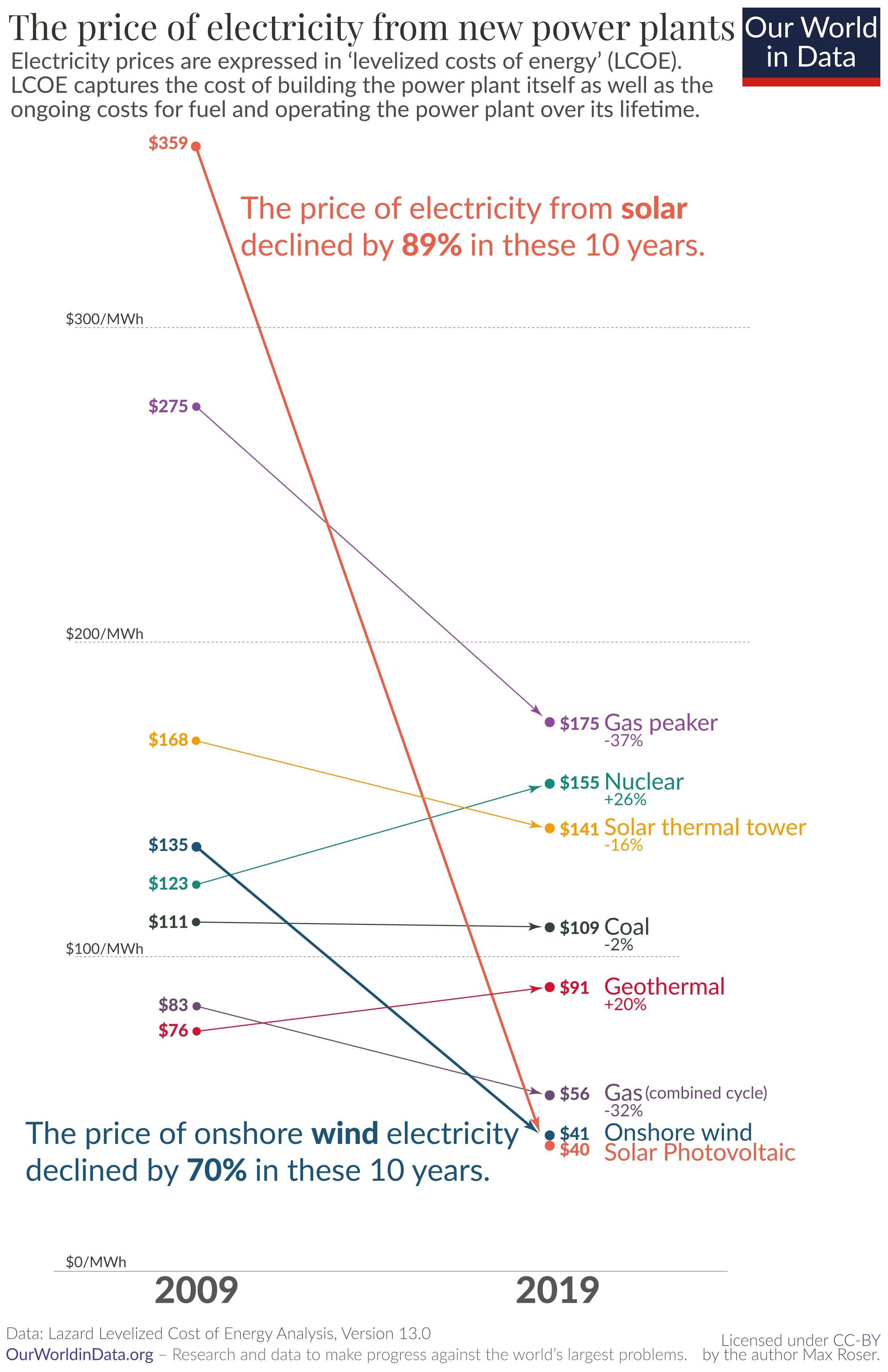
Our World In Data chart, via SingularityHub By Jason Dorrier – Dec 13, 2020This has been in the news but discounted in some ways utility side issues still make this a success story the utilities could do without. A couple of general downside views. Solar modules are a troubling refuse stream until recycling tech hits new highs. The cell modules wear out over time, the wear out and $payback often overlap in the wrong way. Both of these issues should ease in the coming years but you cannot discount them yet. Still this is amazing and it seemed obvious at least 5 years ago, nice that it kept on trend.
Boston Dynamics Atlas doing parcur from an article in The Verge
The Boston Dynamics robots are at the point that they can do most things a human can in regards to locomotion. It is unclear how much beyond balance and moving is local to the robots as the thoroughly bounded arena makes clear but the basics of the body frame is there. Ability to manipulate the environment other than in the most basic way has not been demonstrated by Boston Dynamics but other companies are making huge strides in manipulators. Ability to sense and understand the environment is another huge step. Except that the sensors exist (autonomous cars etc). Leaving understanding the environment beyond a very limited ‘world.’ And that takes a brain, and that seemed a long way off….except is it?
From the article The picture above shows an inverted dome with a waterfall at is base pouring water into another circular waterfall. An interesting visual metaphor for the reinforced learning of many modern AI systems.
GPT3 would appear to be on the threshold of general purpose artificial intelligence. In the article it is noted that GPT3 is a brain in a box with no ability to sense or manipulate the environment without human intervention. But ‘wrapping’ those abilities ‘around’ GPT3 appears all but trivial. Given its ability to learn on its own would a Boston Dynamic’s wrapped GPT3 become something close to the robot of our dreams and nightmares. It certainly appears so.
Atlas’s is battery powered, I think, to the tune of an hour or so. GPT3 is instantiated on a huge computer network but both of those limitations are receding every day as computing power and battery storage continue to improve driven by their broad application across the tech scene.
Five years from now it would seem likely that the general purpose android robot will be a real thing. If built in quantity like say a Tesla 3 are you looking at $30K a pop? What does that lead to?
I want to make sure they understand that I for one welcome our dancing robot overlords.
So this seems crazy but in all honesty it has actually been a thing for a long time. It is mentioned in a lot of sixties/seventies SF not focused on space flight. It was seriously studied several times as a sort of replacement for parachute insertion of military force. And like most of those sorts of efforts there was a commercial concept to support the technology since the folks in the defense industry understood that military programs cannot support a robust industry on its own.
Just look at nuclear power, there was a reason that nuclear power stations evolved as the Navy came to realize they wanted nuclear ships. And there is a reason that small aircraft carriers and non nuclear submarines are anathema to certain parts of the Naval establishment. They know that if non nuclear CVs and SSs became common the industry required to support the nuclear fleet would become unaffordable.
People have already talked about the DoD buying Starships and using them as bombers / hypersonic weapons platforms. This is just turning the model above around.
Back in medieval times freighters and warships were the same thing, they just tacked on some fighting platforms and went at it with bows, crossbows, catapults, swords, etc. Even the Vikings probably started out as traders though always ready to ‘raise the black flag and slit a few throats’ if that looked like the right business strategy.
Anyway…sorry for the side commentary, it’s evening and I had a good dinner so I’m wandering a bit.
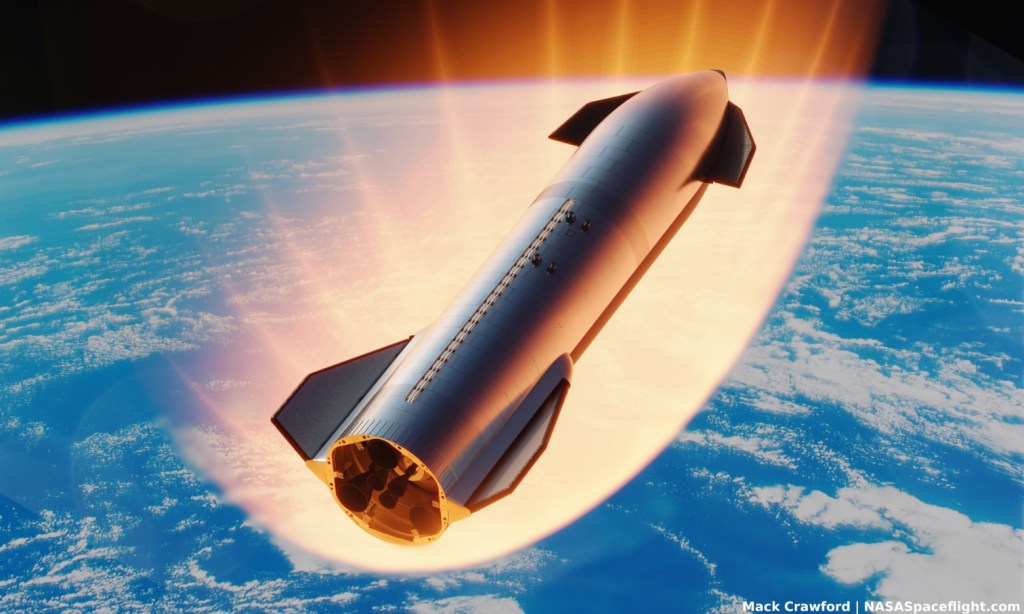
So, again anyway…if you look at it, a craft like the Starship, which has the performance as a single stage vehicle to haul 100 tons 10,000 miles in less than an hour has some attraction on its face….but in reality?
To my mind the most value dense time sensitive cargo is people but that’s years out at the least.
In the meantime are there cargos that are so time sensitive that something like a starship might make sense?
Couriered documents. Maybe
Mail. Does not seem like it.
Medical supplies only if the ship could land almost anywhere and take off again.
High value tech like chips? Maybe but 100 tons is overkill.
In fact most of the above are not 100 ton class cargos and frequency and flexibility of landing seem critical.
So dead on arrival? No there are customers who might pay for a a limited 100 ton capability. I think it would need to be anywhere in the world which is more than 10,000 miles but is probably within the capability of a modified Starship with more fuel and less cargo…or maybe an extended tank Starship could do 100 tons out to 18,000 miles (my wag of anywhere in the world from anywhere in the world.)
A somewhat smaller starship could do 10 tons 18,000 miles and probably land at just about any port or airfield as long as you can supply LOx and LNG, which is not that uncommon.
Go back to the start. If you burn a couple of hundred tons of LOx/LNG what is the cost? Does it make economic sense? Is it safe, is it going to be acceptable?
Economics:
LOx/LNG are in the same $/ton range as Jet fuel, you are burning a couple of times the fuel since you have to haul up the oxidizer with you and pay for that as well so say 4x the fuel bill.
The hull is in line with a modern airline.
If you can do a trip a day or so with support costs in the same range as a jet, it would appear to me that for the right cargo you could make it work.
Is it safe?
Well not right now but once the tech is wrung out ?? I think so.
the big difference is much higher energies than a jet.
But…your exposure time is a fraction of that of a jet over the same range. Accidents in mid flight are rare but generally lead to complete loss. Exposure time is probably the most important difference…advantage Point to Point
Ok so the major threat time is when you are near the ground around take off and landing, Those are shorter for the Point to Pointer.
And to me the difference in energy involved is immaterial…dead is dead and most of the time accidents of any magnitude in those phases are not survivable.
Accidents on the runway often have survivors but that is eliminated in the Point to Point case…up and down…no in between…
Acceptable?
Only time will tell, my guess is YES.
It will be a bit like the glamor days of the early airliners I would expect point to point for certain segments to be a real elite punch card
Especially as near earth space becomes an exotic but achievable location.
An act of cyberwar is usually not like a bomb, which causes immediate, well-understood damage. Rather, it is more like a cancer – it’s slow to detect, difficult to eradicate, and it causes ongoing and significant damage over a long period of time. Here are five points that cybersecurity experts – the oncologists in the cancer analogy – can make with what’s known so far.
Description of who, how, what at least in general terms and a thoughtful overview of how to start thinking about the impact and meaning.
To me this attack seems just part of the reality we live in. As discussed in Modes of War, this is one of the modern modes that are more about gains and pains than blood and gore. This sort of strike, ignored and multiplied, could bring a nation down and given the context of reality today, direct kinetic action is highly unlikely.
Sunrise at Boca Chica, SN9 on Launch Mount B being readied for the test campaign. Thanks to Mary and all the gang for keeping me sane.
So one of the things that has kept me a little bit sane this last 9 months is SpaceX, Starship, and 24 Falcon launches… All I have to say is WOW and thank you Elon!
I’m in the periphery of the electric car business and have been for over twenty years now. The only thing that made me a believer was Tesla.
I’ve been watching space since I sat in front of the telly as Armstrong stepped off the lunar lander. The first time I believed that the final frontier finally within grasp was watching SpaceX doggedly pursuing landing Falcon boosters.
I’ve been a big believer in sub surface transportation, in particular for cargo and rapid medium distance, since high school! And the first time I saw it really taken seriously was Elon’s Boring Company.
It is really hard to think of another great innovator who had such a broad impact in the world. Brunel maybe (Victorian England) Edison, Tesla, Marconi, the Wrights, Sikorsky, Johnson…they all did great things only Brunel had as broad as Elon Musk. Maybe some of the other engineer entrepreneurs of the 1850’s to 1950’s working in what would become industrial powerhouses might have been similar but a different time and public culture hid them…maybe it’s just that Elon’s working today and as a geek I gravitate to him and the search engines feed my observer bias.
So linked at the bottom is a file by the congressional research service regarding the progress the Navy is making on laser weapons, rail guns and hyper velocity smart munitions. Not the best topic for Christmas Season but oh well.
A series of articles in the Drive and elsewhere have discussed the progress in laser weapons over the last few years. To recap, a technology that was discovered as a fairly early practical application of quantum theory evolved into an important digital communications tool where the demand for longer distance between repeaters drove the power up to a point where cutting material like paper was practical that evolved into cutting steel which provided the basis for weapons grade systems although the military R&D complex had been exploring alternative paths for decades.
Now real systems (in the sense of shooting down light weight drones or setting outboard motors on fire, as well as dazzling or spotting) are being deployed and fairly aggressive plans are being made. There still remain problems with the technology though many of them are resolvable. And like earlier many pieces are being worked on for civilian reason, not the least in the field of astronomy where light transmission through the atmosphere is important and the brain power is deep and unfettered by military R&D issues.
In the end it is not clear that at sea is the best place to locate a laser weapon but ships are (relatively) big and have (relatively) large power systems so they are a good early trial. If lasers can be of value there they are going to make it other places as the technology improves.
Rail guns…what can you say (I could say a fair amount but won’t) they are the technology of the future and have been my whole adult life. I spent a couple of years involved with them and that is enough to tell me that there are a lot of fundamental problems that appear surmountable in early hand waving but are practically insurmountable as you get closer and closer to reality.
The ‘rail’ part of the gun has most of the problems of a powder gun barrel of erosion, fatigue, stress, compounded by huge electromagnetic forces in the metal itself. Vastly more complex than a simple bang tube. The energy required is huge but not only that it has to be released in a controlled manner at several times the rate of an explosion since the energy and the power are both higher than the propellant ‘burn’ of a powder weapon. Modern power electronics can handled this but they are not light and the resultant waste heat instead of exiting the barrel in a plume of plasma is retained in the energy storage device and switching system, none of which can be dowsed with water like you can do with a gun barrel.
Every 5 years or so since the seventies the rail gun has popped up as a candidate to replace the powder cannon of the day. Each time more of the hurdles identified in the last round are knocked down. But then new hurdles appear, often more complex than those dealt with and hidden by the earlier barriers.
And at the end of the day is the result worth the price? In WWI and WWII guns of prodigious range were developed but made no difference in the end. Mostly filling in for fighter bombers when the weather was crappy or the target too diffuse to be worth risking a pilot/aircraft.
In the early days (the 1970’s) of the rail gun its potential range and rate of fire appeared very attractive especially for Naval support gunfire. 100 miles and 10 rounds a minute of lethal kinetic punch were very much of interest to the amphibious forces. Since they were powered by electricity and fuel is relatively cheap + plentiful and the rounds compact, the ‘depth of magazine’ was fantastic. And all of this is still deeply interesting. But. In the end is this really what you need? In WWII through Desert Storm this capability set would have been game changing. Today? Maybe not.
The round designed (successfully) for the rail gun, can fit in any of our current 155mm class cannons. These guns with their 52 caliber barrels can punch the round out to 40 miles or more. The round is guided and has shown the ability to shoot down a cruise missile ! So it is as accurate as you like. It’s ‘shortfall’ in modern ops game theory is that it is a bit slow for shooting down ballistic missiles or reaching the outer theater to shoot down other high performance targets. But there are missiles that can do that and the attrition cost of a missile on that sort of target is worth it.
40 miles is not 100 miles, some targets are out of reach, you cannot stand off as far or reach in as far to destroy targets. But in reality is that an issue? If you think that you are going into amphibious war against hostile beaches maybe. But you have to assume that you can destroy the enemies area denial defenses (Because otherwise why worry about 100mile standoff?) so you can get the amphibious forces in close enough to get on and over the beach at acceptable cost. None of that appears realistic today. While some kind of Eurasian Fascist Empire and air tight anti strategic defenses might create an existential threat that triggered WWIII and the concomitant bloodbath this scenario is simply not on the table now or foreseeable in the next twenty years.
For now we have Taiwan and the South China Sea as the most likely battleground for near peer conflict. ——— OK no one ever really KNOWS what is coming next, the Med, the Baltic, maybe somewhere in Oceana might go south with zingers but none of those have the deep resources required to cause an existential threat or survive an attrition campaign long enough to make the rail gun a potential player——
To continue, while T and SCS are both in their way an argument for that extended range neither is going to be resolved in any way by one weapon. Neither are any other scenarios one might game other that EFE+ATSD above and that ain’t goin to happen (yet.)
So? Lasers…full speed ahead, look to the sky, 150kW on a fighter is a game changer. Rail guns…spend some money, let the Chinese trial their barge, see if they have solved the problems, they haven’t but what do I know? Hyper (or High) velocity smart munitions,…go, go, go power rangers !










 This World and Others