A little air, a bit of heat, some light

What Global Warming? 148 New (2020) Scientific Papers Affirm Recent Non-Warming, A Degrees-Warmer Past at WattsUpWithThat

Climate Change Horror Porn is another tool of the apparat to frighten us. In realty there is an objective truth out there…none of us know it. Two sides largely aligned Left and Right though not precisely have taken sides and because the liberal left is ascendant and deeply intwined in academia and the media they are trying to ‘scare us straight.’ It might be well intentioned in many cases, but ideologues, abusers, users and grifters have gathered around a powerful ideological tool that can be used to manipulate the population.

  • The science such as it is….which is a lot…but not what you are told it is by the media and the ideologues who want to use it.
    • Climate science
      • What climate was/is/will be:
        • Is based on models of how the whole atmosphere, hydrosphere and lithosphere work.
          • Early simple models were very illuminating.
          • Complex models are horribly sensitive to incorrect knowledge and unknowns.
        • A lot of it is based on prior history comparing things like plant and sea life growth vs temperature, CO2 etc.
          • But most of this knowledge is based on proxies up until a decade or at most two ago.
          • Plus sparse and non technical accounts up until the modern era
          • Has a sparse and erratic technical record from about a century and a half.
          • Decent deep record for a couple of decades.
          • Can see what it is today in fair but not omniscient detail.
        • We model the future based on models that we ‘test’ against the past. Like the stock market sometimes these models can do an ok job. But that is only because of parameter fiddling to ‘match the curves.’ The models are by necessity highly simplified and often just plain wrong. For example:
          • recent discovery that cloud impact on surface temperature can increase not decrease surface temperature. And that it may depend on where you are in the world.
          • Recent discovery that CO2 concentration’s affect on green house is not linear and tapers quickly at higher concentrations.
          • That the planetary heat balance is highly affected by cooling at the poles, and that the magnetosphere/sun link into the climate also is highly linked at the poles.
          • Etc.
        • While the first climate models that brilliant men and women came up with less than a century ago have been proven to be largely correct, the details are practically, hardly better modeled today than they were in the 1950’s.
        • Today there are literally hundreds of complex computer models and that are run many times with many different start parameters. They generate families of predictions, effectively at random. Those predictions are never even close to right at a rate greater than chance.
Continue reading

Grumping

So I pay way to much attention to the internet though I do focus on STEM topics other than libertarian leaning current events and world view ‘stuff.’

One of my favorites is as I have said Scott Adams of Dilbert fame. You can find him on the web quite easily…well unless his support of Orange Man Bad got him kicked off at last.

But one of my grumps ever since the start of Covid has been his ‘blithely panicked’ (yes I meant that) response to what I see as a very serious but never, ever, even close to civilization ending, epidemic.

While I do not agree with those who call it just a flu, I do agree that it has been blown out of all proportion. I suspect that the response has killed more people (untreated conditions, suicide, drug overdose, ennui…) than the disease has.

Also the impact, being highly focused on people like me (a bit older with co morbidities) was tragic but after the first 3 months clearly within the realm of reasonable countermeasures to limit spread among the affected community without broad swath lockdowns (which were and are Fascistic over reactions.)

But Orange Man Bad drove a lot of folks into the fear and freak out theater business and there was nothing that reasonable people (Orange Man Bad amongst them) could do about it. Now ZombieJoe and his HenchWench will use the winding down of the fear frenzy to cover up a lot of their wild eyed supporters power grabs and revenge fantasy role playing.

Now one of the tropes is how hideous this disease is because of its lingering effects. Horrors, you may loose your sense of smell, have brain deficit issues, other health affects lasting who knows how long???

Get a Fucking Grip. I have had several serious infections due to physical damage early in my twenties (bone infection can recur more than once after 40 years!!!!) I also seem to get a really really really bad flue reaction every few years. These episodes have left me depressed and enervated for months…getting on for years. I often hear folks commenting about how serious infections drag out and lead to knock on effects.

This Covid HORROR is only something because we are paying millions of people billions of dollars to pay attention to this one thing.

What that attention has given us is a huge pile of data on what a viral infection can do the human body. And a whole bunch of youngish punkish doctors have seen this effect in detail in multiple patients for the first time and think its something new.

It’s not new, ask any group of older folks with less than perfect health records. And look at reality, this infectious vector and others have been around for hundreds of millions if not billions of years. A variant of this one might have helped kill of the Fucking Neanderthals (along with our ancestors and a few rocks and clubs.)

I was born in the year of the Hong Kong flu, probably a worse flu than this one but much less of a problem because travel was vastly less easy and people didn’t panic when an unknown disease popped up. They had lived with Polio, Typhoid, Yellow Fever, the Mumps, etc, etc most of their lives and were still stunned by the efficacy of the penicillin and its ilk.

I know that few will read this post and even if they did it would have no effect, but as with most Grumps, it helped me. Thank you for your support.

Tragedy of the NotCommons

https://www.pexels.com/@akos-szabo-145938

A blog tag to an article I did not read set me to thinking today. Read on if you think that the Net today is fraught with societal risk.

I have been using the WWW, Internet, since a couple of years after its start as ARPANET and MilNet for email and data transmission. Following it through the years I saw the slow exploration then the exuberant exploitation through the 80’s and 90’s even the 0ughts.

One of the things I had a hard time understanding was the effervescent froth about how this was freedom and that governments could never control it. When governments where the entity that installed it and ran it in many places. There are arguments in support of a weakish case for net freedom but for the masses it is not and will never be a truly open commons.

A big part of this is because of the way most people interface with the Net. They use it like they use a car, get in and drive, many times not knowing a thing about internal combustion engines, transmissions, etc. They are not technically savvy people, but then even people like me, an engineer, thirty plus year user of the Net, do not understand the ‘stacks’ on ‘stacks’ that are the interwoven hardware, firmware, protocols and software that makes the Net hum.

In the early days the Net was about Protocols, eMail and Hyperlink were two critical protocols that enabled communication and the creation of documents (Still, though they are called, Blogs, or Sites) that could be read out of sequence and include incredible depths of information that were simply impossible with a book or the like.

This early Net was dynamic and boisterous but largely a land of technical folks, academics, geeks and nerds. It was a natural environment for them in a way only the still evolving desktop computer had been until then.

After a while businesses started to move in and the media started to look at this as a way of distributing their content without the cost and logistic drag of newsprint, TV stations or even radio. Of course what most did not see coming was that the net would make their old advertiser supported business model very difficult to support over the long term while giving new Platforms (AOL and their ilk, now TWITTER, FACEBOOK etc) a leg up as essentially the new middle man between the consumer and ‘the content.’

But even at the start with AOL et al, some philosopher technical types pointed out that these Platforms ,while they gave Joe User an easy path to the internet, put a barrier between the user and the broader Net. Some like me never went down the platform path because we wanted the depth of the Net in the raw as it were but we pay the penalty of having to work harder to get things that Platform users get for free.

Twenty years on Facebook and Twitter have paved over the Net to a very significant degree. They started as just social networks with different focuses. But they have become the principle distributor of news and opinion. They have sucked up adjacent Net onramps in their fight to gain share and suppress competition. Now they lust after your data so they can sell it to the highest bidder, while using it, somewhat unintentionally to wrap the users in ever thicker cocoons of confirmation bias. They have also strangled the legacy media in its bed by stripping away the advertiser revenue.

Why?

I see 3 main reasons, ease of use, addictive content and the network affect. Ease of Use: You might argue that some of them are not that easy today but in the beginning essentially each of them was drop dead simple, so simple a tweener cheerleader could use it in ten seconds or less. Addictive Content: Most of these tools make something you want to do easy and provide reinforcing feedback, if your tweet goes viral to a 1000 people, woohooo! If your facebook post gets a like from a dozen friends, charge UP! This is addiction. Network affect: Simply stated, a network of 10 people has 100 interconnects, 100 people have 10,000 interconnects, the more people on a platform the more valuable it is to the user as well as the owner. Since you have limited time in your life, you cannot copy identical on multiple platforms going along. Then the platforms will make it hard for you to migrate from them with your list of friends, follows, photos, blogs, whatever.

So?

The title of the article I mentioned at the start said something about Protocols vs Platforms and this was one of those epiphany things you hear about. AHA!

Platforms are largely just Net hubs and they hate open protocols because it will reduce them to pipes and strip away their ability to siphon off value from the users, both consumer and creator.

Facebook or Twitter are just Protocols of Protocols with a software wrapper. Their core are proprietary protocols & software, not open protocols so that competition is impossible. The network affect and the users addiction to the particular flavor of Platform makes changing essentially impossible.

But if the Platforms are required to open their protocols and enable users to migrate their core identity the monopoly would be broken without destroying the user side value. One could even see an anti monopoly order that required some kind of Baby Twitter / Baby Facebook disaggregation that requires the ‘Babies’ interlink and compete.

This seems relatively clear cut process . It would provide the users with competition for their core value that is simply not there today. And while it will hurt the stockholders (who are earning monopolist profits today) it does not strip their assets while providing the opportunity to earn significant returns going forward.

The NonCommons of today, the Platforms, are a tragedy for the users in that their value is stripped without much recompense beyond ease of use. If we go back to the roots of the Net, open protocols, and user value, we have a chance to build back better….and make the Net great again.

The Woke Purge is Beginning

From Maggies Farm: The Woke Purge is Beginning in total because it’s short and very clear:

“ Parler being dumped by Amazon Web Services wasn’t the first shot. Gab was in 2018. Gab is still around, though it is private now and subscription only. That may be the future for Parler and others like it which fill a need.

But going private isn’t the only solution, there are other solutions. But private is probably bes. However, being aware and adept at meeting the Progressive/Leftist challenges to free speech is essential. I am particularly fond of The Mises Institute’s approach.

This is a space in which I’m uniquely informed and aware. I’ve been seeing this slowly developing for years, and it’s been a growing concern. I’ve been told for years “oh it will never get that bad” and now it really is that bad. Many said Net Neutrality was necessary because the provider of the pipes would throttle, reduce and limit ability for sites and apps to work. Ironically, the purported supporters of Net Neutrality are the very same businesses who are throttling free speech – you know, the free speech they felt Net Neutrality was required to prevent OTHERS FROM THROTTLING THEM. Except, they will argue, ‘this is different’. It’s not. And Net Neutrality would have given these tech oligarchs more power to do this very kind of thing.

That said, because all this has happened slowly at first, then suddenly (due to the Capitol incident), Hemingway’s description of bankruptcy fits these moves restricting the freedoms on speech very well. When it’s taken, unlike bankruptcy – which is usually noticeable, this is going largely unnoticed and unmentioned. Or, at least, it’s being done in a manner many consider ‘acceptable’. Because the main beneficiaries are the very groups doing damage to free speech – the tech oligopolists. Who know ‘better than you’ about how things should be done, how you should live your life, and what you can or should say.

Don’t get me wrong. Tech in’t bad. Social media isn’t bad. It’s not inherently evil. It is ambivalent to morality. But individuals themselves can be good or bad, and as a result can have overbearing and long-lasting impacts on our realities. I’m sure Gutenberg was not loved by leaders of the day and “War of the Worlds” certainly sent many scurrying to talk of the damage radio can do. TV was described as a “vast wasteland” and Bill Gates felt there was little commercial value to the internet.

What is happening now requires individual awareness and action. It does NOT require fighting or violence. Just intelligence and smart, cordial and meaningful action. The Progessives are just starting, in my view. I don’t believe violence will help solve issues – it will be used to justify positions. But being louder, smarter and more aware will make a difference.Posted by Bulldog in Hot News & Misc. Short Subjects at 17:06 | Comments (10) | Trackbacks (0)
. “

More on Politics sorry, got to get it out…of me..out there…something

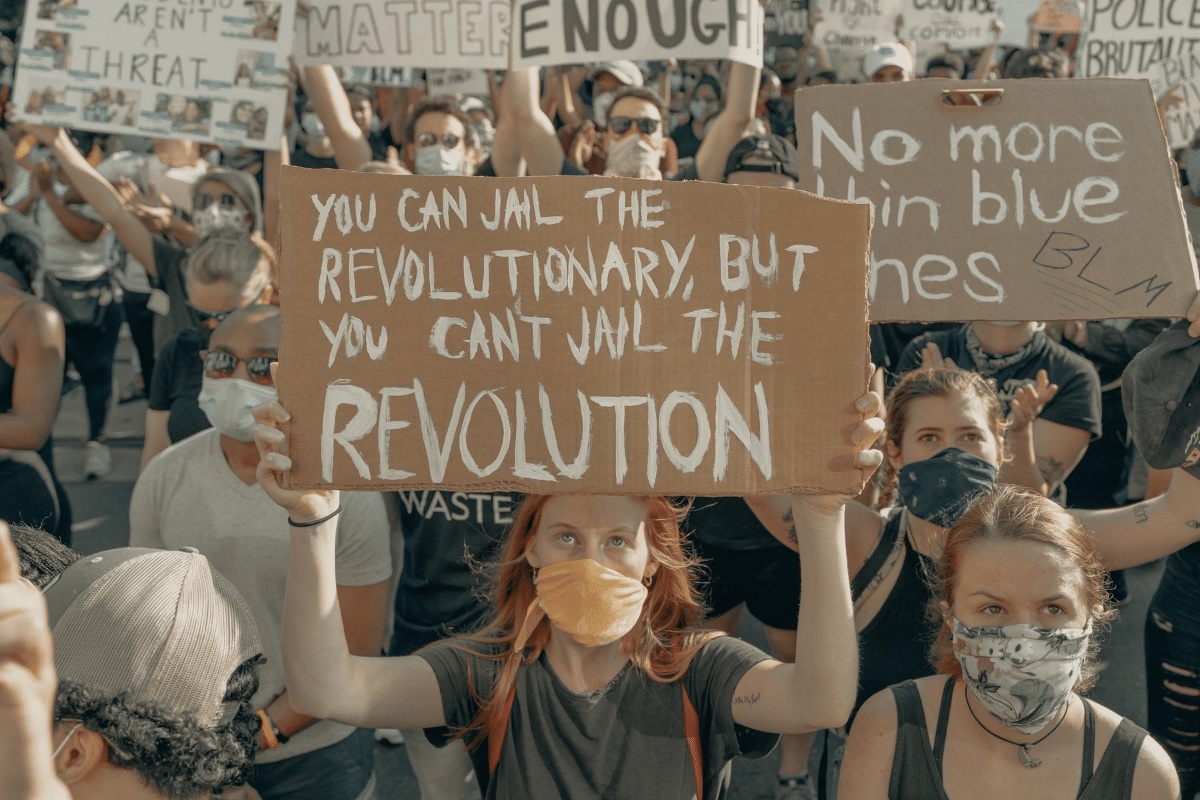
It’s fascinating that the razors edge of revolution is often young women

The Challenge of Marxism
written by Yoram Hazony
Published on August 16, 2020

This well written and insightful article lays out the fundamental problem that ‘liberal-society’ has with Marxism, it is fundamental and insurmountable without stepping back and being able to address the core intellectual attraction of Marxism.

The article also points out clearly that the challenge to the liberal-capitalist society today is a dispersed network of Neo-Marxist follow ons not the International Communist Marxism of the soviet era.

The current rag bag liberal street agitation groups espouse Neo-Marxism in the form of defining the world as made up of human association groups (once classes now identity groups) who have natural affiliation and self awareness, organized in society into a hierarchy of oppressors and oppressed. Where the oppressors form a web of custom, law and history that supports this oppression largely hidden from most of the oppressed.

  • In this theory:
    • there is nothing but oppression and
    • that when seen this can and should be attacked in all ways possible up to and including direct violence. That there is
    • one true view of the world, that of the woke (or Marxist, SJW, etc) and
    • any other view is false and that
    • defending other views is violence and
    • can be addressed with physical violence up to and including death.

The basis of liberalism are enlightenment values of freedom, liberty, human worth… which can be argued are actually conservative values expanded to the masses without much of a rational argument.

The Marxist analysis of class, oppressor and oppressed is clean, rationale and expansive enough to cover most situations if the area of regard if defined clearly. The liberal while depreciating the marxists’ absolutist tendencies can understand the analysis and is forced to agree since they rarely have a good counter argument that does not require them negating marxist truisms and engendering attacks on their racism, classism, elitism, misogyny, etc. Over time one article of liberal faith or piece of history, has it’s context distorted to the Neo Marxist account and is then pulled down by the rabble no one can deny.

And so the Marxist cadre, not calling themselves that but acting in swarming semi accord have captured the elite institutions which were largely liberal and now are largely controlled by Neo-Marxists with the reins of power in their hands.

  • So I say that the Marxist analysis makes sense right?
  • No I said that the Marxist analysis is clean and rational.
    • But it purposefully limits the definition of ‘the problem.’
  • The basic analysis of self aware human groups is true.
    • But the abstraction of the definition is taken to extremes to sharply define a ‘class’ such as mobility, demographics, etc are limited
    • The other abstraction; of oppression, also goes to extremes to ignore countervailing facts, social cohesion, economics, even the availability of violence to both sides
  • In Marx’s time, while the Imperial Russian autocratic-oligarchy vs serf appeared to have some relationship to the Owner-Manager vs worker in capitalist free holds like Victorian England, the reality was that in all cases each side had its risks and its pains as well as advantages and pleasures.
    • And at the end of the day the masses always had the pitchfork and torch if things got bad enough. While peasant rebellions rarely ended well for the rebel leadership it usually had a positive long term effect on the survivors because the upper class wanted to avoid reoccurrences.

Ok so I have wandered on for some time, and off topic really, the article is very good, much better than my rough handling of a few of it’s very clear points. Read it.

Book reviews…Cities, roads, history, society…

I have as always been reading a lot on a broad range of topics. Here are three very worthwhile reads that have some things in common and might give you some interesting insight into society history, cities, transportation.

Metropolis: A History of the City, Humankind’s Greatest Invention Kindle Edition
by Ben Wilson

Saw this at Barnes and Nobles but bought the kindle edition. The physical book is nice but was not sure it was a real keeper. This is a good book, probably written before 2020 and Covid-19 raised questions about ‘the urban’ but I think either well thought out and thus an argument against the Anti-Urban angst right now, or edited well to address it without being too pointed.

This is an interesting read going back to pre history and even pre town/village to show that mankind was building monuments long before cities and that the typical early city surrounding religious/social centers was not an after thought but the genesis of the city. Also pointed out that when Mesopotamia was originally ‘urbanized’ it was more like Tenochtitlan, a wetland/jungle, not a desert as it is today. This actually points to a minor theme about natural climate change in this book and how it enabled then destroyed many early societies and their cities.

Dr. White works up from Uruk (probably oldest major city) through the more well known Mesopotamian city states to the coastal city states of the Mediterranean and Asia and how these cities lived and died by trade as much as by being centers of power. That usually the power came after economic power. Each city is put in its own context but that context extended to today. A city on the monsoon trade routs of the Middle Ages compared to modern Singapore. The trashing of Medieval Paris by Napoleon the II’s city planer (in the 1850’s) to build todays ‘city of lights’ is compared to the trashing of many other city centers in the name of modernity and the car.

But throughout the dynamism of the city, its inventiveness and its beating heart at the center of economic power is stressed. And above all that cities are human creations and habitats that are rebuilt and rehabilitated by the human spirits that enliven them. And despite wandering into and even making a strong case for the maleness and misogynistic tendencies of cities and the anti other tendencies Dr. White pulls back and strongly supports the case that cities are centers of diversity and new ways of living and new ways of empowering the downtrodden. While at the same time pointing out again and again that the elite urge to ‘clean up’ slums and old sections invariably destroys as much or more that is strong and beautiful as ‘helps.’ That the humans that give the city heart and power are the lower and middle classes not the elites and that elite re-planning is generally destructive of the human in the city. Again and again slums and ghettos are shown as a horror to the elites that is utterly at odds with the dynamic creativity that they hide in back alleys. Even in Mumbai and Lagos today the power of the slum is at odds with its image as presented by the largely ignorant elite.

The chapter on Warsaw in WWII is hard to read, but again and again points to the humanity of the urban core and its draw on the human soul for those it has become home to.

This book is an eye opening read and an excellent piece of work with a different view of the urban and the city. Not the least because it even deals with the suburbs and the suburban city (LA) and shows that it is in many ways just part of the continuum of development over something like ten thousand years.

I grew up in what I would call metro-suburbs of England and the Suburbs of the US and find that this book provides a much more solid base for thinking about the city than any article or techno dissection of the city vs suburbs vs rural…. Read the book, don’t miss some fascinating images and the use the author puts them to to explain times and places in some depth.

The effect of Covid-19 and the internet (one cannot be dealt with without the other) the coming impact of electric and autonomous cars and then personal air transport should be thought of AFTER you have read this book. It gives one pause and a new way to address what a city is and its draw to and repulse from the human spirit.

Ravenna: Capital of Empire, Crucible of Europe Kindle Edition
by Judith Herrin

Ravenna on the Adriatic (the sea between Italy and the start of Eastern Europe is not a city one has heard of. Rome, Venice, Pisa, these cities of the Middle Ages and Renaissance are famous but a city that was for some hundreds of years the Capital of the Western Empire is simply not mentioned in most history books. Largely because its history started when Rome fell for the first time to the invaders and the Roman capital moved to what we call Constantinople. This was the start of the dark ages as first the barbarians and then Islam destroyed the Roman Empire. But that empire took a great deal of killing and our simple view of Rome the City = Rome the Empire, reinforced by Gibbons and others is simply false.

The city was important in Roman times, a city on an estuary that was much like we might imagine Venice a few hundred years later. The romans built/dredged a large harbor next to the city and it became the main sea link from Rome to the East, Anatolia, Greece, etc.

As Rome as Rome fell Ravenna became a center of gov’t and it also became a center of Christian faith, usually linked to the Abbot of Rome but also linking to the Eastern Faith, it was often at odds with the Abbot of Rome and or the Abbot (Patriarch) of Constantinople, where the later emperors tried to control the universal (Catholic) faith and failed.

Because of its link to the Eastern Church and Greece its Churches were richly decorated with mosaics, some of the most startling survivals of a period of history little remembered in the west.

Over the period of the barabarian invasions and later Empire the Emperors in Constantinople used Ravenna as their Western center of Government from where famous generals led army after army out to defend or recapture Roman lands. But in the end the powerful warrior tribes out of Germany, etc beat down the empire and took it as their own and Italy splintered into the city states that enliven the story of the Renaissance.

This history is rich and interesting, politics, religion, sociology, art, woven together. Dr Herrin uses a lot of first sources and actual peoples words to weave the story. Photographs of the wonderful mosaics makes one want to visit this historic city. The details of this ‘missing’ period are deeply interesting and helps explain the rise of Catholicism and the split with Orthodoxy. Another great read if you are interested in the history of Rome, Europe, the Middle Ages.

The Big Roads: The Untold Story of the Engineers, Visionaries, and Trailblazers Who Created the American Superhighways Kindle Edition
by Earl Swift

Earl Swift’s The Big Roads starts at the beginning, in the nineteenth century with dirt tracks and cobbled lanes of the towns, cities and rural expanses and leads through their evolution over time. It is interesting that so much of the early work was more about associations building assets for commerce and the socialization of the automobile, prior to its becoming a power in its own right. And that the bicycle had a part to play before the automobile was big.

The story of the US routes, Route 66, Route 31, Route 71 etc etc and then the genesis of the interstate system are fascinating tales of time, place and actors.

A very human story interwoven with fascinating people and lacing in stories of places and times that you had heard elsewhere but never linked into the creation of the highways and now byways across the US.

As with the books above, particularly Metropolis this book talks about the hubris of the elites and of the blinders that technical leaders can have and the damage they can do while believing they are in the right and having the best interest of the people they are displacing at heart.

A fun book with fun side stories that especially resonate with me as I grew up as the Interstate system really came into its own and the knock on effects it had became visible, mostly for good but too often at a cost to various neighborhoods and towns.

Meaning of Liberty

Triggered in the best possible way by the following, Benjamin Constant, writing on meanings of liberty, ancient vs modern, in 1819 France. Read the whole thing it is shockingly applicable today.

This is related to the idea of todays forming Neo Feudalism and to a degree the concept of the Individual and sovereignty.

Constant lays out that in ancient times liberty (for the tightly defined citizen) was extremely broad and powerful, in Greece and early on in Rome, the citizens as a body had essentially unlimited power to wage war, make piece, expel, execute, as far as their power extended. But as individuals they were controlled, watched, forced to conform. This was possible because the citizens were a smallish percentage of the total population and well enough off to spend a huge part of their time debating.

In a practical sense these citizen assemblies were more like our Legislators than our citizens, though with arbitrary and absolute power. But Constant follows the traditional line and does not make this distinction. In part because he still lived in a world of urban aristocratic elites supported by a huge rural underclass.

In counter to ancient liberty he explains modern liberty as about the individual vs. arbitrary power of any kind. Essentially it is about the individual and their ‘happiness’ in the sense of controlling their own life and own concerns with the expectation that society and the hand of society (the government) has strictly limited power to interfere.

He points out that individual liberty is what humans really want but in the case of the ancients were willing to sacrifice for collective liberty since in their small and always threatened polities it was glaringly obvious that it was cooperate or be enslaved.

That stark choice is still there but hidden by the immensity and generally good living of the modern world. Governments span continents not little seaside towns and in the developed world we never want for goods unless we are ‘unlucky’ in some way. So the real power of gov’t is far from obvious to most, if you go along you get along and only criminals or sociopaths get in trouble…right? If everyone is on the same page maybe, but in a world of oligarchs, elites, yeomen, plebs and deplorables everyone is not on the same page any longer.

During the later 19th and through the 20th century there was, in the west and US, in retrospect, a fairly concerted effort to keep everyone on ‘the same page ‘ But as the echoes of WWI reverberated, the liberal republican concepts came under increasing threat from political philosophies we call communism, socialism, marxism, fascism, and their social outreaches of materialism, deconstructionism, etc. The ‘conservative-liberal’ mainstream dealt with the geo political threats fairly well but the social political attacks came through chinks in the armor that ‘freedom of expression and thought’ leave wide open. Children and Intellectuals are particularly attracted to the avant-garde, new, kind, progressive, and while many of them grew out of it as they moved through life ,all too many became entrapped in the mind fog if they did meet the real world of real people and real trade offs that the schools of hard knocks provide.

And so we are today a country, a civilization under threat of our own success. The varigated liberty of the constitutional republic has been hollowed out due to pragmatic, lazy, risk averse decisions by the interlocking social, fiscal, judicial, etc elites.

We deconstructed education, society, civility in the name of equality but without a consensus of what was going to replace those things and others. Deconstruction occurred in the shadows, the termites were at work on the frame with no replacement under construction because no one could agree on even a need as long as the old structure was there. Unfortunately no one told the termites to stop.

As this became somewhat obvious there were those, maybe many, who said, ‘let it crash,’ ‘let it burn,’ ‘tear it down’ because it represented something that they defined as completely evil, even if the same underpinnings being eaten away kept the roof over their head and provided protection for their food and defined their safety from the wild.

The problem is that the people who most want it torn down least understand what it took to create and what it protects them from.

If you look at things a certain way you can see the US, the West sliding towards something all too like the Chinese model. Perhaps a kinder gentler version but that is no certainty.

Is there a way out? ?

Was there a way in?

My view is that we stumbled and mumbled our way here. Reality is that nothing here was planned. We live with the contingent outcomes of unplanned inputs. it is possible that this outcome was expected by some but they are unlikely to have had any ability to direct it.

It does not really appear possible to plan anything like a society any longer unless it is a subset of self selected actors. And since humans are human no such society will last longer than about half an average human lifetime.

So?

It is what it is.

Don’t see evil around every corner, there is evil in the world but it is rare in the wild. Most people just believe what they believe they learned somewhere. They are most likely wrong (as am i.).

And remember this, over the sweep of time things have been getting better for more and more (in absolute and relative terms) people across time. There have been crashes and horrors but most people most of the time were relatively happy. The up slope was ver, very low ten thousand years ago but it has been steepening as it goes. While the whiners all see disaster ahead the reality is that there are solutions for every problem we (as a world civilization) have. Where we are going in any one part at any one time is always a bit of a random walk but that walk is usually uphill (in the best sense.)

Stay strong, be happy, work at making a difference.
Noble Intention = Elite Pretension Elites, intentions, nobility, lies

I do not know the answer to the question: What can we do to slow the the spread of an airborne disease such as COVID 19. What I do know is that approaches with some history have been massively abused. Often with ‘noble’ intentions but to the detriment of the populace.

  • Quarantine – traditionally the people who have the disease. In this case the people most obviously at risk, the elderly. Where this has been implemented it seems to help, BUT the negative impact on the individuals and their family are significant. In the end will this be shown to have been a disaster because of the isolation killing tens of thousands by suicide and drug overdose? Also abuse of this by sending infected into ‘isolation’ wards that weren’t sufficiently isolated killed thousands.
    • The ultimate abuse of quarantine is the tyrannical lock downs, has damaged the economy to the detriment of everyone and in all likelihood killed tens of thousands if not more through overdose, suicide and delay of medical attention to lethal but treatable medical problems.
  • Social Distancing – a modern form of soft quarantine (needs very specific circumstances to mean much.) Where companies implemented for critical staff it appears reasonable, its bland plastering on ever floor in every stored seems silly.
  • Masks – traditional but misunderstood: It stops you from spreading vastly more than catching. Along with social distancing it is reasonable for limiting spread if followed well enough.
  • Crowds indoors – known bad BUT: space and air handling is very important, driving many gatherings into homes was a stupidly obvious result of stopping certain types of events.
  • Crowds outdoors – People need to get out and sunlight and exercise, good feelings are seriously helpful. And the chances of spreading especially in the day is near nil. Health enhancements massively outweigh risks for most. Of course then supporting rioting at night made the rules look political and stupid.
  • Restaurants/bars – Obvious targets of concern. But crowd limitations and rules about cleaning and masking mitigate issues. The ability to get out and mingle in reasonably controlled environment along with the support of the economy outweigh risks.

At the start of all this if the elite (gov’t, medical, media) had acted with open clarity about what was known and unknown. There might have been a chance to get through the last nine months without the breakdown we are seeing.

Politics, especially ‘orange man bad’ was a starting point for the majority of the elite, spin, narcissism and gotcha were key issues especially in what was seen as an existential election year. Lies, more lies and counter lies to control of information, opinion and public activity spun out so that the general populace at this point pretty much ignores whatever is said other than as a sort of televised comedy/drama.

The following and at the link is a fairly mild analysis of the issue from the CATO institute via Instapundit

The main political conflict in recent years is between experts or elites and non‐experts. For lack of a better word, the non‐experts are called populists. Their complaints have been specific: Elites and experts are arrogant, they have different values, they condescend in annoying ways, they ignore the sometimes legitimate concerns of populists, among others. Experts say that they should be listened to because they’re more knowledgeable. We see it in debates on every issue from climate change to trade, immigration, and everything in between.

CATO Institute: Against the Noble Lie – COVID 19s Edition (March of 2020)

Noble intention = Elite pretension