Now this Really Is Rocket Science

New research key to revolutionary ‘green’ spacecraft propellant at Phys.org
Got me interested in this new material…liquid…which is REALLY cool, in a hot sort of way, look at this briefing by the Air Force Research Lab…this Rocket Fuel burns at 1600degC but it just sort of fizzles if thrown on a fire, sits there when hit by a hammer, does not create clouds of toxic fumes and while not a great ice cream topping is not wildly poisonous either…and this stuff was actively developed, not just stumbled across. Such is the power of modern research tools and materials knowledge.

20130507-211124.jpg

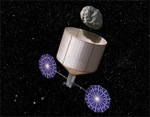
The GPIM project aims to introduce AF-M315E as a green alternative to hydrazine (Credits: NASA).

phys.org | Do-it-yourself invisibility with 3-D printing

20130506-220828.jpg

“I would argue that essentially anyone who can spend a couple thousand dollars on a non-industry grade 3-D printer can literally make a plastic cloak overnight,” said Yaroslav Urzhumov, assistant research professor in electrical and computer engineering at Duke’s Pratt School of Engineering.
Urzhumov said that producing a cloak in this fashion is inexpensive and easy. He and his team made a small one at Duke which looks like a Frisbee™ disc made out of Swiss cheese. Algorithms determined the location, size and shape of the holes to deflect microwave beams. The fabrication process takes from three to seven hours.
“Computer simulations make me believe that it is possible to create a similar polymer-based cloaking layer as thin as one inch wrapped around a massive object several meters in diameter,” he said. “I have run some simulations that seem to confirm this point.”

Read more at: http://phys.org/news/2013-05-do-it-yourself-invisibility-d.html

Well ain’t that just Harry Potter cool?

Machine Design | Local-for-local strategy drives U. S. expansion

An artical / opinion piece in Machine design talks about how reality/ growth caught up with plans an sparked an epiphany: Local-for-local strategy drives U. S. expansion . This seems right and in line with what seems to be happening more broadly which is not a retreat to the USA but a charge into the future. This is all to the good…except in many ways the blue blues less clues have been taking advantage of the disappearance of the factories and their irritatingly outspoken managers / operators to tighten up regulation. Not that regulation is all bad but the regulatory net in blue states/ cities seems to be stifling growth in many places that could do with it.

Eye Candy

20130506-131540.jpg

Wired, young Audubon works

Living tissue 3D printed

First fully-cellular liver tissue 3D bioprinted at Organovo

20130503-232416.jpg

Bioprinted human liver with CD31+ microvessels (green) forming within the tissue.

Since liver cells are used in labs to test the toxicity and efficacy of drugs, these printed tissues will first serve that purpose. Soon though, a larger liver will be printed, and it won’t be long after that that printed organs will be tested in animals. It’s a short hop from there to humans.

Does it whistle in the wind?

20130503-213449.jpg

The Met, Bangkok, Photo: Aga Khan Award for Architecture/Patrick Bingham-Hall, Each week, Wired Design brings us a photo of one of their favorite buildings

Completed in 2009, Bangkok’s 66-story Met Tower is an attempt to build an apartment complex uniquely suited to its surroundings, rather than adapting temperate techniques to a tropical location. WOHA Architects did this by incorporating elements of more traditional tropical housing, and the results have been shortlisted for Aga Khan’s 2013 Award for Architecture. The perforated 748-foot structure is actually six columns connected by breezeways that promote cross ventilation — each unit is exposed on all four sides. The facade is inspired by traditional Thai architecture and materials, with shade and vegetation screens reaching all the way to the top.

Cool! Hopefully in all the right ways.

Modeling distant Earths

20130503-210339.jpgModeling of various atmospheric pressures shows that Exo earths could have life friendly atmospheres across a broader range of orbital distances than our thin aired original. Since we are ‘seeing’ a lot of big worlds out there this is promising, though of course too much of a good thing is bad, as our sister world Venus shows.

20130503-210351.jpg

A figure from Vladilo’s paper summarizing the general findings. The area of the circles is proportional to their habitability. The bottom axis shows the virtual worlds’ distance from their Sun-like star, with 1 AU (astronomical unit) representing the average Sun-Earth distance of approximately 150 million kilometers (93 million miles). The top axis (insolation) shows solar radiation (in watts) received on a unit area (a square meter). Surface pressure is on the y axis to the left. Credit: Vladilo et al. 2013, ApJ, 767, 65; http://wwwuser.oats.inaf.it/astrobiology/planhab/

Read more at: http://phys.org/news/2013-05-pressure-density-exoplanets-atmospheres-odds.html#jCp

Eyeball Earths…Red or Brown Dwarf Life Worlds?

20130503-210405.jpg

Artist’s concept of a planet where one side always faces its star, with the dark side covered in ice. Credit: Beau.TheConsortium

Red dwarfs are small, faint stars about one-fifth as massive as the Sun and up to 50 times dimmer. They are the most common stars in the galaxy and make up to 70 percent of the stars in the universe, vast numbers that potentially make them valuable places to look for extraterrestrial life. Indeed, the latest results from NASA’s Kepler space observatory reveal that at least half of these stars host rocky planets that are half to four times the mass of Earth.

Read more at: http://phys.org/news/2013-05-eyeball-earths.html#jCp

DARPA Finaly got the X51 to successfully ride its wave

20130503-204016.jpg

Tucked under the B-52H’s port wing, the X-51A is pictured prior to launch on May 1

At www.aviationweek.com

The U.S. Air Force has released new details of the record-breaking hypersonic test flight conducted by the Boeing-built X-51A Waverider demonstrator on May 1. The diminutive scramjet-powered vehicle achieved a blistering Mach 5.1, covering 230 naut. miles in just over six minutes (240 seconds!) over the Point Mugu Naval Air Warfare Center Sea Range in the Pacific.

This technology could be the next breakthrough for space booster technology…next as in ten to twenty years. In the meantime it could fuel a new arms race in rapid strike weapons. This is not a US first move, the Russians, Australians, the Europeans, maybe even the Chinese have been leading in this speed regime up to this point.

NASA may support SST x-plane

20130503-201749.jpg

An artist’s concept shows Lockheed Martin’s low-boom supersonic airliner. (Courtesy: NASA)
At www.flightglobal.com
Science and resultant technology may well have made Low Boom supersonic flight practical. A 100 to 150 passenger aircraft could fly NY to LA in something like 2 hours, making one day two way coast to coast trips a practical comfortable reality for premium passengers. This has been impossible because of the glass breaking, cattle disturbing sonic boom, but now aerodynamics and aircraft technology have shown a road forward.

With the ending of NASA’s last ‘five year plan’ on ultra efficient airliners, money will be available to build a scale but largish (fighter sized I’d guess) x-plane to make test flights provingthe boom mitigating design techniques. This sounds like a great idea, the sort of thing that NASA should be doing, has been doing, quietly, since its founding as NACA all those decades ago.

3D printed Camera accessories for cool effects

20130430-231840.jpg

Here is a simple Tilt-Shift adapter which will attach to any micro four thirds camera body and hold a Nikon Series E 50mm lens. This adapter will creates a tilt-shift effect or miniature effect in your photos (see examples below). This is intended to be a more durable and cheaper solution than both DIY and commercial lens adapters ($2100).

20130430-231849.jpg

Galactic Virgin Rockets Away!

20130429-215041.jpg
Love the Logo-shot! The space ship’s pretty simple really, it’s biggest downside would seem to be no fly around capacity if one misses the runway line up, but 1) how often does that happen theses days? 2) if theirs any juice left in the oxidizer tank a short burn would do the trick. Anyone know the plan: depend on getting it right every time or lighting ‘er up for the go-round?

20130429-215802.jpg