Meta material technique allows for high efficiency coupling of light on a surface AND the ability to switch direction via polarization

20130428-161227.jpg
An electron micrograph shows the nanoscale perforations at the surface of the plasmonic coupler. Credit: Jiao Lin and Balthasar Müller.
(Phys.org) —A Harvard-led team of researchers has created a new type of nanoscale device that converts an optical signal into waves that travel along a metal surface. Significantly, the device can recognize specific kinds of polarized light and accordingly send the signal in one direction or another.

Read more at: http://phys.org/news/2013-04-physicists-left-solution-on-chip-optics.html

Pretty important stuff, ducting light around on chips is an important ability for future electronics…or maybe one should say, nano- electro- optic- systems. Cool stuff…

RADICAL SCIENCE | GETMYO.COM | motion interpretation by reading muscle signaling and position

Cool stuff

20130428-141503.jpg
(Phys.org) —”Wave goodbye to camera-based gesture control.” That is the confident directive coming from a one-year-old Waterloo, Ontario, startup called Thalmic Labs. The company is prepared to ship its next batch of wearable-computing armbands for device controls early next year. The $149 armbands called MYO do not require cameras in order to track hand or arm movements. The armbands can wirelessly control and interact with computers and other digital consumer products by recognizing the electric impulses in users’ muscles.
Read more at: http://phys.org/news/2013-04-myo-armband-muscle-video.html#jCp
Using groundbreaking technology, MYO is able to measure electrical activity in your muscles instantly. The result is a seamless way to interact with computers, and a truly magical sense of control.
Read more at: https://getmyo.com/

20130428-141510.jpg

The Senatorial Launch System | Asteroid Capture | Clueless Politicians | Pork | Engineering Jobs + Corporate Welfare

20130427-221407.jpg

Broadly, the administration envisions sending a probe as soon as 2017 to capture a 25-foot, 500-ton asteroid and tug it near the moon – possibly to a spot about 277,000 miles from Earth that would use competing gravitational forces to allow it to “sit” there. Astronauts flying NASA’s new Orion capsule and Space Launch System rocket then would visit it to take samples and possibly set foot on its surface.

This plan is getting pushback because its not a return to the moon or a Mars landing plan. But the reality is that this idea is all NASA can afford given the cost involved with the Senatorial ( or Space, take your pick) Launch System A Saturn V + class heavy lift direct ascent launch system

The lack of resistance is tied to Senate support of the Space Launch System. Senators from key NASA states – Florida, Texas and Alabama – pushed President Barack Obama to build it, and the asteroid mission is seen as a way to give purpose to the rocket, once criticized as a “rocket to nowhere.”
Illustrative of that point was the initial reaction of Sen. Richard Shelby, R-Ala.
“NASA should continue to explore the universe and challenge scientific and technical boundaries,” he said in a statement. “However, NASA should maintain focus on its core mission and continue development of the Space Launch System so that it will be ready for any future NASA mission.”

So my question is, why the SLS, don’t get me wrong some of the SLS related work like resurrecting the Saturn V F1 engine (as I pointed to a few days ago) is a good thing, but reality is it should be part of getting a commercial venture to back development. NASA shoulddevelop Orion and its support module, but the booster should be gov’t sponsored / stimulated effort as part of a get to the moon, Mars, big asteroids plan, in support of the commercial civilian space efforts.
If you look at all the recently proposed and ongoing civilian efforts and roll in appropriate gov’mnt support you can see a very robust human and robotic space development plan emerge.
Read more at: http://phys.org/news/2013-04-nasa-chief-asteroid-agency.html/


20130427-221747.jpg

Printing tactile images for the blind

3D Printer | Exploring the world of 3D printing | Printing tactile images for the blind
by Cameron Naramore on April 25, 2013
20130425-190348.jpg

A “relief” is an example of what a 3D printed picture could look like.


Etchings, reliefs, contoured renderings of images. But what would a blind Rembrandt create with the right tools, ways for the sighted to gain concept for the inner perceptions of the blind? In the end this will become a new art form.

Graphene conductor is ink-jet-able, flexible, what about 3D enabled?

Inkjet-printed graphene electrodes may lead to low-cost, large-area, possibly foldable devices at phys.org by Lisa Zyga

This is the sort of technology that could enable 3D electronics for all sorts of applications from industrial and maker shops.

20130424-214235.jpg

‘Just’ eye candy

Engineering, science, technology, art

From molecules to gallons: Scaling up fuels created by artificial photosynthesis: Sabin Russell @ :phys.org
Ok so I’m a geek but I see this a neat and a form of artistry.

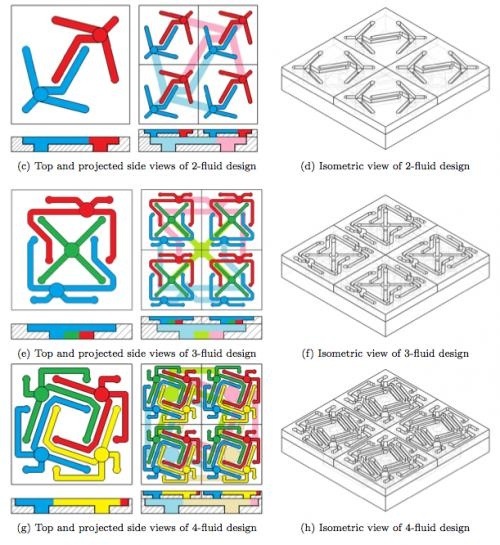
Self similar patterns, derived from nature’s models, provide a route to scale from meters to sub micron with features of self assembly and ‘natural’ scaling. Allowing fluids to flow in and out of a microscopic reaction site at macro-scales.

20130424-074717.jpg

20130424-074730.jpg

Merlin 1D engine ready for space

The SpaceX Merlin 1D engine, the more powerful, more robust and less expensive
follow on to the operational 1C, has been certified for flight.

20130423-232802.jpg
This is the family, an interesting thing about the Heavy is the plan to have the strap-ons share fuel with the core, consequently when they separate the core is still fully fueled, a big performance increase.

20130423-232817.jpg
The engines have been run far harder than standard rating regimes require, 1) to solidify their ‘man rating’ for future crew lofting flights, 2) because SpaceX wants to reuse them, 3) because SpaceX wants top line insurance rates for their customers even while brining new approaches to the party.

20130423-232832.jpg
Rocket engines, so ugly you just know they’re powerful!

SpaceX Grasshopper, hops up 820ft

Cool videos at the Verge article.

20130423-224330.jpg
Held at height and then landed straight down unaffected by what looks like a reasonable breeze.

Second gen Falcon this year, possibly Falcon Heavy first flight, soft water return for a booster this year and ground return next year! Each demonstrates fundamental capabilities and the power of a committed commercial / civilian play with tech and team unfettered by bull crap FARS oversight dead weight. But each is advancing tech at a rate that seems more reminiscent of the sixties NASA and aviation tech| 2nd gen Falcon: new improved engines, Heavy: buddy tank w/ common boosters engines, any of the above: fly back boosters w/ powered soft landing first at sea then on land. Each step something daring and commercially valuable. I’m not sure how some of the competitors keep from going into terminal depression, if Musk’s SpaceX team nails the string the old guard are toast.