
From Space.Com

Like it or not, history shows that taxes and bureaucracy are cornerstones of democracy
Article In Phys.Org by Field Museum of Natural History.
It is actually a reasonable article about a study that on its face makes sense though I believe it to be one that could be easily spun. It is a quantitative analysis of essentially qualitative factors, this is done by assigning numerical scores to identifiable attributes for multiple, ancient civilizations. You can then run analysis from simple to complex and use the scoring to make a point. Having done this sort of thing the problem is that it is very easy to bias the output especially when the results (as they all too often do) come out showing no clear message.
But as I said the basic discussion is not bad and appears balanced but the top level spin put on it by the articles title is spin. And then using images of Imperial Chinese Bureacracy and Festivals seems extremely Propagandistic. While the ancient Chinese Imperial Dynasties varied in many ways and had some good in them more by accident than intent, they were autocratic and ruthless to a one and to a fault.
This is the sort of soft propaganda one gets with things like the Confucius institute A CCP run propaganda arm, the Biden administration is giving free reign in academia to put their thumb on the scales with this sort of authorship, along with the woke fellow travelers who seem to feel that this sort of spin is necessary.
I would not protest this article, even its title so much if I felt that there was a reasonable, rational, balanced, look at the path from the past to now in modern academia especially in the west. The problem is that there are only so many minutes in a day so many moments of attention that can be paid to anything. If this sort of soft propaganda and equivalent takes up mind space, and is not counter balanced by a strong base of what current civilization owes to the West and to Industrial Anglo Sphere then the intent is to create a totally false impression of reality.
The rest of the world was not an empty bowl waiting to be filled from the west, representatives of the west did bad things. But the Christian West was always on an upward path. None of the eastern empires had advanced in any consistent and appreciable way for centuries or millennia and that had nothing to do with resources, everything to do with culture, religion, conquest and autocratic rule, none of that the peoples fault, all geography and circumstance. But pulling down the smallish bit of humanity that managed to break free and start the ball rolling uphill is chillingly evil.
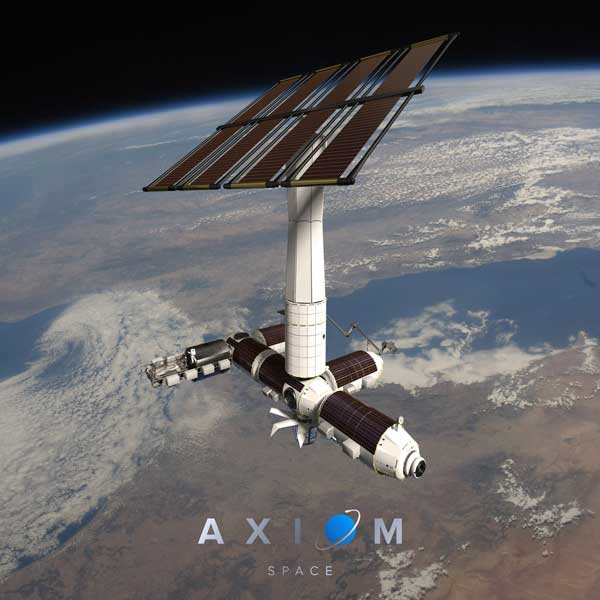
Axiom is not as famous as SpaceX or BlueOrigin, even Boeing or NG but it is setting up to be a big noise in commercial space. “Axiom Space, Inc., which is developing the world’s first commercial space station, has raised $130M in Series B funding”

In January 2020, NASA selected Axiom to begin attaching its own space station modules to the International Space Station (ISS) as early as 2024, marking the company as a primary driver of NASA’s broad strategy to commercialize LEO. While in its assembly phase, Axiom Station will increase the current usable and habitable volume on ISS and provide expanded research opportunities. By late 2028, Axiom Station will be ready to detach when the ISS is decommissioned and operate independently as its privately owned successor.
From the above ParabolicArc article.
But they are already in the ride share business, setting up launches of multiple smaller missions on one booster, Axiom buying the ride then working with the launch customers to integrate their satellites on the mission bus. Another recent milestone:

Lots of cSpace development, keep it coming…


While a chemically powered trip to Mars is feasible given the ability to lift a lot of mass so orbit, See SpaceX-Elon Musk, this is probably not the solution you would go for first. I think it makes sense as part of the Vision Setting that Musk does but the preference has always been for nuclear propulsion it enables faster (safer) trips and makes reusability even more effective since the ‘shuttles’ are not spending many months in transit each way.
Posit a Freighter something like the illustration below. Departing Mars having dropped of say 2, 3, 4 starships’ worth of cargo. MarsStarships shuttle up and down and provide point to point transport on Mars. EarthStarships shuttle cargo up to earth orbit. Maybe LunarStarships shuttle fuel from production stations on the Moon to reduce the cost of fuel for the starships and the Freighter.
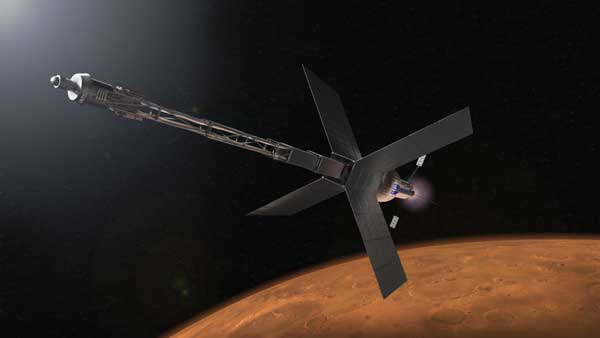
Now you have a system that provides Access to the solar system with significant cargos and the ability to establish and support exploration stations wherever you go.

I think this says a lot about the ability of this autonomous system, robot, to do what it could to mitigate what was to come. RIP SN9 we thank you for your service.
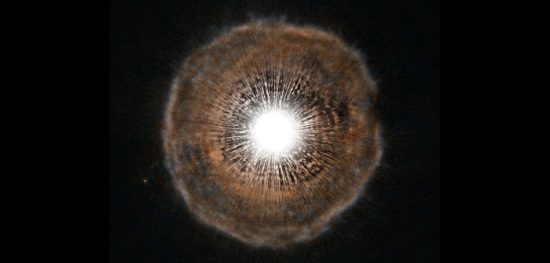
Seems like there must have been a mash up of astrophysics/cosmology/cybernetics a couple of weeks ago there have been a series of articles about computers and the universe. One series pointing out that once could conceive of using the AGB stars in their ‘dusting mode’ (above) as a computing engine.
But on the other side there have been a couple of articles that touch on the metaphysical (philosophical basis of reality) concept that we and our universe, are one vast simulation.
…Oxford philosopher Nick Bostrom’s philosophical thought experiment that the universe is a computer simulation. If that were true, then fundamental physical laws should reveal that the universe consists of individual chunks of space-time, like pixels in a video game. “If we live in a simulation, our world has to be discrete,”….
From: New machine learning theory raises questions about nature of science
….a discrete field theory, which views the universe as composed of individual bits and differs from the theories that people normally create. While scientists typically devise overarching concepts of how the physical world behaves, computers just assemble a collection of data points…..
From: New machine learning theory raises questions about nature of science
…A novel computer algorithm, or set of rules, that accurately predicts the orbits of planets in the solar system….
… devised by a scientist at the U.S. Department of Energy’s (DOE) Princeton Plasma Physics Laboratory (PPPL), applies machine learning, the form of artificial intelligence (AI) that learns from experience, to develop the predictions.
Qin (pronounced Chin) created a computer program into which he fed data from past observations of the orbits of Mercury, Venus, Earth, Mars, Jupiter, and the dwarf planet Ceres. This program, along with an additional program known as a ‘serving algorithm,’ then made accurate predictions of the orbits of other planets in the solar system without using Newton’s laws of motion and gravitation. “Essentially, I bypassed all the fundamental ingredients of physics. I go directly from data to data,” Qin said. “There is no law of physics in the middle…
…”Usually in physics, you make observations, create a theory based on those observations, and then use that theory to predict new observations,” said PPPL physicist Hong Qin, author of a paper detailing the concept in Scientific Reports. “What I’m doing is replacing this process with a type of black box that can produce accurate predictions without using a traditional theory or law.”…
From: New machine learning theory raises questions about nature of science
Ok so now I am going to go a bit sideways and you may want to just go on about your internet day. But while I laude Qin and his team I have a bit of an issue with what he claims re the basis is Philosophy. Not the claim that the discrete field theory sparked his concept exploration. But that the actual system he developed has anything to say about that metaphysical theory.
Taking nothing away from the team what I see seems like a straightforward application of machine learning. In fact a relatively simple one though I would laude the whole idea of applying it to physics in general. A very interesting though, like many interesting insights, oddly obvious is retrospect. (Sorry for the repeated Though clauses…I absolutely see this as fascinating insight…and possibly extremely important…it just seems like D’oh in retrospect.)
As physics is very much aligned with mathematics (I think because the discovery of each was feedback on the other) and mathematics and cybernetics are also deeply intwined it should come as no surprise that computer systems designed to create black box solutions, when fed the right kind of data, will create a black box model of physical phenomena.
The output of science are tools that allow us to predict finite things about the universe we live in, repeatably and accurately. These tools are often used by engineers to enable technologyy that make life better for everyone.
But in many ways this is an engineers (relatively narrow) viewpoint. To some large degree an engineer does not care why the tool works, only that it does and how accurately. Counter to that, a strength of the theory based + mathematical model approach is that it gives you a tool to link the rest of reality to the ‘discrete’ piece you are working on right now. A jumping off point or a linking point to other theories that allows us to move onto other problems and link the
And/But (you knew it was coming) i wonder if this has anything to do with discrete field theory per se. Maybe if the learning algorithm used had that in it this would show something of that nature, but otherwise I do not see this as showing anything in particular other than the ability of learning systems which are in some sense continuous not discrete systems to develop predictive models directly from the data (as Qin says) rather than through the labor intensive methods of theory extraction and proof that has been the basis for scientific exploration since it first evolved in the Middle Ages.
Again BUT, it has been getting harder to develop these ‘deep’ theories. Look at the colliders and other tools that physicists use these days to probe the depths of our reality. In this world there are many things, like Qin’s next test with Nuclear Fusion, where an engineering model might be much more valuable than a ‘theory of this’ if it can be captured and used in a fraction of the time.
It’s all good, fascinating, wonderful…but let’s not get ahead of ourselves.

Private Space Missions Multiplying Like Rabbits
by Douglas Messier
Managing Editor (Parabolic Arc)
With the spate of announcements about private space missions over the past year, it’s easy to lose track of the who, what, where, when, why and how of the flights.
As a public service, Parabolic Arc has collected information about all five of the announced missions.
Nuff said

As limited and degraded as man undeniably is, he yet remains “the proof by contraries” of the divine Prototype and of all that this Prototype implies and determines in relation to man. Not to acknowledge what surpasses us and not to wish to surpass ourselves: … is the very definition of Lucifer. The opposite, or rather the primordial … attitude is this: to think only in reference to what surpasses us and to live for the sake of surpassing ourselves; to seek greatness where this is to be found and not on the plane of the individual and his rebellious pettiness. In order to return to true greatness, man must first of all agree to pay the debt of his pettiness and to remain small on the plane where he cannot help being small; the sense of what is objective on the one hand and of the absolute on the other does not go without a certain abnegation, and it is this abnegation precisely that allows us to be completely faithful to our human vocation.
Logic and Transcendence: A New Translation with Selected Letters
© 2009 World Wisdom, Inc. pg 14, The contradiction of Relativism
OK, so I’m addicted to philosophy right now. Directed here by One Cosmos, a autodidactic philosopher and deeply anti-psychological psychologist of the once great state of California.
While some philosophers and metaphysicians can be opaque in the extreme others are as one should expect extremely good writers with depth and clarity that is remarkable. Others are opaque but readable because what you ‘get’ seems true and sensible and the opacity is often in their use of old words, Greek or Latin words to try and de conflict their meaning from the everyday words that have been so poisoned by intentional obfuscation. The above book is of near preternatural clarity type. I have found another writer, Voeglin the type that makes you want to work at it.

