Unknown's avatar

About Sci Fi Engineer

Husband Father Writer Engineer

CommercialSpaceStation in sight

From this article in ParabolicArc
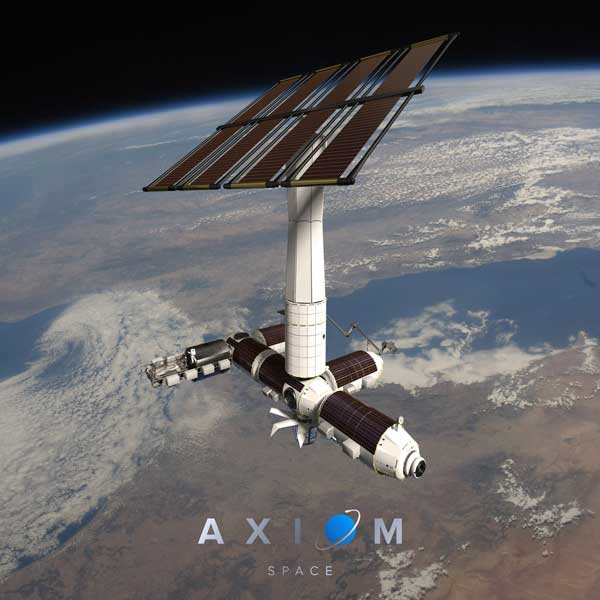
Axiom space image of their commercial space station.

Axiom is not as famous as SpaceX or BlueOrigin, even Boeing or NG but it is setting up to be a big noise in commercial space. “Axiom Space, Inc., which is developing the world’s first commercial space station, has raised $130M in Series B funding

Early Axiom module attached to the current ISS.
from this article in SpaceNews

In January 2020, NASA selected Axiom to begin attaching its own space station modules to the International Space Station (ISS) as early as 2024, marking the company as a primary driver of NASA’s broad strategy to commercialize LEO. While in its assembly phase, Axiom Station will increase the current usable and habitable volume on ISS and provide expanded research opportunities. By late 2028, Axiom Station will be ready to detach when the ISS is decommissioned and operate independently as its privately owned successor.

From the above ParabolicArc article.

But they are already in the ride share business, setting up launches of multiple smaller missions on one booster, Axiom buying the ride then working with the launch customers to integrate their satellites on the mission bus. Another recent milestone:

The four people who will fly to the International Space Station on Axiom Space’s Ax-1 mission include (from left) commander Michael López-Alegría and passengers Mark Pathy, Larry Connor and Eytan Stibbe. Credit: Axiom Space. From this article in SpaceNews

Lots of cSpace development, keep it coming…

Thought for the age

Governments have no resources. They only have spending power insofar as they can arrogate to themselves a percentage of private production; meaning government spending is a consequence of economic growth rather than an instigator. The same applies to “money.” It’s not wealth; rather it’s an agreement about value that enables the movement of actual wealth. In short, abundantly circulated money is a consequence of production as opposed to an instigator.

Forbes article via RealClearMarkets

To explore you need Access

Photo of a nuclear thermal propulsion (NTP) system from the Rover/NERVA programs (left) and a cutaway schematic with labels (right). SOURCE: M. Houts et. al., NASA’s Nuclear Thermal Propulsion Project, NASA Marshall Space Flight Center, August 2018, ntrs.nasa.gov/citations/20180006514.
Space Nuclear Propulsion for Human Mars Exploration
National Academics of Sciences, Engineering and Medicine
National Academies Press
2021
[ParabolicArc Executive Summary, Findings & Recommendations from National Academies Report on Space Nuclear Propulsion
February 13, 2021 Doug Messier
]

While a chemically powered trip to Mars is feasible given the ability to lift a lot of mass so orbit, See SpaceX-Elon Musk, this is probably not the solution you would go for first. I think it makes sense as part of the Vision Setting that Musk does but the preference has always been for nuclear propulsion it enables faster (safer) trips and makes reusability even more effective since the ‘shuttles’ are not spending many months in transit each way.

Posit a Freighter something like the illustration below. Departing Mars having dropped of say 2, 3, 4 starships’ worth of cargo. MarsStarships shuttle up and down and provide point to point transport on Mars. EarthStarships shuttle cargo up to earth orbit. Maybe LunarStarships shuttle fuel from production stations on the Moon to reduce the cost of fuel for the starships and the Freighter.
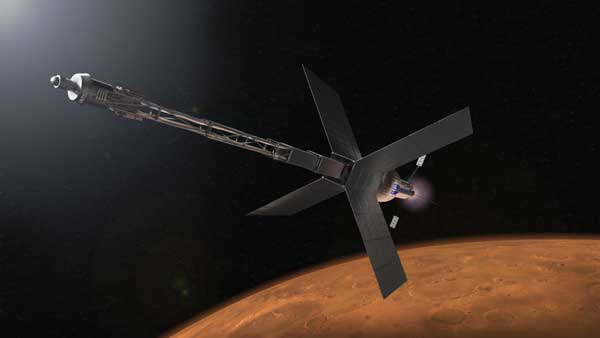
Illustration of a Mars transit habitat and nuclear propulsion system that could one day take astronauts to Mars. (Credits: NASA) [ParabolicArc: Executive Summary, Findings & Recommendations from National Academies Report on Space Nuclear Propulsion February 13, 2021 Doug Messier]

Now you have a system that provides Access to the solar system with significant cargos and the ability to establish and support exploration stations wherever you go.

CPU’s the Universe and Everything

The image from an interesting article on the ultimate in cloud computing. Hubble image of the asymptotic giant branch star U Camelopardalis. This star, nearing the end of its life, is losing mass as it coughs out shells of gas. Credit: ESA/Hubble, NASA and H. Olofsson (Onsala Space Observatory).

Seems like there must have been a mash up of astrophysics/cosmology/cybernetics a couple of weeks ago there have been a series of articles about computers and the universe. One series pointing out that once could conceive of using the AGB stars in their ‘dusting mode’ (above) as a computing engine.

But on the other side there have been a couple of articles that touch on the metaphysical (philosophical basis of reality) concept that we and our universe, are one vast simulation.

…Oxford philosopher Nick Bostrom’s philosophical thought experiment that the universe is a computer simulation. If that were true, then fundamental physical laws should reveal that the universe consists of individual chunks of space-time, like pixels in a video game. “If we live in a simulation, our world has to be discrete,”….

From: New machine learning theory raises questions about nature of science

….a discrete field theory, which views the universe as composed of individual bits and differs from the theories that people normally create. While scientists typically devise overarching concepts of how the physical world behaves, computers just assemble a collection of data points…..

From: New machine learning theory raises questions about nature of science

…A novel computer algorithm, or set of rules, that accurately predicts the orbits of planets in the solar system….

… devised by a scientist at the U.S. Department of Energy’s (DOE) Princeton Plasma Physics Laboratory (PPPL), applies machine learning, the form of artificial intelligence (AI) that learns from experience, to develop the predictions.

Qin (pronounced Chin) created a computer program into which he fed data from past observations of the orbits of Mercury, Venus, Earth, Mars, Jupiter, and the dwarf planet Ceres. This program, along with an additional program known as a ‘serving algorithm,’ then made accurate predictions of the orbits of other planets in the solar system without using Newton’s laws of motion and gravitation. “Essentially, I bypassed all the fundamental ingredients of physics. I go directly from data to data,” Qin said. “There is no law of physics in the middle…

…”Usually in physics, you make observations, create a theory based on those observations, and then use that theory to predict new observations,” said PPPL physicist Hong Qin, author of a paper detailing the concept in Scientific Reports. “What I’m doing is replacing this process with a type of black box that can produce accurate predictions without using a traditional theory or law.”…

From: New machine learning theory raises questions about nature of science

Ok so now I am going to go a bit sideways and you may want to just go on about your internet day. But while I laude Qin and his team I have a bit of an issue with what he claims re the basis is Philosophy. Not the claim that the discrete field theory sparked his concept exploration. But that the actual system he developed has anything to say about that metaphysical theory.

Taking nothing away from the team what I see seems like a straightforward application of machine learning. In fact a relatively simple one though I would laude the whole idea of applying it to physics in general. A very interesting though, like many interesting insights, oddly obvious is retrospect. (Sorry for the repeated Though clauses…I absolutely see this as fascinating insight…and possibly extremely important…it just seems like D’oh in retrospect.)

As physics is very much aligned with mathematics (I think because the discovery of each was feedback on the other) and mathematics and cybernetics are also deeply intwined it should come as no surprise that computer systems designed to create black box solutions, when fed the right kind of data, will create a black box model of physical phenomena.

The output of science are tools that allow us to predict finite things about the universe we live in, repeatably and accurately. These tools are often used by engineers to enable technologyy that make life better for everyone.

But in many ways this is an engineers (relatively narrow) viewpoint. To some large degree an engineer does not care why the tool works, only that it does and how accurately. Counter to that, a strength of the theory based + mathematical model approach is that it gives you a tool to link the rest of reality to the ‘discrete’ piece you are working on right now. A jumping off point or a linking point to other theories that allows us to move onto other problems and link the

And/But (you knew it was coming) i wonder if this has anything to do with discrete field theory per se. Maybe if the learning algorithm used had that in it this would show something of that nature, but otherwise I do not see this as showing anything in particular other than the ability of learning systems which are in some sense continuous not discrete systems to develop predictive models directly from the data (as Qin says) rather than through the labor intensive methods of theory extraction and proof that has been the basis for scientific exploration since it first evolved in the Middle Ages.

Again BUT, it has been getting harder to develop these ‘deep’ theories. Look at the colliders and other tools that physicists use these days to probe the depths of our reality. In this world there are many things, like Qin’s next test with Nuclear Fusion, where an engineering model might be much more valuable than a ‘theory of this’ if it can be captured and used in a fraction of the time.

It’s all good, fascinating, wonderful…but let’s not get ahead of ourselves.

Space news this week

Articles at Space.Com, SpaceNews, etc.

NASA Has decided to launch one of its astrophysics craft on Falcon Heavy as well as the first parts of Lunar GateWay. These had putatively been ‘assigned’ by congress to the Senate Launch System also known as the Space Launch System (SLS) or what I call the Big Boeing Boondoggle (B3). Hopefully this is a sign of NASA and congressional common sense (I known! Who’d’a thought?) The B3 made some sense until Falcon Heavy was proven now it’s a vast resource ($ and brains) sink that we could do without.

So Boeing is also screwing us because NASA once more has to go to Russia to buy seats to the space station. The notes all imply SpaceX Dragon could cause this…but the reality it is only because Boeing Starliner is late and still in question.

On other Boeing Space Crap, why is it that we have paid billions for the Orion spacecraft for ‘ ‘ Deep SPACE Exploration’ ‘ and that looks a lot like the StarLiner which we paid some towards as well? OK Boeing put up something towards StarLiner…but look I work(ed) in this sector for a long time. Companies in it rarely really put much if anything up in reality. They game money and work are fungible. The contractors make the money coming in for one program cover work that they use on others, calling it ‘in kind contribution.’ And it is, in a green eye-shady way but not in any sense like work coming from the real cSpace sector.

Looking at SLS and new push into space, and the SLS and Orion craft, Boeing and NASA have evolved into a ‘married couple.’ Congressional parsimony and special interest driven oversight cause this all the time. NASA cannot really compete anything in the system because once Boeing got the main contract they could make it far too expensive for anyone else to get the work. Boeing then pulls in subs from all over the country (with political weight as important as technical or cost) to make sure that congress stays satiated. This is a negative way of looking at it and you can spin it positive with some ‘necessary’ downsides. The reality is that for large government programs (due to regulation, oversight and parsimony) you get very very little choice once the program is past early concept. Costs are baked in and out of control almost as soon as metal starts getting bent.

It’s cold and I’m cranky…nuff said…cheers