Combating the ‘hot’ with cold

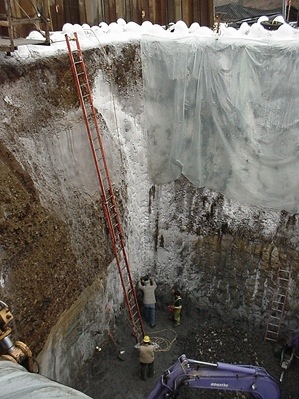
20130901-101708.jpgCold storage: A freeze wall created for a construction project by the company SoilFreeze
How the Fukushima Ice Barrier Will Block Radioactive Groundwater

Japan plans to stop leaking radioactive groundwater at Fukushima with an underground wall of ice. Here’s how it would work. … Vertical pipes are to be drilled or driven into the ground at one-meter intervals, creating what looks like an array of sub-soil fence posts. Fourteen 400-kilowatt refrigeration plants would pump -20 °C to -40 °C coolant down each pipe to absorb heat from the ground, producing an expanding cylinder of frozen earth.

In roughly six weeks, those cylinders would fuse together to form a continuous barrier that keeps groundwater out and contaminants in. The result would be a solid barrier from the surface extending approximately 95 feet down to meet a low-permeability layer of clay and rock. And while it would require long-term chilling to endure, the wall is immune to power outages lasting days or weeks. “It would take months or years to thaw the wall out,” says Daniel Mageau, vice president and design engineer for Seattle-based contractor SoilFreeze.

Reagan’s ’86 Libyan strike is a reasonable model for a ’13 Syrian strike

From Real Clear Politics: 86 Attack on Libya: A Template for U.S. Action Now

Should we choose to demonstrate our resolve in this manner, we must also prepare for the counter-response of Syria and its confederates. While we should prepare for terrorist attacks, kidnapping, or military strikes against U.S., allied, or Israeli targets, we must be equally vigilant in the cyber-domain. The actions of the Syrian Electronic Army already indicate the ability to launch increasingly sophisticated cyber-disruptions, and Syria’s Iranian sponsors also have significant cyber-capabilities that could be used to disrupt key infrastructure, communications, or energy facilities throughout the region. Suspected Iranian cyber-attacks have already targeted Saudi Aramco and Qatari RasGas, and similar attacks could be part of any retaliation.

Using the historical lesson of 1986’s Operation El Dorado Canyon, U.S. and allied forces can incur significant damage against Syria through a limited campaign and avoid the more deleterious outcomes of inaction or prolonged intervention. The bottom line: Like Reagan in Libya, Obama today has few good options — but the use of chemical weapons by Syrian government forces requires a response, albeit a judicious one.

It seems likely that ‘Syria’ will end up a patchwork of mini states, so we probably should encourage the regime to retreat to its bastion on the coast, perhaps with a loose network of the other small sects in mutual support. Once the players set up their own cores, hopefully they would settle into some kind of loose confederation. Of course the jihadis don’t want this, but if there comes a period of settling out, separating and then taking out the hard liners should become feasible, with local support…expect more drone war…

This requires a basis for a future better time, right now the old regime has proven that the only peace they accept is that of subjugation and coercion. So degrading the regimes offensive capability and its ability to limit future intervention while not going for the jugular, in any more than a symbolic way, makes sense beyond mere face saving. Degrade the offensive forces enough and a defensive cordon is their only hope. It is going to be ugly, monstrous, utterly unfair, but there is no other solution given the situation as it stands today.

Reagan had to live with Carter’s mess, Obama has to deal with his own, times have changed, bad outcomes are accelerating in a more densely populated and seriously degraded world…social and ecological degradation are at the root of this disaster and something was going to break. But the level of horror could have been reduced if action had been taken earlier.

I always figured You were a Martian!

20130830-225627.jpg

“The evidence seems to be building that we are actually all Martians; that life started on Mars and came to Earth on a rock,” says Professor Benner. “It’s lucky that we ended up here nevertheless, as certainly Earth has been the better of the two planets for sustaining life. If our hypothetical Martian ancestors had remained on Mars, there might not have been a story to tell.”

Read more at: phys.org

SAE: cool tech, cooler route market

20130830-103643.jpg

The M-KERS flywheel hybrid system is an example of small innovation business R&D that can be readied for volume production by a global manufacturer.

“We have identified that the biggest barrier to commercialization of an innovation is confirming the competitive advantage for a customer when every factor is taken into account,” Deering told AEI. “So we refocused our engineering capability to provide precisely the expertise and resources required during this critical stage.”

Being small can be an advantage for the innovators. Torotrak itself doesn’t have volume manufacturing capability, but it has greatly increased its ability to supply prototype and pilot volumes to help its Tier 1 customers bridge this gap. “This helps a Tier 1 establish the technical and commercial viability of the technology while also creating a growing income stream for Torotrak,” explained company Chairman John Weston. “It’s an approach based on the commercial needs of Tier 1s, moving away from the traditional approach of trying to sell them a relatively unproven idea.”

But the tech applications are cool:

(1)For car applications, Torotrak’s technologies are aimed at downsized engine solutions and hybridization (via flywheel systems) where the designs offer cost and packaging benefits. Its V-Charge variable-drive supercharger for gasoline and diesel engines, now entering a new test and demonstration phase of the latest V2 version, is claimed to be capable of boosting torque from zero to 95% in less than 400 ms, which overcomes one of the liabilities of engine downsizing.

(2)A flywheel-based energy storage system developed by Flybrid Automotive, a company in which Torotrak holds a 20% share, is claimed to deliver performance that is similar to established HEV powertrains with superior packaging, at about one-third the cost.

…(though) “An electric system typically has a large battery and a useful range with the IC engine completely switched off; a flywheel application does not.”

… Flybrid’s flywheel system will propel a vehicle for about half a mile – not impressive per se but very useful in managing the engine operating point. The flywheel could be used to power the car in parts of the drive cycle where the engine would be inefficient…

Spiders in Space! SpiderFab, a fabulous NASA initiative

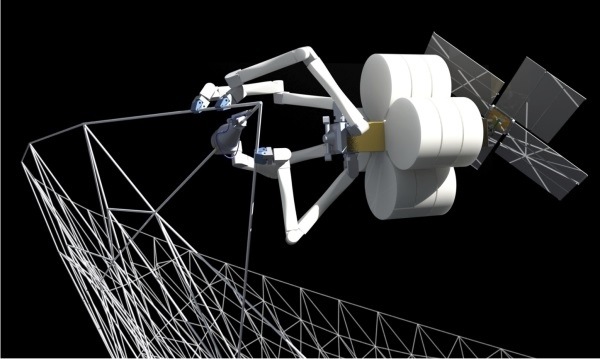
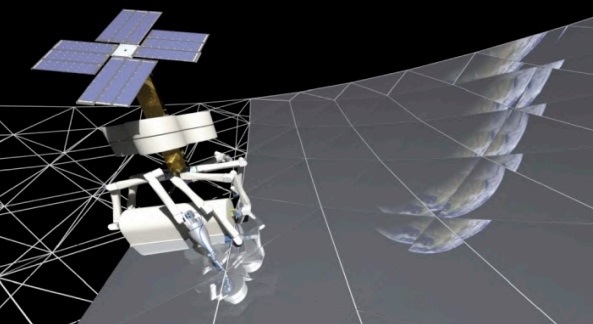
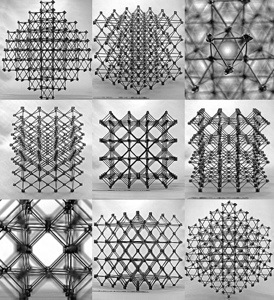
3ders.org a great 3 D printing site has this up…..TUI, a space technology development company based in Bothell, WA is currently developing “SpiderFab” to provide order-of-magnitude packing- and mass- efficiency improvements over current deployable structures and enables construction of kilometer-scale apertures within current launch vehicle capabilities.
20130830-101220.jpg20130830-101230.jpg
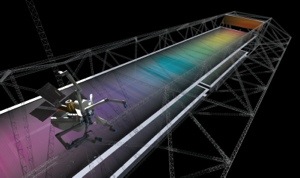
Trusselator
20130830-101401.jpg20130830-101411.jpg

SpiderFab project (credit: Tethers.com)

Go NASA!

Here is the TUI SpiderFab site

And remember this, Lego for the MIT set20130830-102928.jpg20130830-102946.jpg

Design, fab, test, iterate…. NASA gets 3D Printing’s advantages

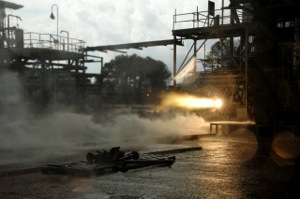
Ars techica: NASA test-fires 3D printed rocket parts: low cost, high power innovation
Propulsion engineers focus on R&D and pushing new tech into private industry.20130828-222007.jpg

A 3D-printed injector plate delivers 20,000 lbs of thrust in a hot-fire test on August 22.
NASA

Fidelity is an issue with 3D printed parts, even using advanced techniques like DMLS. (direct metal laser sintering) Greg Barnett, the lead propulsion engineer on the project, … “The surface is a little rougher,” he explained; however, those variations are within a consistent range and can be compensated for in the design. …

The test results on the 3D printed components have been extremely positive; Barnett and Williams told Ars that the 3D printed injector is equivalent in performance to the traditional machined one. The next step is to move on to an injector with more elements, which will mean testing with more power.

3D printing—or “additive manufacturing,” as it’s called when you get industrial like this—is seen by NASA as a vital way to keep rocket component development costs down. In a lot of ways, the ability to rapidly prototype via DMLS harkens back to the Apollo-era development method of fast physical iteration. Rather than spending a tremendous amount of time performing deep, computer-based analyses of rocket components, NASA can rough in a design and then print and test a component within hours or days.

The deep analysis and simulation tools are still available and still used, but the months- or years-long physical manufacturing time is drastically reduced. This gives engineers the flexibility to design and build in the most optimal fashion. They can use complex software analysis where necessary, but they don’t have to rely solely on computer modeling.

In the days of Apollo, NASA operated with effectively unlimited funding, which it used to create a nation-wide army of contractors with tremendous manufacturing capabilities. Design-by-iteration was feasible because there was so much design going on. These days, the picture is entirely different. “It’s almost a cultural issue,” explained Williams, “where a part can cost so much, you get into what I call ‘analysis paralysis.'” Without additive manufacturing, prototype rocket parts that can withstand actual hot-firing can cost so much and take so long to produce that when you finally get a physical component to test, you’re already hoping the tests show that it’s perfect—otherwise it would take too long to redesign. With additive manufacturing, that paralysis goes away, and engineers can iterate as needed on actual physical components.

Ingenuity unleashed, development accelerated, designs simplified…the power of 3D printing.

The world Often confuses plebiscites with democracy, as if the two were synonymous.

Democracy’s Dog Days by Victor Davis Hanson. August 26th, 2013

We all want democracy to thrive and flourish, but can it?

The Obama administration was quite pleased that the anti-democratic Mohamed Morsi and his Muslim Brotherhood had come to power through a single plebiscite. That confidence required a great deal of moral blindness, both of the present and past.

Like other once-elected authoritarians who believe that democracy is similar to a bus route — in the words of Mr. Erdogan of Turkey, once you get to your stop, you get off — Morsi had no intention of fostering the sort of consensual institutions so necessary for republican government. Almost immediately he gave a de facto green light to cleanse the government of his opponents, to Islamicize a once largely secular society, and to persecute religious minorities.

. It appears that the Turkish Erdogan government and the Islamic Brotherhood utterly hoodwinked the US State Department and Obama into believing a rather threadbare lie, about their support of broad base elective government.

But more basically, only fools believe that good government is simply about elections. We spout ‘democracy!’ and yet our own nation is a republic not a pure democracy and is vastly better off because of that difference. You have to believe in government by and for the people before plebiscites, elections, voting, matter much. Our nation has evolved towards more direct elections over centuries, decades, years, and it is clear some of this is good, but even in our highly stable elective system it is not clear all direct ‘democracy’ is good

Ladies and Gentlemen all…

GENTLEMAN SPEAK: A GENTLEMAN IN PROGRESS

A gentlemen is, first of all, a cultural achievement. No boy is born opening doors or laying his jacket across puddles for his sisters and girlfriends. A boy doesn’t naturally keep his word or forbear a slight when an excuse or a score settled is within easy reach. All those things we might call virtues, and good manners must be learned. But to be learned they must be taught, and that requires first of all that they are esteemed. So you’ll immediately see our predicament: Mr. Darcy is not born, ladies, he is made.

…the American author James Freeman Clarke wrote over a century ago:

“Manliness means perfect manhood, as womanliness implies perfect womanhood. Manliness is the character of man as he ought to be as he was meant to be. It expresses the qualities which go to make a perfect man–truth, courage, conscience, freedom, energy, self-possession, self-control. But it does not exclude gentleness, tenderness, compassion, modesty. A man is not less manly, but more so, because he is gentle. In fact, our word ‘gentlemen’ shows that a typical man must also be a gentle man.”

In the end it is the intent and striving for the imago that is important. But that imago has to have a cultural context and be imagined in touchable icons. This is why father figures are so important…as long as they have something worthy they strive for.

Lies, filthy lies, statistics and spin…the Roman’s started this as well

From StrategyPage: The Golden Age Of Artful Dodging

August 26, 2013: Over the last few decades there has been an explosion in the number of news media outlets. With this has come fierce competition and more interest in gaining an audience than in reporting the news accurately. That has led to there being more propaganda than news out there. That wasn’t a difficult leap to make because in the last century some powerful propaganda methods and techniques for controlling public opinion were developed. Many of these techniques are actually ancient, but never before have they been used so intensively, persistently and in greater variety.

But this sort of thing goes back a long way. Two thousand years ago the ancient Romans saw schools of rhetoric as the best place to send bright young men with potential to be leaders. There schools of rhetoric taught how to use logic and persuasion to make a point and convince people. Some of books those students used are still studied and many of these ancient techniques evolved and mutated into modern propaganda and media spin. The schools at Rhodes were, for well-off ancient Romans, sort of a university education.

Has a good(horrifying) list of techniques, many in use by the media outlets we all listen to…even bloggers and the like, who may use the techniques without knowing they’re techniques.

Stupid…back at the beginning and today

20130827-065512.jpg 20130827-065540.jpgFrom StrategyPage.com: The USAF Stands Like A Rock

August 26, 2013: The U.S. Air Force continues to come up short in its effort to supply enough pilots for its growing UAV fleet. Currently the air force has about 1,300 operators for its 280 large UAVs (about half of them Predators, nearly 40 percent Reapers and the rest Global Hawks). UAV operators are now nearly nine percent of all air force pilots, triple the percentage in 2008. But now the air force is unable to get enough manned aircraft pilots to volunteer to do a three year tour as a UAV operator and cannot train non-pilots fast enough to be career UAV operators. Another problem is dissatisfaction with the job. UAV operators leave the air force at three times the rate of pilots of manned aircraft. There are several reasons for this. UAV operators have a heaver workload than pilots of manned aircraft and less time to study and prepare for promotion opportunities. As a result UAV operators are promoted at a rate 13 percent lower than pilots of manned aircraft. Worst of all, UAV operators are not shown the same respect as pilots who go into the air aboard their aircraft. All this would go away if the air force allowed NCOs (sergeants) to be operators of the larger UAVs but the air force leadership is very hostile to that idea.

Absolutely certain that the AirForce and Navy can come up with highly articulate rationales for their systems but it’s all politics and tradition. In the end stupid since it damages the very ‘institutions’ the ‘traditionalists’ think they are protecting.