Unknown's avatar

About Sci Fi Engineer

Husband Father Writer Engineer

Meta material technique allows for high efficiency coupling of light on a surface AND the ability to switch direction via polarization

20130428-161227.jpg
An electron micrograph shows the nanoscale perforations at the surface of the plasmonic coupler. Credit: Jiao Lin and Balthasar Müller.
(Phys.org) —A Harvard-led team of researchers has created a new type of nanoscale device that converts an optical signal into waves that travel along a metal surface. Significantly, the device can recognize specific kinds of polarized light and accordingly send the signal in one direction or another.

Read more at: http://phys.org/news/2013-04-physicists-left-solution-on-chip-optics.html

Pretty important stuff, ducting light around on chips is an important ability for future electronics…or maybe one should say, nano- electro- optic- systems. Cool stuff…

RADICAL SCIENCE | GETMYO.COM | motion interpretation by reading muscle signaling and position

Cool stuff

20130428-141503.jpg
(Phys.org) —”Wave goodbye to camera-based gesture control.” That is the confident directive coming from a one-year-old Waterloo, Ontario, startup called Thalmic Labs. The company is prepared to ship its next batch of wearable-computing armbands for device controls early next year. The $149 armbands called MYO do not require cameras in order to track hand or arm movements. The armbands can wirelessly control and interact with computers and other digital consumer products by recognizing the electric impulses in users’ muscles.
Read more at: http://phys.org/news/2013-04-myo-armband-muscle-video.html#jCp
Using groundbreaking technology, MYO is able to measure electrical activity in your muscles instantly. The result is a seamless way to interact with computers, and a truly magical sense of control.
Read more at: https://getmyo.com/

20130428-141510.jpg

The Senatorial Launch System | Asteroid Capture | Clueless Politicians | Pork | Engineering Jobs + Corporate Welfare

20130427-221407.jpg

Broadly, the administration envisions sending a probe as soon as 2017 to capture a 25-foot, 500-ton asteroid and tug it near the moon – possibly to a spot about 277,000 miles from Earth that would use competing gravitational forces to allow it to “sit” there. Astronauts flying NASA’s new Orion capsule and Space Launch System rocket then would visit it to take samples and possibly set foot on its surface.

This plan is getting pushback because its not a return to the moon or a Mars landing plan. But the reality is that this idea is all NASA can afford given the cost involved with the Senatorial ( or Space, take your pick) Launch System A Saturn V + class heavy lift direct ascent launch system

The lack of resistance is tied to Senate support of the Space Launch System. Senators from key NASA states – Florida, Texas and Alabama – pushed President Barack Obama to build it, and the asteroid mission is seen as a way to give purpose to the rocket, once criticized as a “rocket to nowhere.”
Illustrative of that point was the initial reaction of Sen. Richard Shelby, R-Ala.
“NASA should continue to explore the universe and challenge scientific and technical boundaries,” he said in a statement. “However, NASA should maintain focus on its core mission and continue development of the Space Launch System so that it will be ready for any future NASA mission.”

So my question is, why the SLS, don’t get me wrong some of the SLS related work like resurrecting the Saturn V F1 engine (as I pointed to a few days ago) is a good thing, but reality is it should be part of getting a commercial venture to back development. NASA shoulddevelop Orion and its support module, but the booster should be gov’t sponsored / stimulated effort as part of a get to the moon, Mars, big asteroids plan, in support of the commercial civilian space efforts.
If you look at all the recently proposed and ongoing civilian efforts and roll in appropriate gov’mnt support you can see a very robust human and robotic space development plan emerge.
Read more at: http://phys.org/news/2013-04-nasa-chief-asteroid-agency.html/

20130427-221747.jpg

Printing tactile images for the blind

3D Printer | Exploring the world of 3D printing | Printing tactile images for the blind
by Cameron Naramore on April 25, 2013
20130425-190348.jpg

A “relief” is an example of what a 3D printed picture could look like.


Etchings, reliefs, contoured renderings of images. But what would a blind Rembrandt create with the right tools, ways for the sighted to gain concept for the inner perceptions of the blind? In the end this will become a new art form.

Ice Giant’s make water exotic

New phase of water could dominate the interiors of Uranus and Neptune : phys.org: by Lisa Zyga

20130425-181811.jpg
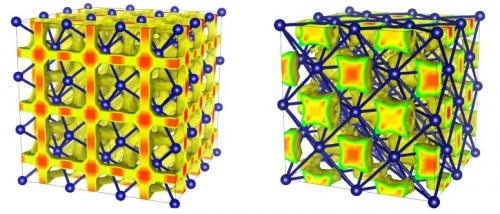
Structure of superionic ice in (left) the bcc phase and (right) the newly discovered and more stable fcc phase. Credit: Hugh F. Wilson, et al. ©2013 American Physical Society
Read more at: http://phys.org/news/2013-04-phase-dominate-interiors-uranus-neptune.html/

Mysterious planets
Although superionic ice doesn’t exist under normal conditions on Earth, the high pressures and temperatures where it is thought to exist are very similar to the predicted conditions in the interiors of Uranus and Neptune.
“Uranus and Neptune are called ice giants because their interiors consist primarily of water, along with ammonia and methane,” Wilson said. “Since the pressure and temperature conditions of the predicted new phase just happen to line up with the pressure and temperature conditions of the interiors of these planets, our new fcc superionic phase may very well be the single most prevalent component of these planets.”
The researchers predict that understanding superionic ice—particularly the stable fcc phase—will offer insight into these ice giants.
“Uranus and Neptune remain very poorly understood at this stage, and their interiors are deeply mysterious,” Wilson said. “The observations we have are very limited—every other planet in the solar system we’ve visited multiple times, but Uranus and Neptune we’ve just done brief flybys with Voyager 2. What we do know is that they have bizarre non-axisymmetric non-dipolar magnetic fields, totally unlike any other planet in our solar system. We also know that they’re extremely similar in mass, density and composition, yet somehow fundamentally different, because Neptune has a significant internal heat source and Uranus hardly emits any heat at all.”
It’s possible that the predicted bcc-to-fcc phase transition may explain the planets’ unusual magnetic fields, although more research is needed in this area.
“Our results imply that Uranus’s and Neptune’s interiors are a bit denser and have an electrical conductivity that is slightly reduced compared to previous models,” Militzer added.
Understanding Uranus and Neptune’s interiors could have implications far beyond our solar system, as well.
“One thing we’re learning from the Kepler mission is that Uranus-like or Neptune-like exoplanets are extremely common,” Wilson said. “They appear to be more common than Jupiter-like gas giants. So understanding our local ice giants is important, because they’re an archetypal example for a huge class of planets out there in the universe.”

20130425-182306.jpg

Graphene conductor is ink-jet-able, flexible, what about 3D enabled?

Inkjet-printed graphene electrodes may lead to low-cost, large-area, possibly foldable devices at phys.org by Lisa Zyga

This is the sort of technology that could enable 3D electronics for all sorts of applications from industrial and maker shops.

20130424-214235.jpg

‘Just’ eye candy

Engineering, science, technology, art

From molecules to gallons: Scaling up fuels created by artificial photosynthesis: Sabin Russell @ :phys.org
Ok so I’m a geek but I see this a neat and a form of artistry.

Self similar patterns, derived from nature’s models, provide a route to scale from meters to sub micron with features of self assembly and ‘natural’ scaling. Allowing fluids to flow in and out of a microscopic reaction site at macro-scales.

20130424-074717.jpg

20130424-074730.jpg

Merlin 1D engine ready for space

The SpaceX Merlin 1D engine, the more powerful, more robust and less expensive
follow on to the operational 1C, has been certified for flight.

20130423-232802.jpg
This is the family, an interesting thing about the Heavy is the plan to have the strap-ons share fuel with the core, consequently when they separate the core is still fully fueled, a big performance increase.

20130423-232817.jpg
The engines have been run far harder than standard rating regimes require, 1) to solidify their ‘man rating’ for future crew lofting flights, 2) because SpaceX wants to reuse them, 3) because SpaceX wants top line insurance rates for their customers even while brining new approaches to the party.

20130423-232832.jpg
Rocket engines, so ugly you just know they’re powerful!