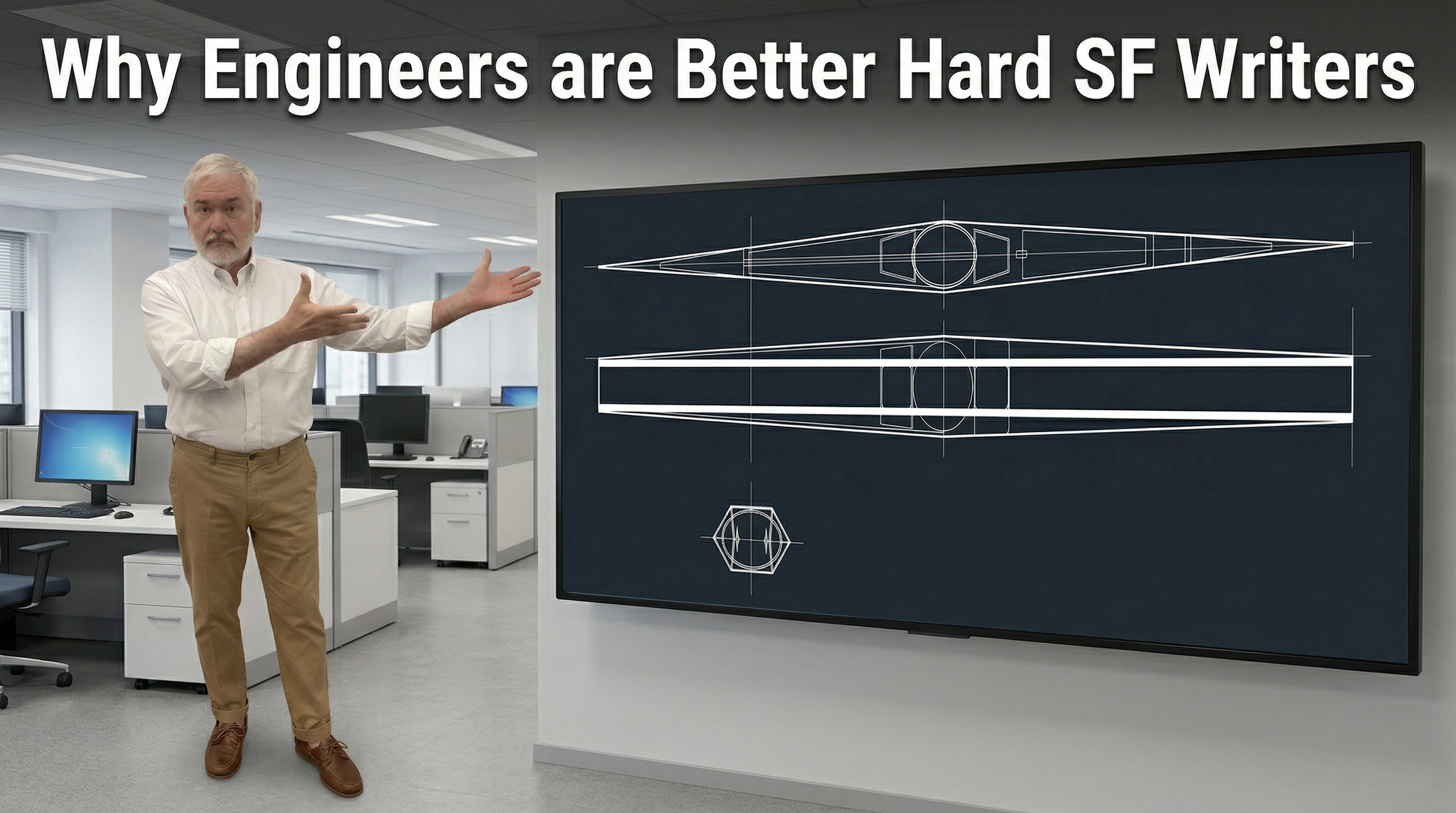
The Physics Produced the Ship

The Dagger Design

Most fictional spacecraft are designed backwards. The writer decides what the ship needs to do dramatically, then invents a reason it can do that. The result is technology that serves the plot. Which is fine, until you need it to do something different in book three, at which point you quietly bend the rules and hope no one notices.

Engineers don’t do that. Not because we’re more disciplined — because we can’t. You don’t change the spec because the schedule is tight. You re-examine the architecture or you live with the constraint.

That instinct, applied to fiction, produces something different.


The principal auxiliary warship in the Sea of Suns universe is called a Dagger. Here’s how it got its name — and it wasn’t because I thought “dagger” sounded good.

The Transit system — the FTL drive in this universe — works through a rail. The rail is a linear gravity generator that manipulates quantum foam to open a wormhole large enough for the ship to pass through. The rail controls volume you can push through: the more mass you want to move between stars, the more rails you need. Compute controls speed: the transit step is a calculation, and the faster you want to step, the more computing capacity you need.

That trade-off isn’t decoration. It’s the architecture.

An auxiliary warship needs to be fast. In this universe, fast means compute capacity. Compute capacity takes up volume inside the vessel. So a fast warship is, almost by definition, a ship that has traded its interior for processors. Twin rails — enough to move a meaningful crew and weapons load — with almost every remaining cubic metre given over to compute. Crew of two to five on a thousand-foot vessel. Not much else aboard.

Now you have a ship that’s fast, carries almost no cargo, and spends all its operational time in real space. Real space means it’s detectable. A detectable warship needs stealth. The most effective passive stealth for a vessel in this universe is minimising cross-section — flat surfaces, minimal radar return. You sheath the hull in flat panels that force the profile into a long, slender blade shape.

The name isn’t metaphor. It’s a description of what the physics produced.

I didn’t design a cool warship and retrofit a justification. The constraints generated the vessel, and then the vessel generated scenes I hadn’t planned, because once you know what a Dagger can and can’t do, certain tactical situations become inevitable.


That’s the engineer’s advantage in hard SF, and it’s not what most people think it is.

It’s not technical accuracy. You’ve invented the technology — accuracy isn’t really the point. It’s that engineering training gives you a specific habit of mind: ask what the constraints produce, not what you need them to produce. Follow the logic. Let the system build itself.

When the system is honest, the world it generates is consistent without effort, because everything follows from the same rules. The Dagger’s tactical role, its crew size, its limitations, the scenarios it enables — none of that required invention. It came out of the trade-off.

The reader doesn’t need to understand the Transit physics to feel that the Dagger is real. They just need to encounter it behaving consistently with itself across the whole story. That consistency is what creates the texture that makes a fictional universe feel inhabited rather than constructed.

Thirty years of engineering taught me that coherent systems generate their own logic. Turns out that works in fiction too.


Why Engineers Write Better Hard SF is on The Unretired Engineer YouTube channel —

Stranded in the Stars, Book One of the Sea of Suns Trilogy, is available on Kindle. The Dagger appears early and often. https://www.amazon.com/Stranded-Stars-M-Harris-ebook/dp/B0GT123PLP

Aliens? The Science Says no….but does it?

Artist’s concept of interstellar object1I/2017 U1 (‘Oumuamua) as it passed through the solar system after its discovery in October 2017. The aspect ratio of up to 10:1 is unlike that of any object seen in our own solar system. Image Credit: European Southern Observatory / M. Kornmesser
From NASA Article

The first known interstellar object to visit our solar system, 1I/2017 U1 ‘Oumuamua, was discovered Oct. 19, 2017 by the University of Hawaii’s Pan-STARRS1 telescope, funded by NASA’s Near-Earth Object Observations (NEOO) Program, which finds and tracks asteroids and comets in Earth’s neighborhood. While originally classified as a comet, observations revealed no signs of cometary activity after it slingshotted past the Sun on Sept. 9, 2017 at a blistering speed of 196,000 miles per hour (87.3 kilometers per second). It was briefly classified as an asteroid until new measurements found it was accelerating slightly, a sign it behaves more like a comet.

This very deep combined image shows the interstellar object ‘Oumuamua at the center of the image. It is surrounded by the trails of faint stars that are smeared as the telescopes tracked the moving comet. Credit: ESO/K. Meech et al.
From NASA Article

The second image is to make you think. Given one of our very powerful telescopes that faint dot circled in the center is all we ever saw of Oumuamua. With our computational tools we could detect that it was accelerating and get an idea of the surface composition but the data we collected was negligible (though also amazing given the distance and velocity of this objectively tiny object.)

Image credit: Kris Snibbe/Harvard file photo.
From Extraterrestrial, Oumamua as Artifiact

Extraterrestrial: On ‘Oumuamua as Artifact

by PAUL GILSTER on FEBRUARY 23, 2021

The reaction to Avi Loeb’s new book Extraterrestrial (Houghton Mifflin Harcourt, 2021) has been quick in coming and dual in nature. I’m seeing a certain animus being directed at the author in social media venues frequented by scientists, not so much for suggesting the possibility that ‘Oumuamua is an extraterrestrial technological artifact, but for triggering a wave of misleading articles in the press. The latter, that second half of the dual reaction, has certainly been widespread and, I have to agree with the critics, often uninformed.

The article in CentauriDreams, as always excellent, discusses the reaction to the book which is very much in line with the arguments of the book itself.

The author of the Book a Harvard Astronomer of high repute, says that the data actually points to Oumuamua being an artifact and that since that theory best fits the data…then it is/was an extraterrestrial visitor. He then goes on review other theories and the way that the science community came together to present a ‘consensus’ that was more about PR and making the life of the average person in the broad community of sky explorers easier rather than doing the hard work of explaining multiple theories and sets of data that left the question very open and leaving a starkly amazing option in play.

Essentially this is about the science and the science community but also about Journalism in its debauched epoch. Many of us grew up with science being pushed as a noble, maybe the last noble, adventure. With heroes and a few villains. Heroes of the mind and of letters and video who didn’t get shot at or mugged or even have to live rough. Carl Sagan, Attenborough, many other names come to mind.

The problem is that these men and women were scientists, academics, with deep knowledge, if often deeply attached to one trope, and great communicators. Far too many of those who followed were/are attached to a trope and its alignment with their desired outcome. Without the background/willingness to understand that even the most beautiful theory may be utterly wrong and always HAS to be able to stand up to any counter evidence presented.

Also the scientific community, once quite a small community is now huge, with all the pressures of a large bureaucratic endeavor to go along to get along; careerism; group think; cliques; etc. And especially in ‘charismatic’ endeavors like space the pressure is to be ‘in the consensus’ and ‘never be caught wrong footed in the lime light.’

Cheers….

Let space bring us together

One of the things that stabilizes a civilization (IMO) is the ability to expand. Like an imaginary pressure vessel with a self replicating gas one can see that at the beginning the gas molecules bouncing around have plenty of space, the ‘pressure’ on the cylinder is negligible and the molecules don’t collide that often. As the molecules become more abundant the pressure and the collisions build. If there is some external source of ‘heat’ say the energy of invention etc, the pressure builds even more and the ‘collisions’ are more violent. Eventually the pressure vessel gives way along fracture lines and explodes releasing the gas into the void….

Carry that image a bit longer, this almost mimics what happened to a lot of the early civilizations. They blew up and dissipated into the wilds leaving almost nothing behind except wreckage.

America (and other civilizational islands let’s call them) had an immense (to them) hinterland. The pressure vessel had something like a sealed bellows (or say a metal balloon) that was stiff, wouldn’t expand easily but could expand. The particles would ‘explore’ this even early on. The cold walls ‘cooled / calmed’ the average energy and allowed the particles to rub along with each other better. As the particles multiply the bellows/balloon expands releasing the pressure on the parent pressure vessel, and providing more wall to absorb energy at the same time.

The human ‘particles’ in our pressure vessel continue to multiply, thankfully, hopefully, at an increasingly slower rate. But the ‘energy’ of invention and desire for ‘happiness’ continues to flow and be amplified by those people/particles. Rearranging the particles…partially solidifying them?…in urban masses lowers the pressure in some ways but does not eliminate it. It provides pseudo new space for the really energetic particles say. But in reality do what we can on this world the pressure will grow too great unless we expand into, we need newSpace.

Even the space (volume) of our solar system is almost infinite from the perspective of the human particles today. And the boundaries of ‘our system’ are only imaginary. The universe is here there and everywhere and there is no reason not to make it ours except fear, mostly fear of ourselves.

We need frontiers, we need places where we can be with ourselves, we need challenge but also calm centers. While the homes we create away from our birthplace will be nothing like what we see today, our descendants will love and hold them just as close to their heart as we hold our home and our memories.

To explore you need Access

Photo of a nuclear thermal propulsion (NTP) system from the Rover/NERVA programs (left) and a cutaway schematic with labels (right). SOURCE: M. Houts et. al., NASA’s Nuclear Thermal Propulsion Project, NASA Marshall Space Flight Center, August 2018, ntrs.nasa.gov/citations/20180006514.
Space Nuclear Propulsion for Human Mars Exploration
National Academics of Sciences, Engineering and Medicine
National Academies Press
2021
[ParabolicArc Executive Summary, Findings & Recommendations from National Academies Report on Space Nuclear Propulsion
February 13, 2021 Doug Messier
]

While a chemically powered trip to Mars is feasible given the ability to lift a lot of mass so orbit, See SpaceX-Elon Musk, this is probably not the solution you would go for first. I think it makes sense as part of the Vision Setting that Musk does but the preference has always been for nuclear propulsion it enables faster (safer) trips and makes reusability even more effective since the ‘shuttles’ are not spending many months in transit each way.

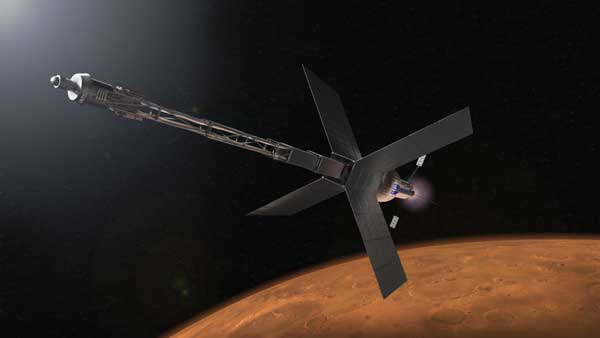
Posit a Freighter something like the illustration below. Departing Mars having dropped of say 2, 3, 4 starships’ worth of cargo. MarsStarships shuttle up and down and provide point to point transport on Mars. EarthStarships shuttle cargo up to earth orbit. Maybe LunarStarships shuttle fuel from production stations on the Moon to reduce the cost of fuel for the starships and the Freighter.

Illustration of a Mars transit habitat and nuclear propulsion system that could one day take astronauts to Mars. (Credits: NASA) [ParabolicArc: Executive Summary, Findings & Recommendations from National Academies Report on Space Nuclear Propulsion February 13, 2021 Doug Messier]

Now you have a system that provides Access to the solar system with significant cargos and the ability to establish and support exploration stations wherever you go.

WOW! A cool SETI theory…

Figure: The Wow! Signal. The peak is 32 times the signal to noise ratio of the observations. Courtesy of Sam Morrell. (From the article)

Not much more to be said so I post the intro to the article from Centauri Dreams, about an article/Theory by James Benford. Cool…

Was the Wow! Signal Due to Power Beaming Leakage?

by PAUL GILSTER on JANUARY 22, 2021

The Wow! signal has a storied history in the SETI community, a one-off detection at the Ohio State ‘Big Ear’ observatory in 1977 that Jim Benford, among others, considers the most interesting candidate signal ever received. A plasma physicist and CEO of Microwave Sciences, Benford returns to Centauri Dreams today with a closer look at the signal and its striking characteristics, which admit to a variety of explanations, though only one that the author believes fits all the parameters. A second reception of the Wow! might tell us a great deal, but is such an event likely? So far all repeat observations have failed and, as Benford points out, there may be reason to assume they must. The essay below is a shorter version of the paper Jim has submitted to Astrobiology.

Our space science Economy has assets

An artist’s depiction of the OSIRIS-REx spacecraft at work at the asteroid Bennu. (Image: © NASA/Goddard Space Flight Center)

NASA’s OSIRIS-REx probe could make a 2nd stop at infamous asteroid Apophis, at Space.com, and noted in several space related blogs, eMags. This sounds like a fantastic use of a remarkable space asset.

The Japanese asteroid prospector Hayabusa2 dropped off its samples from Ryugu at Earth and is on its way for more exploration last year: Farewell, Ryugu! Japan’s Hayabusa2 Probe Leaves Asteroid for Journey Home

These craft and others such as craft like the voyagers continue to return immensely valuable data long after their primary mission is complete. One of the things NASA and other space science organizations struggle with is supporting these ships long after the original funding timeline is past. This is a great problem to have and by and large the money is found since these are very cheap deep space projects in the big picture.

So my title, the economy of ‘outer space’ is all about data, science, prospecting right now. These are valuable assets that we need to support to provide returns orders of magnitude greater than the cost in the sense of other ways of getting that data, data that is both live affirming in its fascination and valuable as part of the bedrock of our understanding of the universe.

Cheers

Cool Stars, Kinda Literally

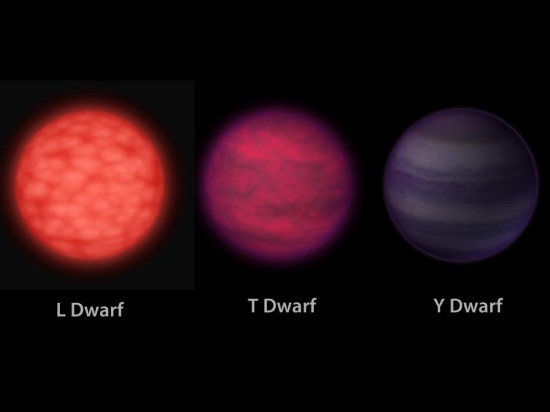
Image: This artist’s conception illustrates what brown dwarfs of different types might look like to a hypothetical interstellar traveler who has flown a spaceship to each one…. Credit: NASA/JPL-Caltech.

There are a class of celestial objects much heavier than our systems Jupiter but about the same size. They are not really planets just balls of dense hot gas, but they are not really stars because they lack the mass to collapse and heat their core to ignite sustained fusion. These Brown Dwarves are probably one of the most common objects in our universe but little is known about them because until recently they were essentially impossible to find. With new tools and new techniques this fascinating class of in between are coming into focus.

Another fascinating article from Centauri Dreams.