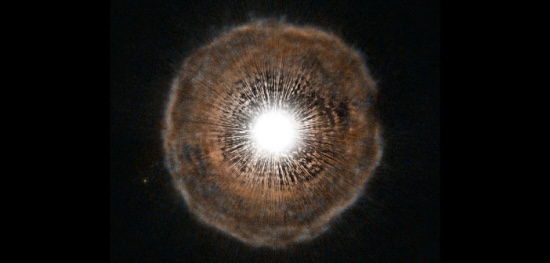
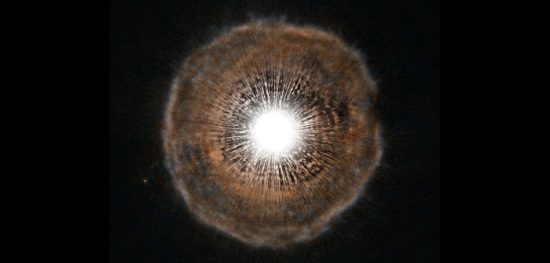
Seems like there must have been a mash up of astrophysics/cosmology/cybernetics a couple of weeks ago there have been a series of articles about computers and the universe. One series pointing out that once could conceive of using the AGB stars in their ‘dusting mode’ (above) as a computing engine.
But on the other side there have been a couple of articles that touch on the metaphysical (philosophical basis of reality) concept that we and our universe, are one vast simulation.
…Oxford philosopher Nick Bostrom’s philosophical thought experiment that the universe is a computer simulation. If that were true, then fundamental physical laws should reveal that the universe consists of individual chunks of space-time, like pixels in a video game. “If we live in a simulation, our world has to be discrete,”….
From: New machine learning theory raises questions about nature of science
….a discrete field theory, which views the universe as composed of individual bits and differs from the theories that people normally create. While scientists typically devise overarching concepts of how the physical world behaves, computers just assemble a collection of data points…..
From: New machine learning theory raises questions about nature of science
…A novel computer algorithm, or set of rules, that accurately predicts the orbits of planets in the solar system….
… devised by a scientist at the U.S. Department of Energy’s (DOE) Princeton Plasma Physics Laboratory (PPPL), applies machine learning, the form of artificial intelligence (AI) that learns from experience, to develop the predictions.
Qin (pronounced Chin) created a computer program into which he fed data from past observations of the orbits of Mercury, Venus, Earth, Mars, Jupiter, and the dwarf planet Ceres. This program, along with an additional program known as a ‘serving algorithm,’ then made accurate predictions of the orbits of other planets in the solar system without using Newton’s laws of motion and gravitation. “Essentially, I bypassed all the fundamental ingredients of physics. I go directly from data to data,” Qin said. “There is no law of physics in the middle…
…”Usually in physics, you make observations, create a theory based on those observations, and then use that theory to predict new observations,” said PPPL physicist Hong Qin, author of a paper detailing the concept in Scientific Reports. “What I’m doing is replacing this process with a type of black box that can produce accurate predictions without using a traditional theory or law.”…
From: New machine learning theory raises questions about nature of science
Ok so now I am going to go a bit sideways and you may want to just go on about your internet day. But while I laude Qin and his team I have a bit of an issue with what he claims re the basis is Philosophy. Not the claim that the discrete field theory sparked his concept exploration. But that the actual system he developed has anything to say about that metaphysical theory.
Taking nothing away from the team what I see seems like a straightforward application of machine learning. In fact a relatively simple one though I would laude the whole idea of applying it to physics in general. A very interesting though, like many interesting insights, oddly obvious is retrospect. (Sorry for the repeated Though clauses…I absolutely see this as fascinating insight…and possibly extremely important…it just seems like D’oh in retrospect.)
As physics is very much aligned with mathematics (I think because the discovery of each was feedback on the other) and mathematics and cybernetics are also deeply intwined it should come as no surprise that computer systems designed to create black box solutions, when fed the right kind of data, will create a black box model of physical phenomena.
The output of science are tools that allow us to predict finite things about the universe we live in, repeatably and accurately. These tools are often used by engineers to enable technologyy that make life better for everyone.
But in many ways this is an engineers (relatively narrow) viewpoint. To some large degree an engineer does not care why the tool works, only that it does and how accurately. Counter to that, a strength of the theory based + mathematical model approach is that it gives you a tool to link the rest of reality to the ‘discrete’ piece you are working on right now. A jumping off point or a linking point to other theories that allows us to move onto other problems and link the
And/But (you knew it was coming) i wonder if this has anything to do with discrete field theory per se. Maybe if the learning algorithm used had that in it this would show something of that nature, but otherwise I do not see this as showing anything in particular other than the ability of learning systems which are in some sense continuous not discrete systems to develop predictive models directly from the data (as Qin says) rather than through the labor intensive methods of theory extraction and proof that has been the basis for scientific exploration since it first evolved in the Middle Ages.
Again BUT, it has been getting harder to develop these ‘deep’ theories. Look at the colliders and other tools that physicists use these days to probe the depths of our reality. In this world there are many things, like Qin’s next test with Nuclear Fusion, where an engineering model might be much more valuable than a ‘theory of this’ if it can be captured and used in a fraction of the time.
It’s all good, fascinating, wonderful…but let’s not get ahead of ourselves.