The Engineer’ Return to the Keyboard

Optimization, Systems, and Storytelling: Why I’m Back

It has been a while—twenty years by some counts—since I first sat down to bridge the gap between “This World” of high-tech engineering and the “Others” I build in my fiction.

For four decades, my world was defined by electronic packaging, power electronics, and project engineering for EVs in both the commercial and defense sectors. I’ve spent my time in the trenches of “Dilbert’s world,” working the real details that make everything from electromagnetic guns to nuclear electric space probes real. But as any engineer knows, a system is only as good as its last optimization.

During those 40-plus years, I was an intermittent author of fiction and science fiction, though at times the projects I worked on felt like fiction as well.

At 68, I was “unretired.” (You can see the genesis of this in my YouTube video, EVs Ate My Job.) Through my channel, The Unretired Engineer, I explore how a lifetime of technical rigor applies to the modern world. Now, I am bringing that same focus back to this blog and my novels. Writing is, after all, the ultimate engineering challenge: building a world from scratch that doesn’t collapse under the weight of its own physics.

What to Expect Moving Forward:

Technical Deep Dives: The “how-to” behind the tech in my books, like the propulsion systems in The Sea of Suns.

The Editing Trench: Updates on my current copy-editing passes for The Sea of Suns and the structural work on Under Siege.

System Reflections: Thoughts on remote work, optimization theory, and the reality of a 40-year career.

World Reflections: Perspectives on technology, civilization, and war based on four decades of study.

The Workshop: Occasional updates on making with wood, resin, and whatever else I’m tinkering with.

I’m no longer just “tinkering.” I’m building. Whether you followed me here from YouTube or found my work on Smashwords, I’m glad you’re part of the system.

Let’s see what we can build next.

For 40 years I was an Engineer 15 of which was remote. It’s a tool not comfort food.

The Systems Engineering of Remote Work: A 40-year viewpoint
https://youtu.be/K6ntv7cWEn0

After 40 years in the industry—from the 13-acre “Industrial Beast” Naval Avionics Center in 1982 to project leadership of global power electronics projects, with long stints working from a home office—I’ve seen the data. In this video, I break down why the “Return to Office” debate is often a struggle against Sub-Optimization.

Explore why the physical office provides the “Grit” required for innovation and the “Density of Learning” necessary for junior engineers, while the home office offers the “Gold” of deep work and the objective distance needed for systems integration.

Internal combustion battery…sort of

The center section is essentially 2 combustion chambers back to back, the orange wrap is the ‘stator’ of an electric generator. When the magnets tied to the piston runs through the stator it generates electricity. Then a spring returns the stator to the center and the cycle (2 cycle) starts again.
Green Car Report :Could Free Piston Range Extenders Broaden the Electric Truck Horizon?
One of the ‘cool’ things about a Free Piston Engine is that it can be packaged in a fairly simple block and because of the elimination of the mechanical drive train and residual mechanical controls (valves, cams, etc) the machine can eat different types of fuel and be tuned in a wide variety of ways quite simply. This makes it compatible with battery electric systems on a packaging and mission program ability standpoint.
A simple schematic of the bare bones of a free piston machine. Other uses have been proposed but tying it to a generator and modern power electronics to make it a range extender is pretty interesting. The technology is derivative of the highly refined IC engines of today and the equally long history of electric generators so this should be something that matures pretty quickly.

Interesting Fuel Cell + Ship Tech

Why the Shipping Industry Is Betting Big on Ammonia
Ammonia engines and fuel cells could slash carbon emissions
Article in IEEE Spectrum MCKIBILLO

There’s a lot to like about ammonia. This colorless fuel emits no carbon dioxide when burned. It’s abundant and common, and it can be made using renewable electricity, water, and air. Both fuel cells and internal combustion engines can use it. Unlike hydrogen, it doesn’t have to be stored in high-pressure tanks or cryogenic dewars. And it has 10 times the energy density of a lithium-ion battery.

So there is always a fly in the ointment of this sort of story…

Manufacturers and engineers must overcome key technical hurdles and safety issues in the design of ammonia engines and fuel cells. Port operators and fuel suppliers must build vast “bunkering” infrastructure so ships can fill ammonia tanks wherever they dock. And energy companies and governments will need to invest heavily in solar, wind, and other renewable-energy capacity to produce enough green ammonia for thousands of ships. Globally, ships consume an estimated 300 million tons of marine fuels every year. Given that ammonia’s energy density is half that of diesel, ammonia producers would need to provide twice as much liquid ammonia, and ships will need to accommodate larger storage tanks, potentially eating into cargo space.

So to fully replace oil you need 600 million tons, all produced artificially in new chemical plants. And then there is the ‘pungent’ odor and its solubility in water where it produces a strong alkaline Ph, the fact that it can cause breathing problems etc etc etc.

Not saying it is not an interesting approach but I really have to wonder how acceptable this would be. This seems like a question of ‘what kind of hell are you willing to accept to reduce CO2’ when the reality is that there are a lot of other things to do first and a lot better future directions to take. I like the idea of the age of windjammers returning…as in the last post.

Cheers

Marine Tech is getting Interesting…

Stena Bulk concept “could be as impactful as containerization”

Not so much for the wings + Wind Turbines + Solar Cells but because it is not one hull but Seven (7!) each one of those sub sections is essentially a barge with a rugged locking mechanism that creates a rigid sea going hull once engaged. This way the crew and propulsion section can drop off and pick up sections either all or one or two as they make their rounds and the expensive bit gets much more use as well as being smaller and less expensive, probably safer as well.

Stena Bulk concept with main ‘sails’ retracted

Russian Naval Renaissance

Russian Navy Commissions 1st Project 20385 Corvette ‘Gremyashchy’
From NavalNews.Com

The Russian Navy has a peculiarly multi faced history and reputation. As a land power with huge boarders and vast empty sectors it would seem more than a little excess to needs. In imperial splendor it has burgeoned into one of the greatest navies in history, in troubled times it has rotted or rusted away. It has lost a whole fleet in battle at the far end of the world after a voyage that would have been hailed as incredible except for the ending. It has built ships, particularly submarines second to none in technological innovation, then had to let them rot. Always a technological arm the Navy has often attracted the best and the brightest and being world spanning it has attracted funding to grow hugely when the money was available….

So today Russia is as troubled as ever, but it does sit astride Eurasia and if you consider the polar region is near the Americas. It has intimate contact with the sea and it needs a Navy for reasons both local and global.

The cycles of growth and rot have shown that one should never count the Russian Navy out. While the end Soviet Era strategic Navy is rotting away the latest revival appears to be underway. The article above and others, point to the fact that after a period of grim news about over runs, decades long builds, etc the lates Corvette program and its predecessor appear successful even given quite sever supply chain issues of geopolitical nature.

While one can poo poo a Corvette as a ‘little ship’ the reality is that this firecracker could conceivably sink a fleet of ships boasting the best of 1980’s technology without a scratch. The US navy and others are rapidly rethinking the efficacy and rational for cruiser sized destroyers in this modern age of omnipresent satellite reconnaissance and hypersonic smart munitions.

But beyond this ship the Russians are once again showing their intellectual metal with A New “Universal Sea Complex” ‘Varan.’

Russia Designs A New Class Of Ship: Universal Sea Complex ‘Varan’

“It is a new approach in domestic and global shipbuilding. The project will represent a new class of naval hardware — universal sea complexes (UMK),”

Nevskoe Bureau (a major Russian designer of ships and the sole designer of aircraft carriers and simulators.). NavalNews.com

The approach appears well suited to modern ship building practices. At modestly sized commercial yards. It is very much in line with the skeptics view of aircraft carriers as a modestly sized vessels with a reasonable strike force. It is not at all a competitor to a US Nuclear Super Carrier in itself but is well suited for power projection and strike warfare in a fleet setting.

Noting the sea gate at the stern you could see this ship as having a significant landing force either standard or optionally providing a strong ‘swing’ capacity. This might be an ideal Marine Amphibious warfare ship.

Looking at it one can see that it is unlikely to be able to support even the noted 24 aircraft wing for long periods at sea. But is that really necessary if you have enough ships so that in peace time they only spend a couple of months at sea at a time?

You can also see that it is unlikely to be able to support a fleet commanders facilities and staff. Again that makes sense, with high bandwidth covert data links the fleet commander can and ought to be separated from the strike asset.

If there was a significant Marine contingent the air arm would have to shrink. But once more you need to think of distributed capability and building your fleet from blocks of assets rather than one Super Duper anything.

So once more the Russians have set the fox among the hens, at least in an intellectual sense. They are always listening and watching the rest of the world and trying to conceive of a ‘system’ that gives them an advantage versus the rest. It’s always a good idea to understand what they are thinking…as in chess and mathematics they are often leaders in the intellectual sphere.

A Cold day in H__L

This is reputedly a photograph of a test from years ago regarding windmills and icing. Almost the reverse of what it has sometimes been used to represent.
BUT….

Did Frozen Wind Turbines Impact the Texas Freeze? Here’s the Data

BY BRYAN PRESTON FEB 17, 2021

As the graph plainly shows, wind generation choked down but natural gas compensated. Coal and even nuclear power generation dipped. Solar generation has been negligible due to cloud cover and several inches of snow and ice.

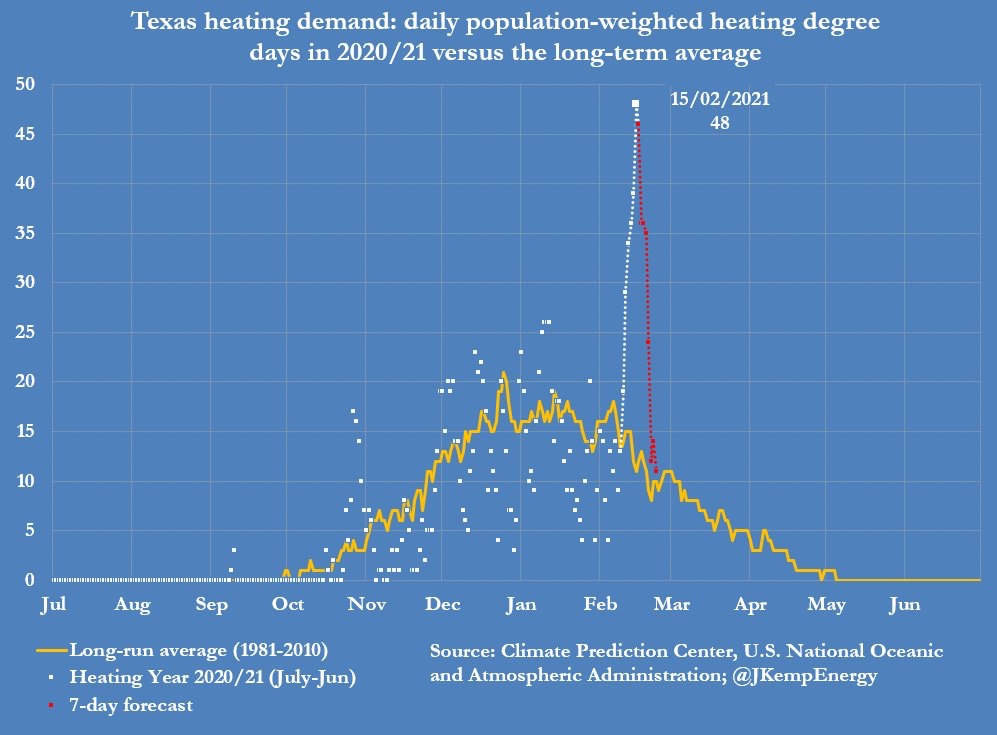
From StreetWiseProfessor: Who Is To Blame for SWP’s (and Texas’s) Forced Outage? “The facts are fairly straightforward. In the face of record demand (reflected in a crazy spike in heating degree days)…

…supply crashed. Supply from all sources. Wind, but also thermal (gas, nuclear, and coal). About 25GW of thermal capacity was offline, due to a variety of weather-related factors. These included most notably steep declines in natural gas production due to well freeze-offs and temperature-related outages of gas processing plants which combined to turn gas powered units into energy limited, rather than capacity limited, resources. They also included frozen instrumentation, water issues, and so on.”

So then Krugman rolls in from the NYT saying ‘Texas’ problem was Windmills is a Lie. ‘ Which itself, while not a lie in Detail, is a lie in Essence. As per some top line thinking in ManhattanContrarian in This Piece Points out:

Total winter generation capacity for the state is about 83 GW, while peak winter usage is about 57 GW. That’s a margin of over 45% of capacity over peak usage. In a fossil-fuel-only or fossil-fuel-plus-nuclear system, where all sources of power are dispatchable, a margin of 20% would be considered normal, and 30% would be luxurious. This margin is well more than that. How could that not be sufficient?

The answer is that Texas has gone crazy for wind. About 30 GW of the 83 GW of capacity are wind.

….sometimes the wind turbines only generate at a rate of 600 MW — which is about 2% of their capacity. And you never know when that’s going to be.

ManhattanContrarian

But/And it IS complicated. 1) You can install deicing systems on windmills but they are expensive to install and maintain and require INPUT of electric power to operate (Texas average weather makes this uneconomic to install.) 2) Texas did this to itself, it has an independent Grid because it IS a country sized state, the grid operator is actually a Bit Wind Crazy…why…because Texas has a lot of wind power. 3) This weather is a Combination of once in a hundred year cold AND snow/cloud cover, which systems are not designed to deal with other than in some degraded manner.

So one can only hope that because it is complicated and is fairly easily shown to be so that the cool heads will be left to work out some solution that prevents this sort of thing happening again. Because yes weather is unpredictable and while this was a 1/100 double header, it did occur and that says that the odds may not be what we think they are and so some mitigation is required. That mitigation is Not more wind, Not stored power, it IS more nuclear +better of all the above, AND better links to the broader national grid, etc, etc.

Myself, I’m planning a new house in the country. Big propane tank, backup generator, solar power, grid tied battery backup, ultra insulated house (for the region.) My prediction is that the grid is going to get worse not better and if you you can, you need to be able to survive without electric power from the mains for a week or more. I can make that possible, though I am in the few percent just because of location, situation, grace of the Infinite.

To explore you need Access

Photo of a nuclear thermal propulsion (NTP) system from the Rover/NERVA programs (left) and a cutaway schematic with labels (right). SOURCE: M. Houts et. al., NASA’s Nuclear Thermal Propulsion Project, NASA Marshall Space Flight Center, August 2018, ntrs.nasa.gov/citations/20180006514.
Space Nuclear Propulsion for Human Mars Exploration
National Academics of Sciences, Engineering and Medicine
National Academies Press
2021
[ParabolicArc Executive Summary, Findings & Recommendations from National Academies Report on Space Nuclear Propulsion
February 13, 2021 Doug Messier
]

While a chemically powered trip to Mars is feasible given the ability to lift a lot of mass so orbit, See SpaceX-Elon Musk, this is probably not the solution you would go for first. I think it makes sense as part of the Vision Setting that Musk does but the preference has always been for nuclear propulsion it enables faster (safer) trips and makes reusability even more effective since the ‘shuttles’ are not spending many months in transit each way.

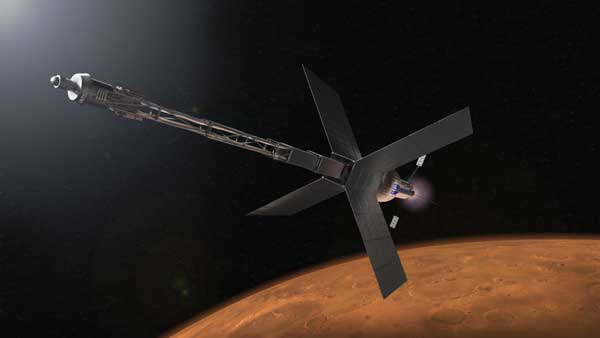
Posit a Freighter something like the illustration below. Departing Mars having dropped of say 2, 3, 4 starships’ worth of cargo. MarsStarships shuttle up and down and provide point to point transport on Mars. EarthStarships shuttle cargo up to earth orbit. Maybe LunarStarships shuttle fuel from production stations on the Moon to reduce the cost of fuel for the starships and the Freighter.

Illustration of a Mars transit habitat and nuclear propulsion system that could one day take astronauts to Mars. (Credits: NASA) [ParabolicArc: Executive Summary, Findings & Recommendations from National Academies Report on Space Nuclear Propulsion February 13, 2021 Doug Messier]

Now you have a system that provides Access to the solar system with significant cargos and the ability to establish and support exploration stations wherever you go.

Space, a little at a time

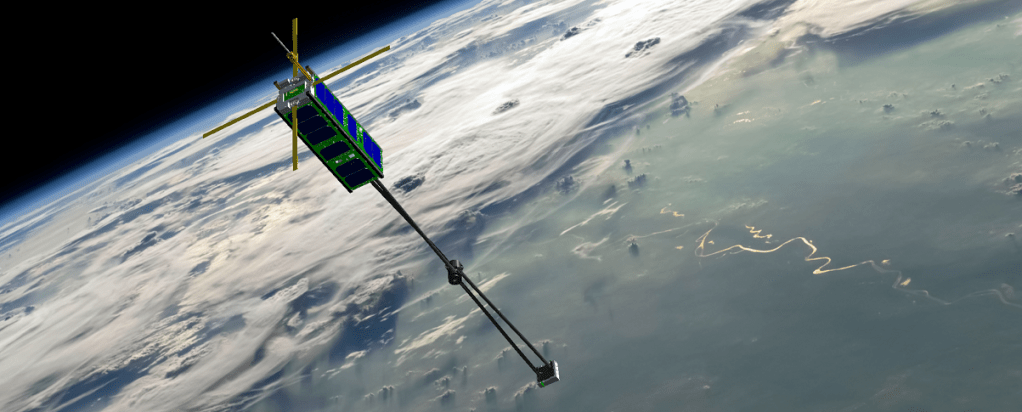
Miniature Tethered Electrodynamics Experiment MiTEE

MiTEE is a cool space experiment out of the University of Michigan. Faculty led, undergraduate, graduate and PhD student team, developed and got launched a cube (stack) satellite that is demonstrating the use of tethers for de orbiting spacecraft, a serious need in this day of thousand plus satellite constellations.

As a note of interest this was on the first successful Virgin Orbit launch.

KelTec the wild man of the gun world

KelTec P50: First Look at the New 50-Round 5.7x28mm Pistol

COMPLETE WITH TWO FN P90 MAGAZINES, THE ALL-NEW KELTEC P50 LOADS BY LIFTING UP THE BARREL AND SLIDING THE 50-ROUND 5.7X28MM MAGAZINE I By BALLISTIC STAFF

So I love the old StarGate series and one of the icons of the series was the use of the FN P90 bull pup machine pistol with its 50 round transparent plastic magazine on the top of the barrel, just popping off the bad Egyptian dudes by the dozens.

The reality was that this French sponsored weapon was not just a prop. Developed in the 80’s as better than a pistol, sub machine gun or rifle for vehicle crews and security forces . Something with the ability to penetrate bullet proof vests, carry a lot of rounds, but not load the soldier down or make a big visual impression.

The core of this is the 5.7×28 mm round…a center fire 22 pistol round. With the ability to accurately hit and penetrate at moderate range. A 9in (ish) barrel in a bull pup kept the weapon short. The plastic magazine was bizarre but worked, stacking the rounds sideways with a ramp/pivot to feed the rounds into the chamber. It doesn’t sound like a great idea but apparently it was engineered well and does the job reliably while providing 50 rounds.

The 5.7×28 round has started to make an impact with the current interest in self defense and concealed carry. The Ruger 57, the FN 57 pistol both are modest successes and deservedly so. Now KelTec kicked it up a whole lot with this 5.7x28mm Maxi Pistol…really a bit of a competitor to the P90 which may be out of print now. It is a wild take on what is supposed to be a personal ‘side arm’ but it certainly makes an impression.

Cheers.