The Physics Produced the Ship

The Dagger Design

Most fictional spacecraft are designed backwards. The writer decides what the ship needs to do dramatically, then invents a reason it can do that. The result is technology that serves the plot. Which is fine, until you need it to do something different in book three, at which point you quietly bend the rules and hope no one notices.

Engineers don’t do that. Not because we’re more disciplined — because we can’t. You don’t change the spec because the schedule is tight. You re-examine the architecture or you live with the constraint.

That instinct, applied to fiction, produces something different.


The principal auxiliary warship in the Sea of Suns universe is called a Dagger. Here’s how it got its name — and it wasn’t because I thought “dagger” sounded good.

The Transit system — the FTL drive in this universe — works through a rail. The rail is a linear gravity generator that manipulates quantum foam to open a wormhole large enough for the ship to pass through. The rail controls volume you can push through: the more mass you want to move between stars, the more rails you need. Compute controls speed: the transit step is a calculation, and the faster you want to step, the more computing capacity you need.

That trade-off isn’t decoration. It’s the architecture.

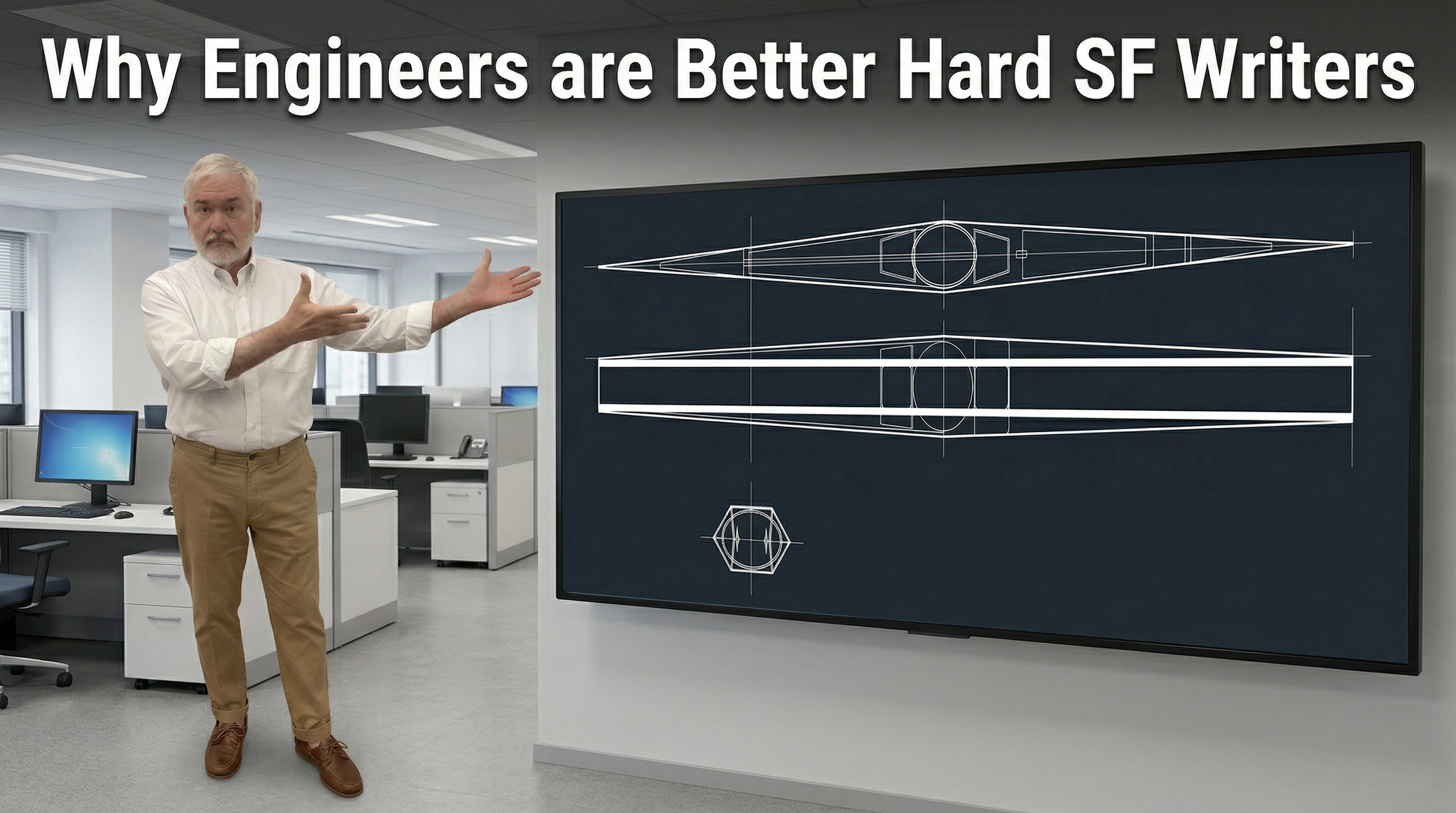
An auxiliary warship needs to be fast. In this universe, fast means compute capacity. Compute capacity takes up volume inside the vessel. So a fast warship is, almost by definition, a ship that has traded its interior for processors. Twin rails — enough to move a meaningful crew and weapons load — with almost every remaining cubic metre given over to compute. Crew of two to five on a thousand-foot vessel. Not much else aboard.

Now you have a ship that’s fast, carries almost no cargo, and spends all its operational time in real space. Real space means it’s detectable. A detectable warship needs stealth. The most effective passive stealth for a vessel in this universe is minimising cross-section — flat surfaces, minimal radar return. You sheath the hull in flat panels that force the profile into a long, slender blade shape.

The name isn’t metaphor. It’s a description of what the physics produced.

I didn’t design a cool warship and retrofit a justification. The constraints generated the vessel, and then the vessel generated scenes I hadn’t planned, because once you know what a Dagger can and can’t do, certain tactical situations become inevitable.


That’s the engineer’s advantage in hard SF, and it’s not what most people think it is.

It’s not technical accuracy. You’ve invented the technology — accuracy isn’t really the point. It’s that engineering training gives you a specific habit of mind: ask what the constraints produce, not what you need them to produce. Follow the logic. Let the system build itself.

When the system is honest, the world it generates is consistent without effort, because everything follows from the same rules. The Dagger’s tactical role, its crew size, its limitations, the scenarios it enables — none of that required invention. It came out of the trade-off.

The reader doesn’t need to understand the Transit physics to feel that the Dagger is real. They just need to encounter it behaving consistently with itself across the whole story. That consistency is what creates the texture that makes a fictional universe feel inhabited rather than constructed.

Thirty years of engineering taught me that coherent systems generate their own logic. Turns out that works in fiction too.


Why Engineers Write Better Hard SF is on The Unretired Engineer YouTube channel —

Stranded in the Stars, Book One of the Sea of Suns Trilogy, is available on Kindle. The Dagger appears early and often. https://www.amazon.com/Stranded-Stars-M-Harris-ebook/dp/B0GT123PLP

The Problem With AI Answers Is That They’re Almost Right

AI slop isn’t obvious. That’s what makes it dangerous.

If an AI gave you complete nonsense, you’d catch it. The problem is when it gives you something fluent, confident, and “mostly” correct — with a flaw buried in the middle that you’ll only find if you already know the answer.

That’s the thing about AI as a research tool: it will give you the consensus view, coherently expressed, at the level of resolution that the training data supports. Where the training data is thin, ambiguous, or where real expertise requires distinguishing between things that *look* similar but aren’t — that’s where it fails. And it fails confidently.

Even when you use the deep research tools there are problems. When I was developing some content for my YouTube channel, The Unretired Engineer I ran into this doing research on Wolfspeed’s financial situation and the SiC power electronics market. I asked a deep research tool to pull together an analysis. What came back looked thorough. The problem was that it took a lot of information that had gone out about the future of the fab and future plans for markets and conflated them with what had happened and what was likely to happen in the near future.

To someone without a background with Wolfspeed and the real status of the SiC, the analysis would have read as authoritative. It wasn’t. It had serious timing errors delivered with confidence. I knew it was wrong because I’d spent years in that space. If I hadn’t, I might have taken it as written.

The fix isn’t to stop using it. The fix is to put yourself into it.

When I work with AI on my engineering writing, or on the physics underlying my novels, I’m not asking it to do the thinking. I’m using my domain knowledge to steer it, to catch the near-misses, and to push it past the consensus into territory where the expertise actually matters. The AI amplifies what I bring. Without that, it’s just averaging.

Use it as a tool. But know what it can’t know — and that’s usually the thing that matters most.


https://youtube.com/shorts/mbmKm_JcHQ0?feature=share

Mark Harris is a system and mechanical engineer and the author of “Stranded in the Stars” (Book One, The Sea of Suns Trilogy), available now on [Amazon](https://www.amazon.com/Stranded-Stars-M-Harris-ebook/dp/B0GT123PLP)
 

The Engineer’ Return to the Keyboard

Optimization, Systems, and Storytelling: Why I’m Back

It has been a while—twenty years by some counts—since I first sat down to bridge the gap between “This World” of high-tech engineering and the “Others” I build in my fiction.

For four decades, my world was defined by electronic packaging, power electronics, and project engineering for EVs in both the commercial and defense sectors. I’ve spent my time in the trenches of “Dilbert’s world,” working the real details that make everything from electromagnetic guns to nuclear electric space probes real. But as any engineer knows, a system is only as good as its last optimization.

During those 40-plus years, I was an intermittent author of fiction and science fiction, though at times the projects I worked on felt like fiction as well.

At 68, I was “unretired.” (You can see the genesis of this in my YouTube video, EVs Ate My Job.) Through my channel, The Unretired Engineer, I explore how a lifetime of technical rigor applies to the modern world. Now, I am bringing that same focus back to this blog and my novels. Writing is, after all, the ultimate engineering challenge: building a world from scratch that doesn’t collapse under the weight of its own physics.

What to Expect Moving Forward:

Technical Deep Dives: The “how-to” behind the tech in my books, like the propulsion systems in The Sea of Suns.

The Editing Trench: Updates on my current copy-editing passes for The Sea of Suns and the structural work on Under Siege.

System Reflections: Thoughts on remote work, optimization theory, and the reality of a 40-year career.

World Reflections: Perspectives on technology, civilization, and war based on four decades of study.

The Workshop: Occasional updates on making with wood, resin, and whatever else I’m tinkering with.

I’m no longer just “tinkering.” I’m building. Whether you followed me here from YouTube or found my work on Smashwords, I’m glad you’re part of the system.

Let’s see what we can build next.

The Unretired Engineer

Stealing the Lede

eye4dtail

So 2 of our most obnoxious ‘organizationoids’ Black Lives Matter (the Org not the concept) and Antifa (Anti-fascist, which is technically anybody not International Socialist[communist-marxist]) essentially stole the lede as I think of that term, which is essentially something like ‘mind share tag.’

When you steal the lede, that mind share tag, you make it very difficult for others to use certain symbols, words, phrases, ideas, against you. For Black Lives Matter it made it very difficult for the majority to point out that they were destroying little B black, little L lives, by destroying their neighborhoods and local businesses. As has been pointed out elsewhere, it made pointing out that Antifa is exactly fascistic in its heart and operations, impossible to make stick.

In both of those cases i think the evidence clearly shows that if you seal off some of our ability to communicate things clearly it in fact makes it very difficult to combat actions and ideas until the damage is obvious enough not to be obfuscated by ‘mere’ words.

A Grumpy Economist on ‘Pay toilets and NYT: a free market microcosm’

So John Cochran of the Grumpy Economist seems a good Blog to follow, this was an amusing reminder of something I had not thought about for awhile.

Nicholas Kristof in Sunday’s New York Times asks a pressing — often quite pressing — question. Why are there no public toilets in America? He is right. He calls for a federal infrastructure plan to fix the problem: “Sure, we need investments to rebuild bridges, highways and, yes, electrical grids, but perhaps America’s most disgraceful infrastructure failing is its lack of public toilets.”

The absence of pay toilets is in fact a delightful encapsulation of so much that is wrong with American economic policy these days. Activists decide free toilets are a human right, and successfully campaign to ban pay toilets. For a while, existing toilets are free. Within months, upkeep is ignored, attendants disappear, and the toilets become disgusting, dysfunctional and dangerous. Within a few years there are no toilets at all. Fast forward, and we have a resurgence of medieval diseases that come from people relieving themselves al fresco. Now let’s talk about rent control.

As with so many things ‘basic human rights’ as espoused by progressives are no such thing. Anything that requires other peoples money is not a ‘basic’ human right, and as above toilets cost money and public toilets are paid for by the public, or no one at all.

In England I know (having lived there in my early years and visited later) that pay toilets were/are a thing. And I have seen articles out of the UK and Europe discussing all sorts of robo toilets to make maintenance less of an issue (Though I seem to remember a story about someone getting stuck in one [maybe after cheating the pay system?] and getting thoroughly doused in sanitizer etc which I think killed that attempt.}

I seem to remember as above that the toilets were 1Penney (spend a penny anyone?) when I was a kid. It was enough. Why is this so onerous on the ‘poor’ you can usually find a penny on the ground if you look hard enough. So what gives? What gives is that the people who can’t pay, won’t pay for this, they would never spend any kind of ‘coin’ that might go for a drink or drugs or….who wants to know? Anyway this is another one of those stupid, stupid, stupid misreadings of human nature and human needs that is tearing our culture, and civilization, apart.

So in flyover country this is not that much of an issue. Any normal fast food facility has reasonably clean bathrooms that are maintained for the use of their staff and customers. While they discourage the use by none customers it’s not that big a deal. I usually stop at a McDonald’s for the ‘duty’ and then get a coffee or a small snack to pay for the privilege and am happy to do it.

I don’t like Cities Sam I am, I do not like them man oh man…

Cheers

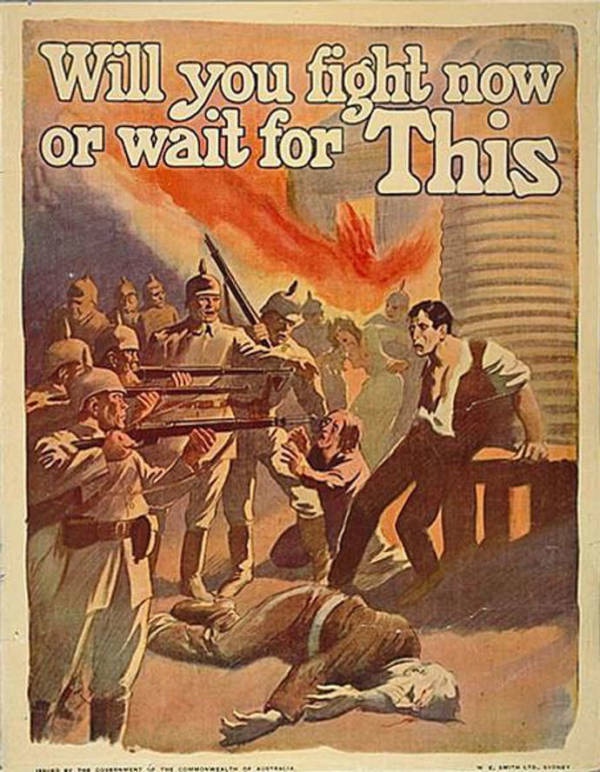
What is Propaganda…is it different from Fake News?…and when is it good?

World War I Posters That Reveal The Roots Of Modern Propaganda
By All That’s Interesting
Published December 26, 2016
Updated July 10, 2019
These World War 1 propaganda posters courtesy of the U.S. government provide a fascinating look at the America of a century ago in the midst of the Great War.

Propaganda is the more or less systematic effort to manipulate other people’s beliefs, attitudes, or actions by means of symbols (words, gestures, banners, monuments, music, clothing, insignia, hairstyles, designs on coins and postage stamps, and so forth). Deliberateness and a relatively heavy emphasis on manipulation distinguish propaganda from casual conversation or the free and easy exchange of ideas. Propagandists have a specified goal or set of goals. To achieve these, they deliberately select facts, arguments, and displays of symbols and present them in ways they think will have the most effect. To maximize effect, they may omit or distort pertinent facts or simply lie, and they may try to divert the attention of the reactors (the people they are trying to sway) from everything but their own propaganda

Britannica.Com on propoganda

If you spend a little time absorbing this definition, which I have no quarrels with, you realize that what has been called Fake News IS largely propaganda. And it IS what the US main ‘news’ channels have been practicing either somewhat accidentally or wholly on purpose for the last four + years. They have been sliding this way for decades, but it has slid down the slippery slope to this end state quickly over the last few. (Read my post on the Slippery Slope…Looking at this topic I realize this fits into that type of situation where the Slippery Slope IS real, all of the actors are in the game and the rational observers have no impact on the discussion AT ALL.)

Is propaganda ever appropriate? I can’t tell. I want to say NO not just ‘no’ but HELL NO. But I also see how difficult it is to get everyone on the same page and can see that in general if there is a societal good that can be defined as good then making sure everyone is on board is also Good.

But….a big one.

I think that with the internet and the explosion of ‘near news’ outlets propaganda and its bastard child fake news, become a very bad thing, an evil. Everyone learns about propaganda and they get a sense that in the right hands it is good, in the wrong hands evil. So it becomes something of a standard tool, because most of us sees ourselves as ‘one of the goodies.’

The problem is that all sides of an argument get a say. And the general populace do not have any deep sense of the reality of the situation, the nuances etc. If you are generally democrat you see mostly democratic outlets. If Republican, only that line. While some resources have centrist voices, they always shade one way or the other, and many outlets are purposefully hard over. One sides group gets propagandized into believing their trope. The other side…the other trope.

So as Scott Adams points out you get two radically different views of the same events. To the point that the objective reality is not even in view of those Propagandized. Take the Capital Intrusion, one side, clearly nonviolent non threatening, good people protesting an at least murky election. Other side clearly violent, threatening, evil people trying to overturn a fair election.

In this war of propaganda the sides are purposefully pushed apart because the two sides cannot allow ‘their’ segment to wander. They rationalize deleting and spinning evidence because it is not important and muddles the message.

But…but…but…Journalism!

Journalism has always had an element of propaganda. Yes there was a period when it was portrayed as noble to present just the facts but the reality was this was at best a hope and and worst cover. The same schools essentially TEACH propaganda methodology as part of the general curriculum. Again in one view to inoculate the innocent learner against it, in the alternate view because there are a lot of jobs in public relations and advertising (commercial propaganda) as well as in government (propaganda straight up though usually for neutral topics.)

And….”If it bleeds it leads”…news of any kind is a business. Yes you can point to billionaire liberals propping up various operations. But at the end of the day news is a good way of turning a billionaire into a millionaire over time. The operation has to support itself or it cannot last long. What Fox showed was that you could get an audience by bending the news in a certain way and feeding them ‘red meat.’ They tried (mostly succeeded) in a combination of pretty clearly factual reporting and pretty clearly politicized editorial content though you were left to guess which was which. What a lot of the other operations couldn’t really afford to do was the factual reporting. Editorializing everything with a left bend…but left the audience to believe they were giving ‘just the facts.’ And probably excusing themselves by closing their senses to the much more complex nuanced reality…Though it is not clear most of those smiles even have a clue that such a thing exists.

Sigh…and so it goes…have not watched TV/Video news in years, probably never will again, despise its superficiality and bias. Even the talk shows are uselessly one sided these days, making the whole realm a danger to the Republic rather than the safety valve it was supposed to be.

Aliens? The Science Says no….but does it?

Artist’s concept of interstellar object1I/2017 U1 (‘Oumuamua) as it passed through the solar system after its discovery in October 2017. The aspect ratio of up to 10:1 is unlike that of any object seen in our own solar system. Image Credit: European Southern Observatory / M. Kornmesser
From NASA Article

The first known interstellar object to visit our solar system, 1I/2017 U1 ‘Oumuamua, was discovered Oct. 19, 2017 by the University of Hawaii’s Pan-STARRS1 telescope, funded by NASA’s Near-Earth Object Observations (NEOO) Program, which finds and tracks asteroids and comets in Earth’s neighborhood. While originally classified as a comet, observations revealed no signs of cometary activity after it slingshotted past the Sun on Sept. 9, 2017 at a blistering speed of 196,000 miles per hour (87.3 kilometers per second). It was briefly classified as an asteroid until new measurements found it was accelerating slightly, a sign it behaves more like a comet.

This very deep combined image shows the interstellar object ‘Oumuamua at the center of the image. It is surrounded by the trails of faint stars that are smeared as the telescopes tracked the moving comet. Credit: ESO/K. Meech et al.
From NASA Article

The second image is to make you think. Given one of our very powerful telescopes that faint dot circled in the center is all we ever saw of Oumuamua. With our computational tools we could detect that it was accelerating and get an idea of the surface composition but the data we collected was negligible (though also amazing given the distance and velocity of this objectively tiny object.)

Image credit: Kris Snibbe/Harvard file photo.
From Extraterrestrial, Oumamua as Artifiact

Extraterrestrial: On ‘Oumuamua as Artifact

by PAUL GILSTER on FEBRUARY 23, 2021

The reaction to Avi Loeb’s new book Extraterrestrial (Houghton Mifflin Harcourt, 2021) has been quick in coming and dual in nature. I’m seeing a certain animus being directed at the author in social media venues frequented by scientists, not so much for suggesting the possibility that ‘Oumuamua is an extraterrestrial technological artifact, but for triggering a wave of misleading articles in the press. The latter, that second half of the dual reaction, has certainly been widespread and, I have to agree with the critics, often uninformed.

The article in CentauriDreams, as always excellent, discusses the reaction to the book which is very much in line with the arguments of the book itself.

The author of the Book a Harvard Astronomer of high repute, says that the data actually points to Oumuamua being an artifact and that since that theory best fits the data…then it is/was an extraterrestrial visitor. He then goes on review other theories and the way that the science community came together to present a ‘consensus’ that was more about PR and making the life of the average person in the broad community of sky explorers easier rather than doing the hard work of explaining multiple theories and sets of data that left the question very open and leaving a starkly amazing option in play.

Essentially this is about the science and the science community but also about Journalism in its debauched epoch. Many of us grew up with science being pushed as a noble, maybe the last noble, adventure. With heroes and a few villains. Heroes of the mind and of letters and video who didn’t get shot at or mugged or even have to live rough. Carl Sagan, Attenborough, many other names come to mind.

The problem is that these men and women were scientists, academics, with deep knowledge, if often deeply attached to one trope, and great communicators. Far too many of those who followed were/are attached to a trope and its alignment with their desired outcome. Without the background/willingness to understand that even the most beautiful theory may be utterly wrong and always HAS to be able to stand up to any counter evidence presented.

Also the scientific community, once quite a small community is now huge, with all the pressures of a large bureaucratic endeavor to go along to get along; careerism; group think; cliques; etc. And especially in ‘charismatic’ endeavors like space the pressure is to be ‘in the consensus’ and ‘never be caught wrong footed in the lime light.’

Cheers….

Oh, oh oh, oh oh oh oh, I saw this coming !

Last Cassette Player Standing, in American Conservative
From the article: Photo by: Education Images/Universal Images Group via Getty Images)

Money Quote:

There are several lessons here. The most politically salient is that in manufacturing, as in cooking, it is possible to “lose the recipe.” And with an accelerating pace of technological progress, it is possible to lose it in an alarmingly short span of time. This is perhaps the strongest argument for some form of industrial policy or trade protection: the recognition that the national value of manufacturing often lies not so much in the end product itself, but in the accumulated knowledge that goes into it, and the possibility of old processes and knowledge sparking new innovation. Of course, innovation is itself what killed the high-end cassette player. But many otherwise viable industries have struggled under the free-trade regime.

The fact is that technology is not embodied in a drawing or set of drawings or any set of instructions. It is embodied in human knowledge. One of the key problems in the industry is the loss of control a customer or prime has when they let a contractor develop the ‘data package’ and ‘product’ with no significant oversight. While the customer or prime may ‘own’ the IP because they paid for it, the fact is that the majority of the capability is embodied in the people and culture of the contractor not in any set of information.

The Hellenic world had machines as complex as early clocks and steam engines of a sort but lost the recipe in a few generations or less. Various complex building skills and wooden machines, metalworking and early chemistry were discovered then lost again and again because the data package was in human brains and examples. This is why the printing press and its ilk were so incredibly important to technological lift off. Along with a culture of progress and invention.

We are far ahead of that world but as above, not above losing the recipe of a complex technology. This is one of the drivers behind Computer Aided Design, Analysis, Documentation, Fabrication. Our cybernetic tools have the ability to record the data package in detail at least for certain classes of things so that we should be able to maintain the ability to replicate things. Making special, small run, even one off technological objects rational rather than nutty.

But at the same time I think that it is likely that the artisanal ethos and products will remain relevant and even increase in value as people shift away from a mind/economy/culture of scarcity to at least sufficiency and if we survive and expand into the universe eventually richness. These transitions will be extremely difficult because they are at odds with many tens of thousands of years of genetic/mimetic coding of our behaviors based on small group hunter gatherers and kin group bonding. Those transition will be enabled by machines that fabricate, even machines that invent. What will happen when humans loose the recipe for technological advancement, because too few engage in the complex enterprise of development??? Is that the point of the Rise of the Machine???

Let space bring us together

One of the things that stabilizes a civilization (IMO) is the ability to expand. Like an imaginary pressure vessel with a self replicating gas one can see that at the beginning the gas molecules bouncing around have plenty of space, the ‘pressure’ on the cylinder is negligible and the molecules don’t collide that often. As the molecules become more abundant the pressure and the collisions build. If there is some external source of ‘heat’ say the energy of invention etc, the pressure builds even more and the ‘collisions’ are more violent. Eventually the pressure vessel gives way along fracture lines and explodes releasing the gas into the void….

Carry that image a bit longer, this almost mimics what happened to a lot of the early civilizations. They blew up and dissipated into the wilds leaving almost nothing behind except wreckage.

America (and other civilizational islands let’s call them) had an immense (to them) hinterland. The pressure vessel had something like a sealed bellows (or say a metal balloon) that was stiff, wouldn’t expand easily but could expand. The particles would ‘explore’ this even early on. The cold walls ‘cooled / calmed’ the average energy and allowed the particles to rub along with each other better. As the particles multiply the bellows/balloon expands releasing the pressure on the parent pressure vessel, and providing more wall to absorb energy at the same time.

The human ‘particles’ in our pressure vessel continue to multiply, thankfully, hopefully, at an increasingly slower rate. But the ‘energy’ of invention and desire for ‘happiness’ continues to flow and be amplified by those people/particles. Rearranging the particles…partially solidifying them?…in urban masses lowers the pressure in some ways but does not eliminate it. It provides pseudo new space for the really energetic particles say. But in reality do what we can on this world the pressure will grow too great unless we expand into, we need newSpace.

Even the space (volume) of our solar system is almost infinite from the perspective of the human particles today. And the boundaries of ‘our system’ are only imaginary. The universe is here there and everywhere and there is no reason not to make it ours except fear, mostly fear of ourselves.

We need frontiers, we need places where we can be with ourselves, we need challenge but also calm centers. While the homes we create away from our birthplace will be nothing like what we see today, our descendants will love and hold them just as close to their heart as we hold our home and our memories.