Your Charger Was Up. It Just Didn’t Work

I put together a short take on this — under 60 seconds if you want the headline — and a longer breakdown of the structural issues for those who want the full picture.

▶ Short version (60 sec): https://youtube.com/shorts/zG-VtW2MUDU
▶ Full video: https://youtu.be/KAHuoShGtrs

There’s a number the EV charging industry reports, and there’s a number drivers experience. They’re not the same number, and the gap between them tells you everything about how this program was designed.

Operator-reported uptime: 97–99%. That’s a contractual requirement under the NEVI program — the $5 billion infrastructure buildout funded by the Bipartisan Infrastructure Law. On paper, the chargers are up nearly all the time.

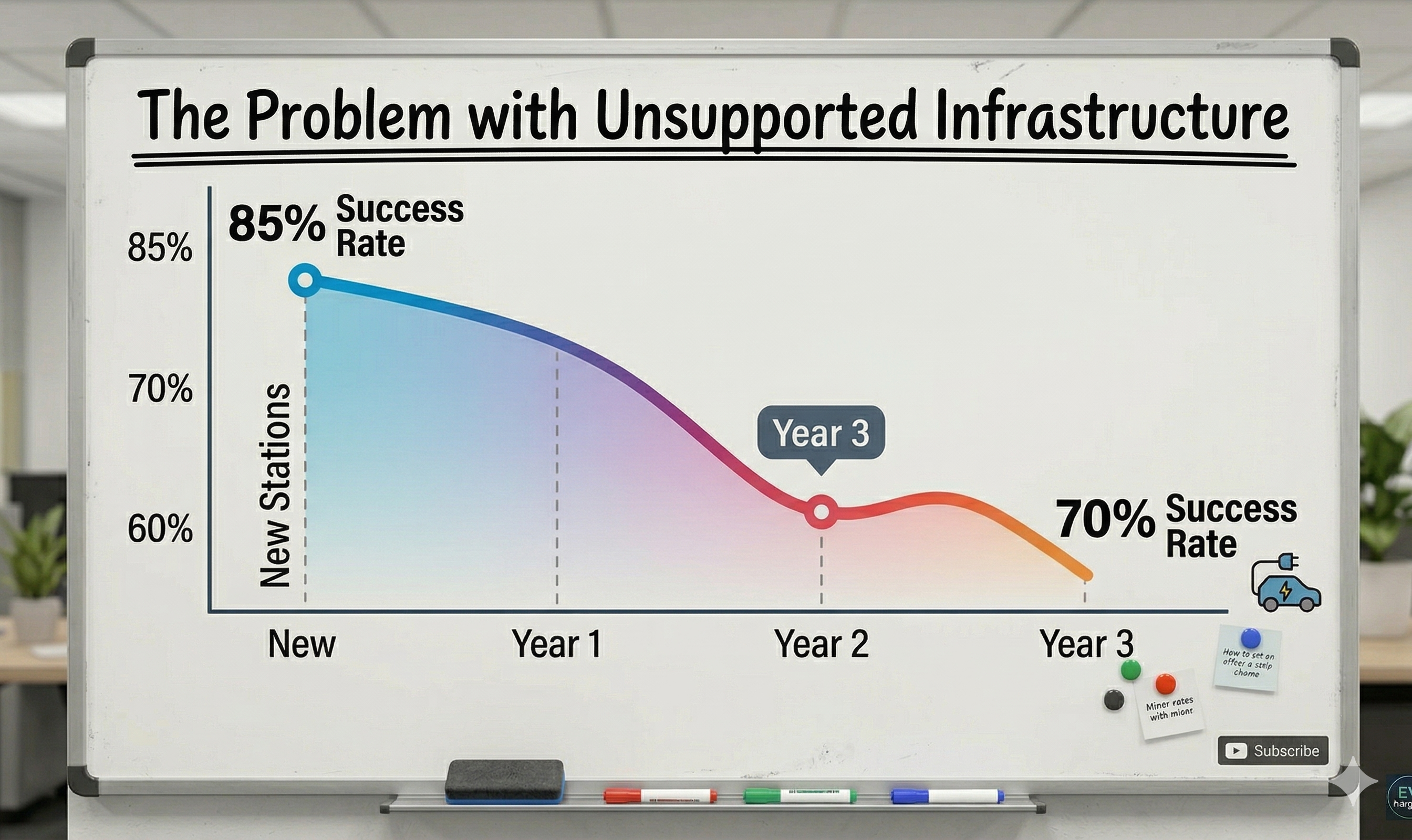
Actual charging success rate: 71%. About a quarter of the time you pull up to a charger, it doesn’t charge your car. In many of those cases, nothing you do will make it work.

These are different measurements. One tells you the charger is technically online. The other tells you whether it did the job. Nobody confused them by accident — the reporting structure was built around the metric that was easiest to meet, not the one that mattered to the driver.

The failure modes are concrete. 60% of failed sessions involve a charger that’s simply out of service — not a user error, not a handshake problem between your car and the network. The unit isn’t working. Hardware degrades, software hangs, payment systems drop, network connections fail. These are expected failure modes for a system like this. The question is whether you’ve built the operations and maintenance infrastructure to catch them quickly. Most of the NEVI deployment didn’t.

New stations run at about 85% success. By year three, the same stations are below 70%. The 2022–2024 installation wave is hitting that curve now. And after year five, operators have no contractual obligation to keep the units running at all — so a lot of that hardware is simply going to disappear.

The regional variation is the tell. Seattle and LA are seeing failure rates around 24–25%. The East South Central region is at 7%. Same national program. The difference is operator discipline — some built real support structures, most didn’t, because the incentive to do so was never in the grant milestones.

This is a solvable problem. The gas station model solved it a century ago: put someone on site, make them responsible for the equipment, give drivers somewhere to wait while they charge. There’s no reason a charging network can’t work the same way. It’s just that the program specification never required it, so it wasn’t built.

Infrastructure problems are always systemic. The hardware is fine. The failure is organizational.


Mark Harris is a systems and mechanical engineer and the author of Stranded in the Stars (Book One, The Sea of Suns Trilogy). He writes about engineering, technology, and the creative life at This World and Others.
The Physics Produced the Ship

The Dagger Design

Most fictional spacecraft are designed backwards. The writer decides what the ship needs to do dramatically, then invents a reason it can do that. The result is technology that serves the plot. Which is fine, until you need it to do something different in book three, at which point you quietly bend the rules and hope no one notices.

Engineers don’t do that. Not because we’re more disciplined — because we can’t. You don’t change the spec because the schedule is tight. You re-examine the architecture or you live with the constraint.

That instinct, applied to fiction, produces something different.


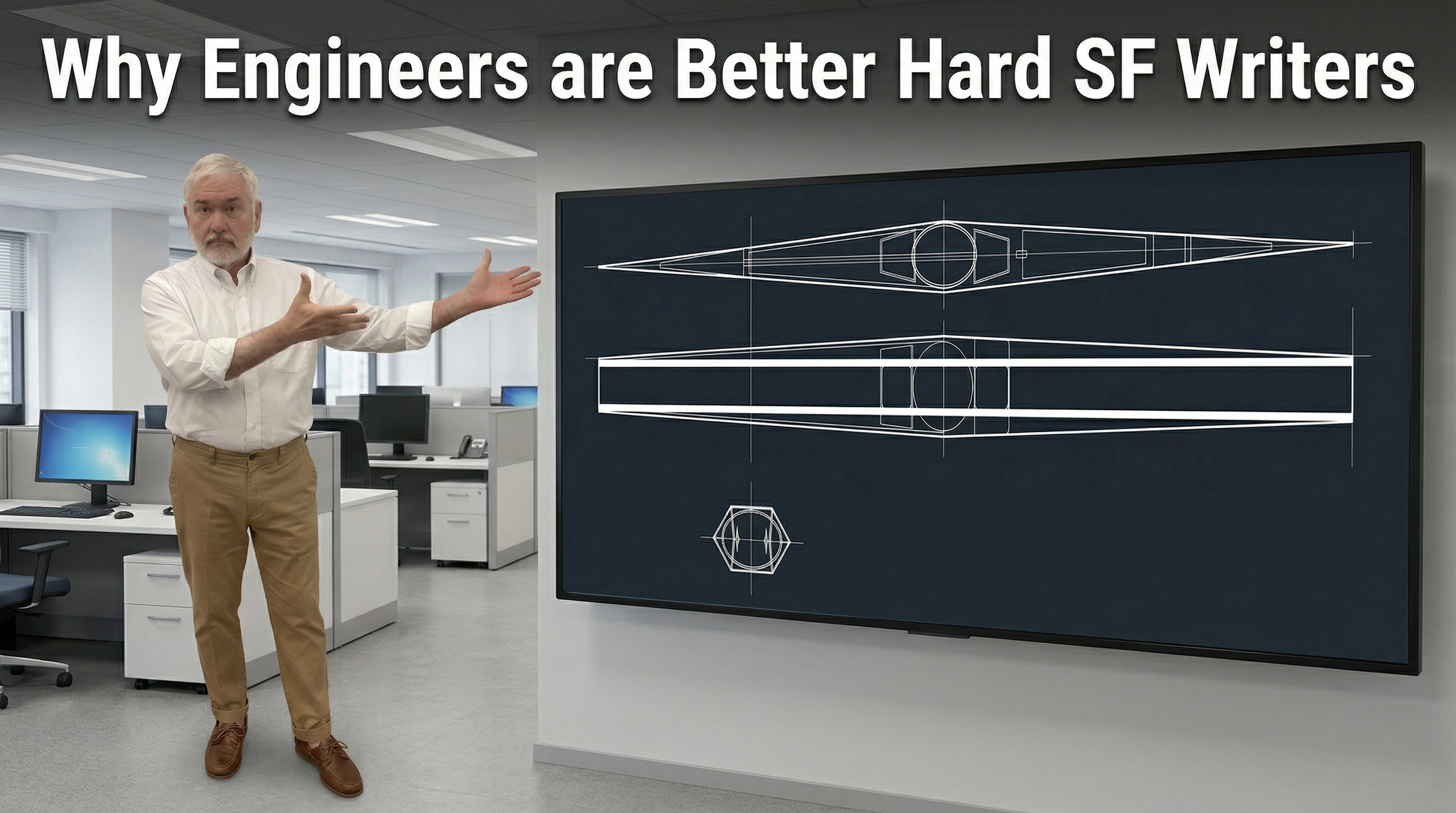
The principal auxiliary warship in the Sea of Suns universe is called a Dagger. Here’s how it got its name — and it wasn’t because I thought “dagger” sounded good.

The Transit system — the FTL drive in this universe — works through a rail. The rail is a linear gravity generator that manipulates quantum foam to open a wormhole large enough for the ship to pass through. The rail controls volume you can push through: the more mass you want to move between stars, the more rails you need. Compute controls speed: the transit step is a calculation, and the faster you want to step, the more computing capacity you need.

That trade-off isn’t decoration. It’s the architecture.

An auxiliary warship needs to be fast. In this universe, fast means compute capacity. Compute capacity takes up volume inside the vessel. So a fast warship is, almost by definition, a ship that has traded its interior for processors. Twin rails — enough to move a meaningful crew and weapons load — with almost every remaining cubic metre given over to compute. Crew of two to five on a thousand-foot vessel. Not much else aboard.

Now you have a ship that’s fast, carries almost no cargo, and spends all its operational time in real space. Real space means it’s detectable. A detectable warship needs stealth. The most effective passive stealth for a vessel in this universe is minimising cross-section — flat surfaces, minimal radar return. You sheath the hull in flat panels that force the profile into a long, slender blade shape.

The name isn’t metaphor. It’s a description of what the physics produced.

I didn’t design a cool warship and retrofit a justification. The constraints generated the vessel, and then the vessel generated scenes I hadn’t planned, because once you know what a Dagger can and can’t do, certain tactical situations become inevitable.


That’s the engineer’s advantage in hard SF, and it’s not what most people think it is.

It’s not technical accuracy. You’ve invented the technology — accuracy isn’t really the point. It’s that engineering training gives you a specific habit of mind: ask what the constraints produce, not what you need them to produce. Follow the logic. Let the system build itself.

When the system is honest, the world it generates is consistent without effort, because everything follows from the same rules. The Dagger’s tactical role, its crew size, its limitations, the scenarios it enables — none of that required invention. It came out of the trade-off.

The reader doesn’t need to understand the Transit physics to feel that the Dagger is real. They just need to encounter it behaving consistently with itself across the whole story. That consistency is what creates the texture that makes a fictional universe feel inhabited rather than constructed.

Thirty years of engineering taught me that coherent systems generate their own logic. Turns out that works in fiction too.


Why Engineers Write Better Hard SF is on The Unretired Engineer YouTube channel —

Stranded in the Stars, Book One of the Sea of Suns Trilogy, is available on Kindle. The Dagger appears early and often. https://www.amazon.com/Stranded-Stars-M-Harris-ebook/dp/B0GT123PLP

The Problem With AI Answers Is That They’re Almost Right

AI slop isn’t obvious. That’s what makes it dangerous.

If an AI gave you complete nonsense, you’d catch it. The problem is when it gives you something fluent, confident, and “mostly” correct — with a flaw buried in the middle that you’ll only find if you already know the answer.

That’s the thing about AI as a research tool: it will give you the consensus view, coherently expressed, at the level of resolution that the training data supports. Where the training data is thin, ambiguous, or where real expertise requires distinguishing between things that *look* similar but aren’t — that’s where it fails. And it fails confidently.

Even when you use the deep research tools there are problems. When I was developing some content for my YouTube channel, The Unretired Engineer I ran into this doing research on Wolfspeed’s financial situation and the SiC power electronics market. I asked a deep research tool to pull together an analysis. What came back looked thorough. The problem was that it took a lot of information that had gone out about the future of the fab and future plans for markets and conflated them with what had happened and what was likely to happen in the near future.

To someone without a background with Wolfspeed and the real status of the SiC, the analysis would have read as authoritative. It wasn’t. It had serious timing errors delivered with confidence. I knew it was wrong because I’d spent years in that space. If I hadn’t, I might have taken it as written.

The fix isn’t to stop using it. The fix is to put yourself into it.

When I work with AI on my engineering writing, or on the physics underlying my novels, I’m not asking it to do the thinking. I’m using my domain knowledge to steer it, to catch the near-misses, and to push it past the consensus into territory where the expertise actually matters. The AI amplifies what I bring. Without that, it’s just averaging.

Use it as a tool. But know what it can’t know — and that’s usually the thing that matters most.


https://youtube.com/shorts/mbmKm_JcHQ0?feature=share

Mark Harris is a system and mechanical engineer and the author of “Stranded in the Stars” (Book One, The Sea of Suns Trilogy), available now on [Amazon](https://www.amazon.com/Stranded-Stars-M-Harris-ebook/dp/B0GT123PLP)
 

The Engineer’ Return to the Keyboard

Optimization, Systems, and Storytelling: Why I’m Back

It has been a while—twenty years by some counts—since I first sat down to bridge the gap between “This World” of high-tech engineering and the “Others” I build in my fiction.

For four decades, my world was defined by electronic packaging, power electronics, and project engineering for EVs in both the commercial and defense sectors. I’ve spent my time in the trenches of “Dilbert’s world,” working the real details that make everything from electromagnetic guns to nuclear electric space probes real. But as any engineer knows, a system is only as good as its last optimization.

During those 40-plus years, I was an intermittent author of fiction and science fiction, though at times the projects I worked on felt like fiction as well.

At 68, I was “unretired.” (You can see the genesis of this in my YouTube video, EVs Ate My Job.) Through my channel, The Unretired Engineer, I explore how a lifetime of technical rigor applies to the modern world. Now, I am bringing that same focus back to this blog and my novels. Writing is, after all, the ultimate engineering challenge: building a world from scratch that doesn’t collapse under the weight of its own physics.

What to Expect Moving Forward:

Technical Deep Dives: The “how-to” behind the tech in my books, like the propulsion systems in The Sea of Suns.

The Editing Trench: Updates on my current copy-editing passes for The Sea of Suns and the structural work on Under Siege.

System Reflections: Thoughts on remote work, optimization theory, and the reality of a 40-year career.

World Reflections: Perspectives on technology, civilization, and war based on four decades of study.

The Workshop: Occasional updates on making with wood, resin, and whatever else I’m tinkering with.

I’m no longer just “tinkering.” I’m building. Whether you followed me here from YouTube or found my work on Smashwords, I’m glad you’re part of the system.

Let’s see what we can build next.

The Unretired Engineer

Internal combustion battery…sort of

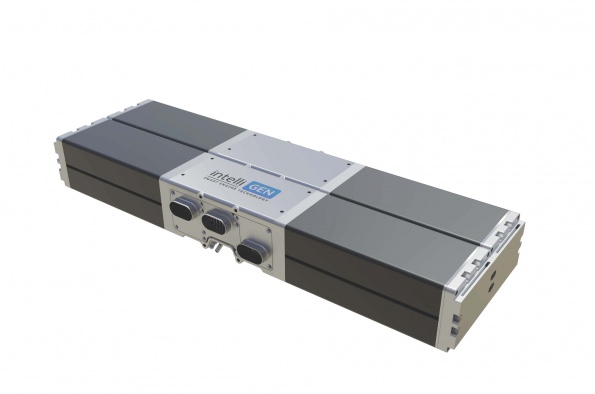
The center section is essentially 2 combustion chambers back to back, the orange wrap is the ‘stator’ of an electric generator. When the magnets tied to the piston runs through the stator it generates electricity. Then a spring returns the stator to the center and the cycle (2 cycle) starts again.
Green Car Report :Could Free Piston Range Extenders Broaden the Electric Truck Horizon?
One of the ‘cool’ things about a Free Piston Engine is that it can be packaged in a fairly simple block and because of the elimination of the mechanical drive train and residual mechanical controls (valves, cams, etc) the machine can eat different types of fuel and be tuned in a wide variety of ways quite simply. This makes it compatible with battery electric systems on a packaging and mission program ability standpoint.
A simple schematic of the bare bones of a free piston machine. Other uses have been proposed but tying it to a generator and modern power electronics to make it a range extender is pretty interesting. The technology is derivative of the highly refined IC engines of today and the equally long history of electric generators so this should be something that matures pretty quickly.

Interesting Fuel Cell + Ship Tech

Why the Shipping Industry Is Betting Big on Ammonia
Ammonia engines and fuel cells could slash carbon emissions
Article in IEEE Spectrum MCKIBILLO

There’s a lot to like about ammonia. This colorless fuel emits no carbon dioxide when burned. It’s abundant and common, and it can be made using renewable electricity, water, and air. Both fuel cells and internal combustion engines can use it. Unlike hydrogen, it doesn’t have to be stored in high-pressure tanks or cryogenic dewars. And it has 10 times the energy density of a lithium-ion battery.

So there is always a fly in the ointment of this sort of story…

Manufacturers and engineers must overcome key technical hurdles and safety issues in the design of ammonia engines and fuel cells. Port operators and fuel suppliers must build vast “bunkering” infrastructure so ships can fill ammonia tanks wherever they dock. And energy companies and governments will need to invest heavily in solar, wind, and other renewable-energy capacity to produce enough green ammonia for thousands of ships. Globally, ships consume an estimated 300 million tons of marine fuels every year. Given that ammonia’s energy density is half that of diesel, ammonia producers would need to provide twice as much liquid ammonia, and ships will need to accommodate larger storage tanks, potentially eating into cargo space.

So to fully replace oil you need 600 million tons, all produced artificially in new chemical plants. And then there is the ‘pungent’ odor and its solubility in water where it produces a strong alkaline Ph, the fact that it can cause breathing problems etc etc etc.

Not saying it is not an interesting approach but I really have to wonder how acceptable this would be. This seems like a question of ‘what kind of hell are you willing to accept to reduce CO2’ when the reality is that there are a lot of other things to do first and a lot better future directions to take. I like the idea of the age of windjammers returning…as in the last post.

Cheers

Oh, oh oh, oh oh oh oh, I saw this coming !

Last Cassette Player Standing, in American Conservative
From the article: Photo by: Education Images/Universal Images Group via Getty Images)

Money Quote:

There are several lessons here. The most politically salient is that in manufacturing, as in cooking, it is possible to “lose the recipe.” And with an accelerating pace of technological progress, it is possible to lose it in an alarmingly short span of time. This is perhaps the strongest argument for some form of industrial policy or trade protection: the recognition that the national value of manufacturing often lies not so much in the end product itself, but in the accumulated knowledge that goes into it, and the possibility of old processes and knowledge sparking new innovation. Of course, innovation is itself what killed the high-end cassette player. But many otherwise viable industries have struggled under the free-trade regime.

The fact is that technology is not embodied in a drawing or set of drawings or any set of instructions. It is embodied in human knowledge. One of the key problems in the industry is the loss of control a customer or prime has when they let a contractor develop the ‘data package’ and ‘product’ with no significant oversight. While the customer or prime may ‘own’ the IP because they paid for it, the fact is that the majority of the capability is embodied in the people and culture of the contractor not in any set of information.

The Hellenic world had machines as complex as early clocks and steam engines of a sort but lost the recipe in a few generations or less. Various complex building skills and wooden machines, metalworking and early chemistry were discovered then lost again and again because the data package was in human brains and examples. This is why the printing press and its ilk were so incredibly important to technological lift off. Along with a culture of progress and invention.

We are far ahead of that world but as above, not above losing the recipe of a complex technology. This is one of the drivers behind Computer Aided Design, Analysis, Documentation, Fabrication. Our cybernetic tools have the ability to record the data package in detail at least for certain classes of things so that we should be able to maintain the ability to replicate things. Making special, small run, even one off technological objects rational rather than nutty.

But at the same time I think that it is likely that the artisanal ethos and products will remain relevant and even increase in value as people shift away from a mind/economy/culture of scarcity to at least sufficiency and if we survive and expand into the universe eventually richness. These transitions will be extremely difficult because they are at odds with many tens of thousands of years of genetic/mimetic coding of our behaviors based on small group hunter gatherers and kin group bonding. Those transition will be enabled by machines that fabricate, even machines that invent. What will happen when humans loose the recipe for technological advancement, because too few engage in the complex enterprise of development??? Is that the point of the Rise of the Machine???