The Physics Produced the Ship

The Dagger Design

Most fictional spacecraft are designed backwards. The writer decides what the ship needs to do dramatically, then invents a reason it can do that. The result is technology that serves the plot. Which is fine, until you need it to do something different in book three, at which point you quietly bend the rules and hope no one notices.

Engineers don’t do that. Not because we’re more disciplined — because we can’t. You don’t change the spec because the schedule is tight. You re-examine the architecture or you live with the constraint.

That instinct, applied to fiction, produces something different.


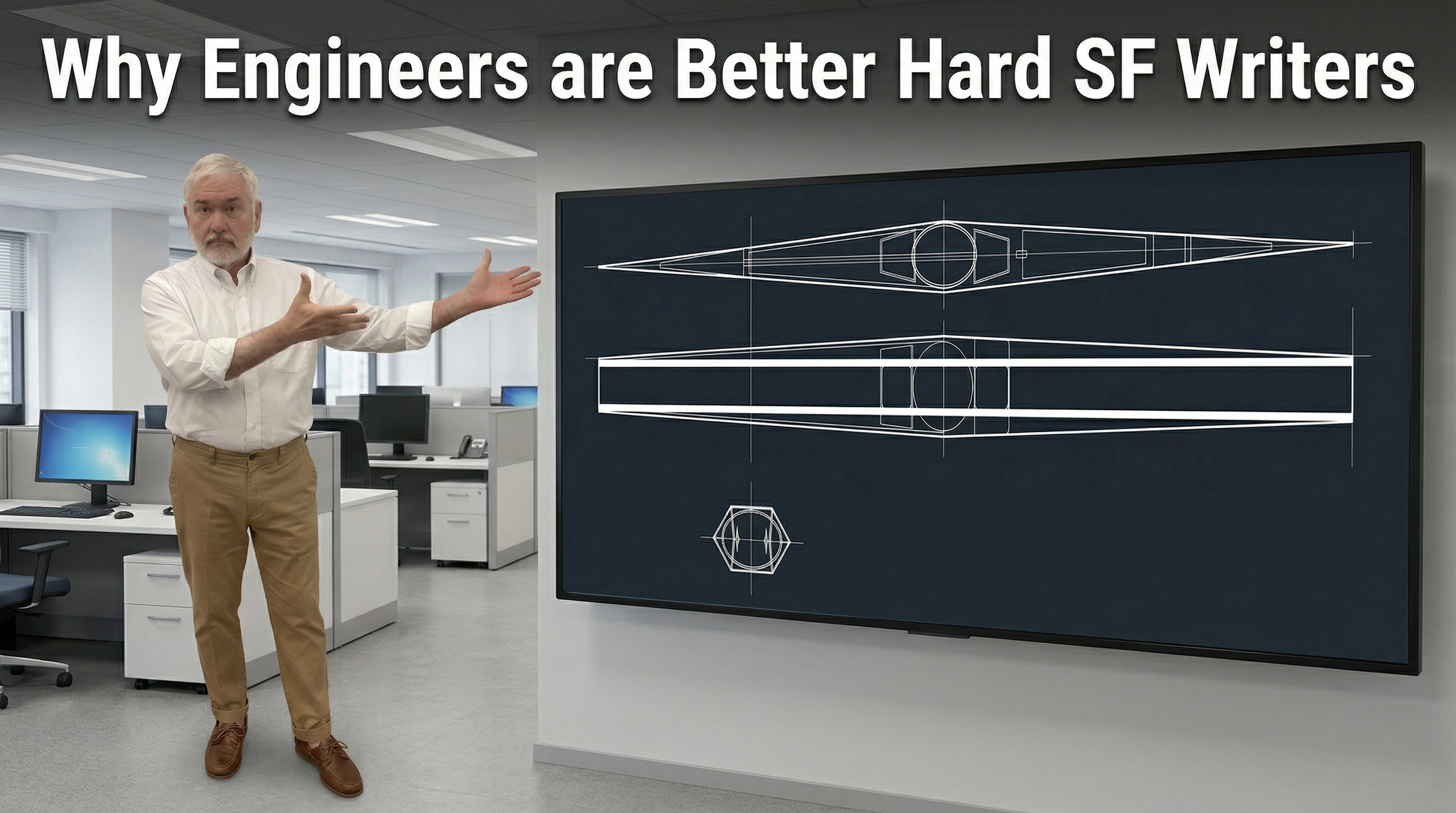
The principal auxiliary warship in the Sea of Suns universe is called a Dagger. Here’s how it got its name — and it wasn’t because I thought “dagger” sounded good.

The Transit system — the FTL drive in this universe — works through a rail. The rail is a linear gravity generator that manipulates quantum foam to open a wormhole large enough for the ship to pass through. The rail controls volume you can push through: the more mass you want to move between stars, the more rails you need. Compute controls speed: the transit step is a calculation, and the faster you want to step, the more computing capacity you need.

That trade-off isn’t decoration. It’s the architecture.

An auxiliary warship needs to be fast. In this universe, fast means compute capacity. Compute capacity takes up volume inside the vessel. So a fast warship is, almost by definition, a ship that has traded its interior for processors. Twin rails — enough to move a meaningful crew and weapons load — with almost every remaining cubic metre given over to compute. Crew of two to five on a thousand-foot vessel. Not much else aboard.

Now you have a ship that’s fast, carries almost no cargo, and spends all its operational time in real space. Real space means it’s detectable. A detectable warship needs stealth. The most effective passive stealth for a vessel in this universe is minimising cross-section — flat surfaces, minimal radar return. You sheath the hull in flat panels that force the profile into a long, slender blade shape.

The name isn’t metaphor. It’s a description of what the physics produced.

I didn’t design a cool warship and retrofit a justification. The constraints generated the vessel, and then the vessel generated scenes I hadn’t planned, because once you know what a Dagger can and can’t do, certain tactical situations become inevitable.


That’s the engineer’s advantage in hard SF, and it’s not what most people think it is.

It’s not technical accuracy. You’ve invented the technology — accuracy isn’t really the point. It’s that engineering training gives you a specific habit of mind: ask what the constraints produce, not what you need them to produce. Follow the logic. Let the system build itself.

When the system is honest, the world it generates is consistent without effort, because everything follows from the same rules. The Dagger’s tactical role, its crew size, its limitations, the scenarios it enables — none of that required invention. It came out of the trade-off.

The reader doesn’t need to understand the Transit physics to feel that the Dagger is real. They just need to encounter it behaving consistently with itself across the whole story. That consistency is what creates the texture that makes a fictional universe feel inhabited rather than constructed.

Thirty years of engineering taught me that coherent systems generate their own logic. Turns out that works in fiction too.


Why Engineers Write Better Hard SF is on The Unretired Engineer YouTube channel —

Stranded in the Stars, Book One of the Sea of Suns Trilogy, is available on Kindle. The Dagger appears early and often. https://www.amazon.com/Stranded-Stars-M-Harris-ebook/dp/B0GT123PLP

The Problem With AI Answers Is That They’re Almost Right

AI slop isn’t obvious. That’s what makes it dangerous.

If an AI gave you complete nonsense, you’d catch it. The problem is when it gives you something fluent, confident, and “mostly” correct — with a flaw buried in the middle that you’ll only find if you already know the answer.

That’s the thing about AI as a research tool: it will give you the consensus view, coherently expressed, at the level of resolution that the training data supports. Where the training data is thin, ambiguous, or where real expertise requires distinguishing between things that *look* similar but aren’t — that’s where it fails. And it fails confidently.

Even when you use the deep research tools there are problems. When I was developing some content for my YouTube channel, The Unretired Engineer I ran into this doing research on Wolfspeed’s financial situation and the SiC power electronics market. I asked a deep research tool to pull together an analysis. What came back looked thorough. The problem was that it took a lot of information that had gone out about the future of the fab and future plans for markets and conflated them with what had happened and what was likely to happen in the near future.

To someone without a background with Wolfspeed and the real status of the SiC, the analysis would have read as authoritative. It wasn’t. It had serious timing errors delivered with confidence. I knew it was wrong because I’d spent years in that space. If I hadn’t, I might have taken it as written.

The fix isn’t to stop using it. The fix is to put yourself into it.

When I work with AI on my engineering writing, or on the physics underlying my novels, I’m not asking it to do the thinking. I’m using my domain knowledge to steer it, to catch the near-misses, and to push it past the consensus into territory where the expertise actually matters. The AI amplifies what I bring. Without that, it’s just averaging.

Use it as a tool. But know what it can’t know — and that’s usually the thing that matters most.


https://youtube.com/shorts/mbmKm_JcHQ0?feature=share

Mark Harris is a system and mechanical engineer and the author of “Stranded in the Stars” (Book One, The Sea of Suns Trilogy), available now on [Amazon](https://www.amazon.com/Stranded-Stars-M-Harris-ebook/dp/B0GT123PLP)
 

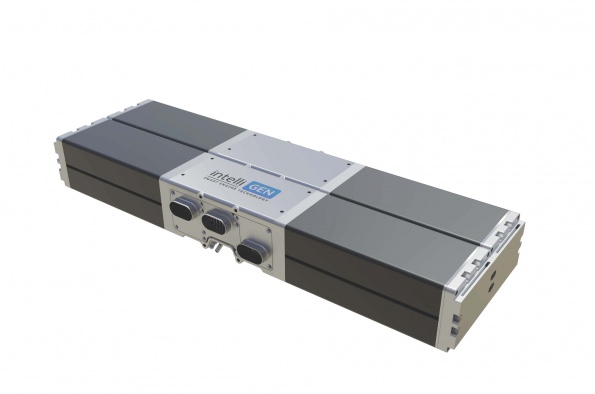
Internal combustion battery…sort of

The center section is essentially 2 combustion chambers back to back, the orange wrap is the ‘stator’ of an electric generator. When the magnets tied to the piston runs through the stator it generates electricity. Then a spring returns the stator to the center and the cycle (2 cycle) starts again.
Green Car Report :Could Free Piston Range Extenders Broaden the Electric Truck Horizon?
One of the ‘cool’ things about a Free Piston Engine is that it can be packaged in a fairly simple block and because of the elimination of the mechanical drive train and residual mechanical controls (valves, cams, etc) the machine can eat different types of fuel and be tuned in a wide variety of ways quite simply. This makes it compatible with battery electric systems on a packaging and mission program ability standpoint.
A simple schematic of the bare bones of a free piston machine. Other uses have been proposed but tying it to a generator and modern power electronics to make it a range extender is pretty interesting. The technology is derivative of the highly refined IC engines of today and the equally long history of electric generators so this should be something that matures pretty quickly.

Marine Tech is getting Interesting…

Stena Bulk concept “could be as impactful as containerization”

Not so much for the wings + Wind Turbines + Solar Cells but because it is not one hull but Seven (7!) each one of those sub sections is essentially a barge with a rugged locking mechanism that creates a rigid sea going hull once engaged. This way the crew and propulsion section can drop off and pick up sections either all or one or two as they make their rounds and the expensive bit gets much more use as well as being smaller and less expensive, probably safer as well.

Stena Bulk concept with main ‘sails’ retracted

Oh, oh oh, oh oh oh oh, I saw this coming !

Last Cassette Player Standing, in American Conservative
From the article: Photo by: Education Images/Universal Images Group via Getty Images)

Money Quote:

There are several lessons here. The most politically salient is that in manufacturing, as in cooking, it is possible to “lose the recipe.” And with an accelerating pace of technological progress, it is possible to lose it in an alarmingly short span of time. This is perhaps the strongest argument for some form of industrial policy or trade protection: the recognition that the national value of manufacturing often lies not so much in the end product itself, but in the accumulated knowledge that goes into it, and the possibility of old processes and knowledge sparking new innovation. Of course, innovation is itself what killed the high-end cassette player. But many otherwise viable industries have struggled under the free-trade regime.

The fact is that technology is not embodied in a drawing or set of drawings or any set of instructions. It is embodied in human knowledge. One of the key problems in the industry is the loss of control a customer or prime has when they let a contractor develop the ‘data package’ and ‘product’ with no significant oversight. While the customer or prime may ‘own’ the IP because they paid for it, the fact is that the majority of the capability is embodied in the people and culture of the contractor not in any set of information.

The Hellenic world had machines as complex as early clocks and steam engines of a sort but lost the recipe in a few generations or less. Various complex building skills and wooden machines, metalworking and early chemistry were discovered then lost again and again because the data package was in human brains and examples. This is why the printing press and its ilk were so incredibly important to technological lift off. Along with a culture of progress and invention.

We are far ahead of that world but as above, not above losing the recipe of a complex technology. This is one of the drivers behind Computer Aided Design, Analysis, Documentation, Fabrication. Our cybernetic tools have the ability to record the data package in detail at least for certain classes of things so that we should be able to maintain the ability to replicate things. Making special, small run, even one off technological objects rational rather than nutty.

But at the same time I think that it is likely that the artisanal ethos and products will remain relevant and even increase in value as people shift away from a mind/economy/culture of scarcity to at least sufficiency and if we survive and expand into the universe eventually richness. These transitions will be extremely difficult because they are at odds with many tens of thousands of years of genetic/mimetic coding of our behaviors based on small group hunter gatherers and kin group bonding. Those transition will be enabled by machines that fabricate, even machines that invent. What will happen when humans loose the recipe for technological advancement, because too few engage in the complex enterprise of development??? Is that the point of the Rise of the Machine???

A Cold day in H__L

This is reputedly a photograph of a test from years ago regarding windmills and icing. Almost the reverse of what it has sometimes been used to represent.
BUT….

Did Frozen Wind Turbines Impact the Texas Freeze? Here’s the Data

BY BRYAN PRESTON FEB 17, 2021

As the graph plainly shows, wind generation choked down but natural gas compensated. Coal and even nuclear power generation dipped. Solar generation has been negligible due to cloud cover and several inches of snow and ice.

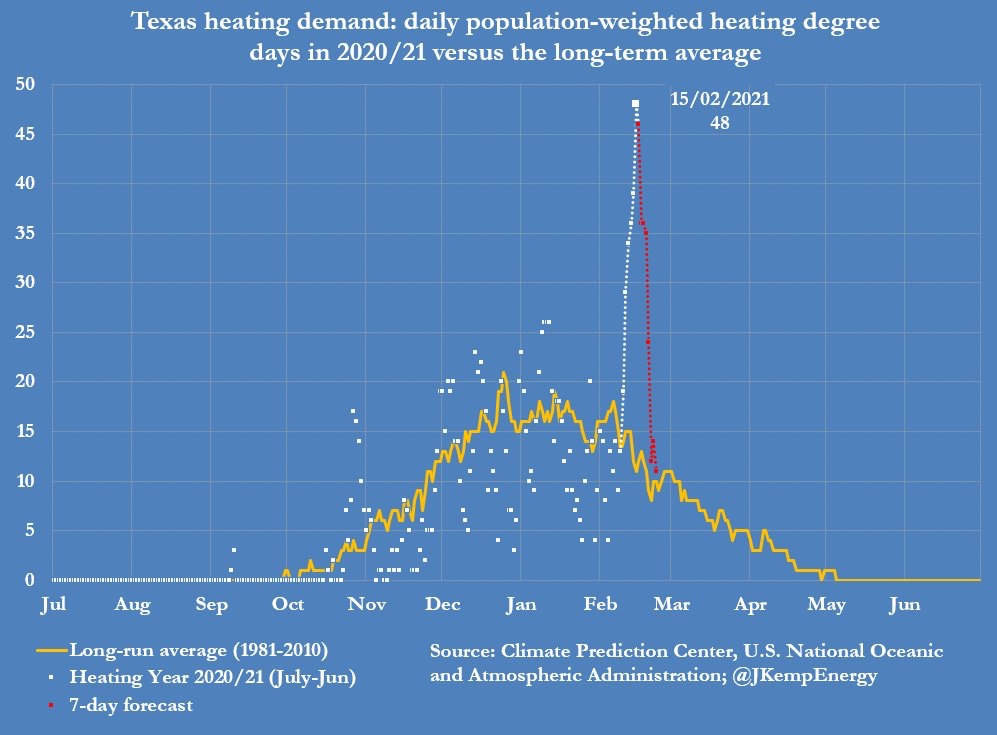
From StreetWiseProfessor: Who Is To Blame for SWP’s (and Texas’s) Forced Outage? “The facts are fairly straightforward. In the face of record demand (reflected in a crazy spike in heating degree days)…

…supply crashed. Supply from all sources. Wind, but also thermal (gas, nuclear, and coal). About 25GW of thermal capacity was offline, due to a variety of weather-related factors. These included most notably steep declines in natural gas production due to well freeze-offs and temperature-related outages of gas processing plants which combined to turn gas powered units into energy limited, rather than capacity limited, resources. They also included frozen instrumentation, water issues, and so on.”

So then Krugman rolls in from the NYT saying ‘Texas’ problem was Windmills is a Lie. ‘ Which itself, while not a lie in Detail, is a lie in Essence. As per some top line thinking in ManhattanContrarian in This Piece Points out:

Total winter generation capacity for the state is about 83 GW, while peak winter usage is about 57 GW. That’s a margin of over 45% of capacity over peak usage. In a fossil-fuel-only or fossil-fuel-plus-nuclear system, where all sources of power are dispatchable, a margin of 20% would be considered normal, and 30% would be luxurious. This margin is well more than that. How could that not be sufficient?

The answer is that Texas has gone crazy for wind. About 30 GW of the 83 GW of capacity are wind.

….sometimes the wind turbines only generate at a rate of 600 MW — which is about 2% of their capacity. And you never know when that’s going to be.

ManhattanContrarian

But/And it IS complicated. 1) You can install deicing systems on windmills but they are expensive to install and maintain and require INPUT of electric power to operate (Texas average weather makes this uneconomic to install.) 2) Texas did this to itself, it has an independent Grid because it IS a country sized state, the grid operator is actually a Bit Wind Crazy…why…because Texas has a lot of wind power. 3) This weather is a Combination of once in a hundred year cold AND snow/cloud cover, which systems are not designed to deal with other than in some degraded manner.

So one can only hope that because it is complicated and is fairly easily shown to be so that the cool heads will be left to work out some solution that prevents this sort of thing happening again. Because yes weather is unpredictable and while this was a 1/100 double header, it did occur and that says that the odds may not be what we think they are and so some mitigation is required. That mitigation is Not more wind, Not stored power, it IS more nuclear +better of all the above, AND better links to the broader national grid, etc, etc.

Myself, I’m planning a new house in the country. Big propane tank, backup generator, solar power, grid tied battery backup, ultra insulated house (for the region.) My prediction is that the grid is going to get worse not better and if you you can, you need to be able to survive without electric power from the mains for a week or more. I can make that possible, though I am in the few percent just because of location, situation, grace of the Infinite.

CommercialSpaceStation in sight

From this article in ParabolicArc
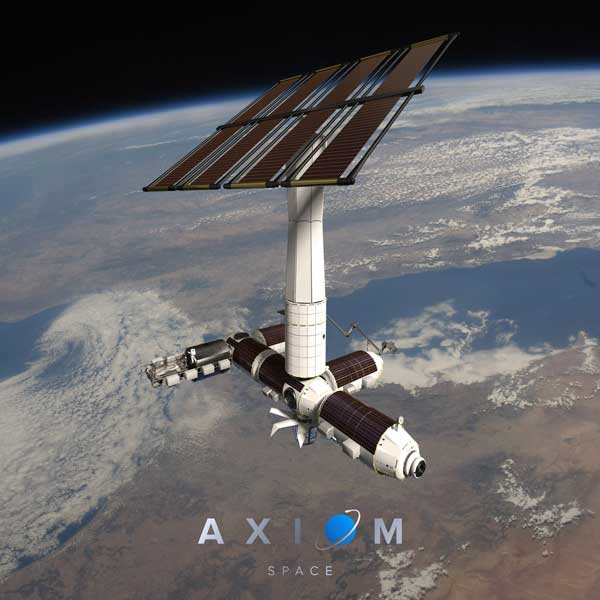
Axiom space image of their commercial space station.

Axiom is not as famous as SpaceX or BlueOrigin, even Boeing or NG but it is setting up to be a big noise in commercial space. “Axiom Space, Inc., which is developing the world’s first commercial space station, has raised $130M in Series B funding

Early Axiom module attached to the current ISS.
from this article in SpaceNews

In January 2020, NASA selected Axiom to begin attaching its own space station modules to the International Space Station (ISS) as early as 2024, marking the company as a primary driver of NASA’s broad strategy to commercialize LEO. While in its assembly phase, Axiom Station will increase the current usable and habitable volume on ISS and provide expanded research opportunities. By late 2028, Axiom Station will be ready to detach when the ISS is decommissioned and operate independently as its privately owned successor.

From the above ParabolicArc article.

But they are already in the ride share business, setting up launches of multiple smaller missions on one booster, Axiom buying the ride then working with the launch customers to integrate their satellites on the mission bus. Another recent milestone:

The four people who will fly to the International Space Station on Axiom Space’s Ax-1 mission include (from left) commander Michael López-Alegría and passengers Mark Pathy, Larry Connor and Eytan Stibbe. Credit: Axiom Space. From this article in SpaceNews

Lots of cSpace development, keep it coming…

To explore you need Access

Photo of a nuclear thermal propulsion (NTP) system from the Rover/NERVA programs (left) and a cutaway schematic with labels (right). SOURCE: M. Houts et. al., NASA’s Nuclear Thermal Propulsion Project, NASA Marshall Space Flight Center, August 2018, ntrs.nasa.gov/citations/20180006514.
Space Nuclear Propulsion for Human Mars Exploration
National Academics of Sciences, Engineering and Medicine
National Academies Press
2021
[ParabolicArc Executive Summary, Findings & Recommendations from National Academies Report on Space Nuclear Propulsion
February 13, 2021 Doug Messier
]

While a chemically powered trip to Mars is feasible given the ability to lift a lot of mass so orbit, See SpaceX-Elon Musk, this is probably not the solution you would go for first. I think it makes sense as part of the Vision Setting that Musk does but the preference has always been for nuclear propulsion it enables faster (safer) trips and makes reusability even more effective since the ‘shuttles’ are not spending many months in transit each way.

Posit a Freighter something like the illustration below. Departing Mars having dropped of say 2, 3, 4 starships’ worth of cargo. MarsStarships shuttle up and down and provide point to point transport on Mars. EarthStarships shuttle cargo up to earth orbit. Maybe LunarStarships shuttle fuel from production stations on the Moon to reduce the cost of fuel for the starships and the Freighter.

Illustration of a Mars transit habitat and nuclear propulsion system that could one day take astronauts to Mars. (Credits: NASA) [ParabolicArc: Executive Summary, Findings & Recommendations from National Academies Report on Space Nuclear Propulsion February 13, 2021 Doug Messier]

Now you have a system that provides Access to the solar system with significant cargos and the ability to establish and support exploration stations wherever you go.